
Unit 14 · From rule to prototype
Week 15 · 45 minutes · 10th and 11th grade · every project, alone or in a group.
What you’ll do
Last week you wrote your project’s rules on paper. Today they become an instruction for a tool, and the tool gives back a prototype you can try.
Each project uses the tool that fits it: a playable-page generator for a game, a tool, a story with choices or a simulation; a music generator for a sound piece; an image generator if your prototype is an illustrated sequence. Your project doesn’t have to become a video game.
But here’s the interesting part: it isn’t enough that something comes out. You have to check whether it’s your project. The tool almost always skips a rule, changes another or invents one nobody asked for.
Why it’s worth it
Anyone can ask for “something fun”. Very few people know how to look at the result and say exactly what doesn’t match what they wanted. That way of looking is what you’ll practice today, and you’ll use it all year.
How the session goes
- Anticipate. You recall your three rules from memory. You see an example with two attempts, described aloud. The group decides how many generations the day justifies —two per project, at most— and writes them on the board. You write the card and “What I think will come out”.
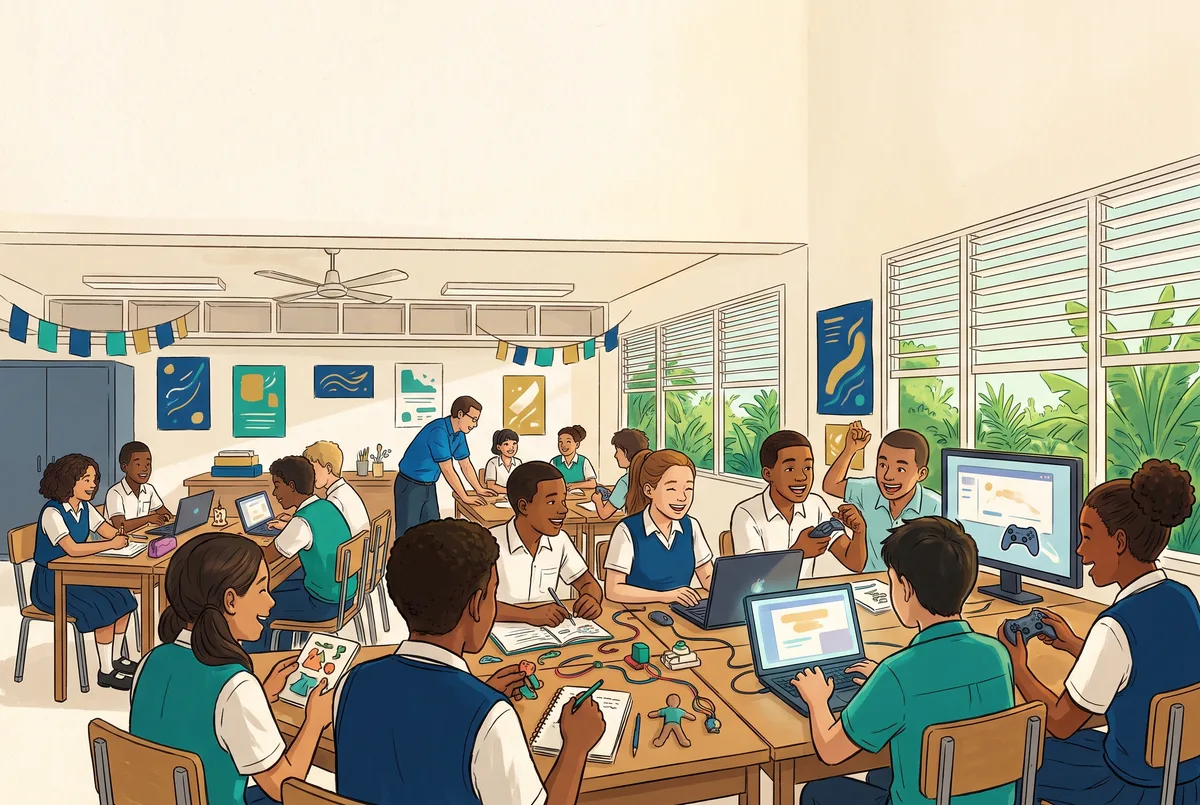
- Act. Before your card runs, it’s checked aloud that it carries no names, data, photos or voices of anyone. Your card runs on the device of the person guiding the session, and the count goes up on the board. You try the prototype in a short turn and tick a list: which rule was met, which wasn’t, which appeared without being asked for. And you name which trade would have done that work.
- Act again. Ten minutes without screens to rewrite the card by hand. First you ask yourself: is changing just one thing enough? Then, the second attempt.
- Connect a model. If your project uses AI inside —in your tool decision in Unit 04 you said yes—, today it makes its first connection through the program’s provider gateway. You write your request: what your product will ask the model when someone uses it, with no one’s data in it. At your table, that same request goes to two providers, and both answers are read aloud, side by side. Which one meets your rule? Which one invents? You choose one for reasons —it meets the rule better, it uses less of the budget, its terms, its footprint— and write the configuration line that names it. Never a key: the keys belong to the program and live in the gateway, not in your code or your repository. If tomorrow you want to switch providers, you change one line.
- Reflect. One sentence per project with C1, C2 or C3. Did the instruction get better, or did the question get better? What did the AI decide here that a person should have decided?
If there are many projects and the queue doesn’t reach everyone, half do their second attempt at the start of Unit 15. Nobody generates outside the queue or outside the budget.
The criteria
- C1. The three rules from the paper are met in the prototype.
- C2. What’s yours in the project shows in how it works, not just in the background or the filler sound.
- C3. You can say what the tool changed without you asking.
If your project is without AI
You do the same work, with the same time and the same criteria, with your technique: paper and scissors, cardboard and tokens, a physical prototype, an instrument, a spreadsheet, an editor or a game engine without AI. Instead of a generation budget, you set your materials and time budget. You build your first attempt while the queue runs, test it in your turn with the same checklist — which rule was met, which wasn’t, which got bent — and, after the ten minutes without screens, you make the second.
And while others connect a model, you take your own method step: you test the same rule with two techniques or tools without AI, your table compares the two results and you choose one for reasons. In the listening, the question for you is: what did you decide, and why?
If the tool doesn’t fit today
If you’d rather make your prototype on paper today, you improve your rules by hand with what you saw in Unit 13 and join the listening just the same. If your project works better that way, that counts as a result too.
If your project doesn’t use AI inside, you don’t connect to the gateway today, and you lose nothing: in your table’s comparison you note which provider met the rule, or you write the rule of your project you’d never leave to a model. If your tool decision changes, you connect later.
If your project doesn’t have rules to translate yet, you take a single rule, write it as an instruction and don’t run it: another table reads it and tells you what a machine that doesn’t know your project would understand.
Your credits
At the end, note on your card what’s yours, what the tool made and whose work you started from, if you started from any. And update the three columns: what the AI does, what you do, what you decide.
For inspiration
- Guagua express (the bus game): two attempts — the same game made twice, with what was learned in between.
- Titans in the neighborhood
- The world where everything talks — how an idea becomes the way you play.
To build your card step by step, use the assistant for building your instruction.
What this is, and what it isn’t
This Unit’s design is original: a design position, not a research finding. It promises no effect. Nothing is graded. Your prototype lives in your project’s folder and its private repository; nothing is published without written consent for that piece. If your project has a narrator or character that speaks through the gateway, it follows the rules you wrote in Unit 12: it’s never a companion.