
aiLearning Challenge · First edition
Create with AI. Live.
A live competition of creativity, innovation and problem-solving with AI — for students from primary school to university. Think Math Olympiads, NASA Space Apps, robotics leagues — but the discipline is creating with AI.
The first edition is scheduled for Saturday 28 November 2026; venues, tiers and locations are being confirmed.
Opens when the clock starts.
What it is
The challenge is revealed when the clock starts.
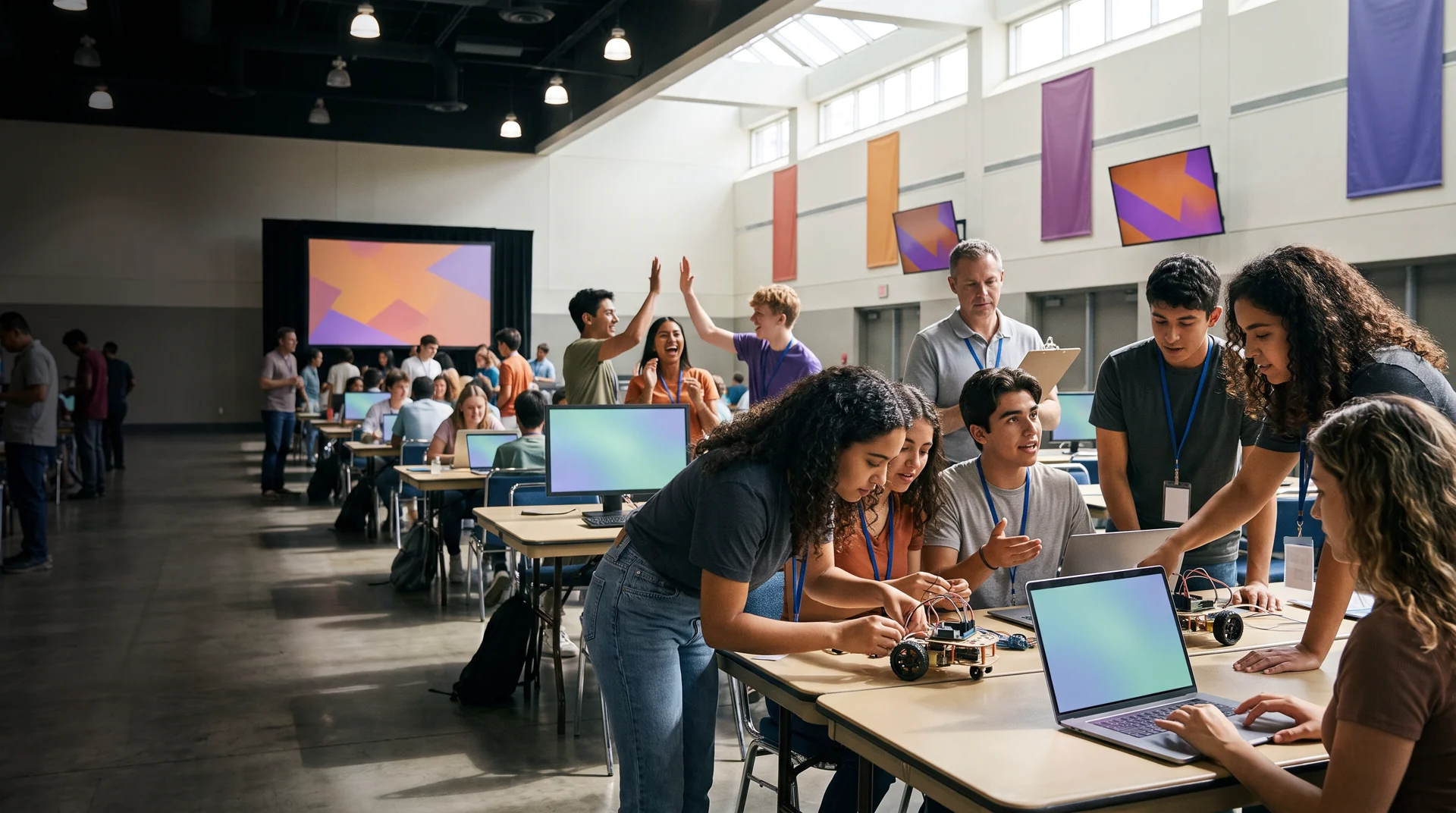
Students from different schools and universities compete in teams or solo, live, to solve a challenge, create something, or propose innovative and creative solutions — using publicly available AI and technology tools. Younger tiers compete in a single live day; older tiers get a guided build after the challenge is revealed — and every tier ends in a live finale, judged in the room.
Conditions can evolve during the event: new information, a twist, a constraint that changes mid-course — the way real problems behave.
The one rule: every tool must be free and available to everyone. Same tools for every team — what differentiates the results is entirely human.The principle
AI is the instrument, never the author.
The challenges are deliberately open, ambiguous, and anchored in real contexts — so open that no first AI answer is ever good enough. The competition lives precisely in the gap between what an AI produces on its own and what students make it produce.
Generic, unowned, never good enough
What an AI produces on its own. Teams that merely generated something will struggle when the challenge twists — because they don't understand what they built.
Owned and directed by the students
Iteration, judgment, and direction — creating, improvising, experimenting, failing, and building again. A legitimate hybrid of human work and AI-enhanced work; teams that understand what they built will adapt.
Four tiers, one architecture
From first creations to professional-grade defense.
Wonder, play, guided discovery
First creations with heavy scaffolding — celebration over ranking.
Building and experimenting in teams
Structured challenges with creative freedom.
Open challenges, real-world constraints
Open challenges with real-world constraints and competing considerations.
Full complexity
Ambiguous problems, real stakeholders — defended like professional work.
Challenges are cut to each tier's developmental stage — the openness scales, the principle never changes.
What every team produces
Three deliverables. No exceptions.
The creation
Something demonstrable: a solution, a design, a prototype, a campaign, a performance, a story, a system. The output format is open; reframing the brief in a brilliant direction is a feature, not a violation.
The creation record
A lightweight account of how it was made: what the humans decided, what the AI produced, what was rejected and why. This is where the learning becomes visible — and where authorship questions dissolve instead of being policed.
The live presentation and defense
Teams demonstrate what they made and answer questions from the judges. A team that cannot explain its choices didn't make them.
How it's judged
A profile across dimensions, not a single score.
-
Creativity and innovation
Originality, surprise, the distance traveled from the obvious.
-
Human direction
The depth of iteration, judgment and transformation visible in the creation record.
-
Craft and execution
Does it work, does it hold together, is it finished at its own ambition level.
-
Communication and defense
The story of the solution, told and defended live.
Process counts alongside product: a spectacular artifact with no visible human direction loses to a bold, well-directed attempt. Judges come from many fields — because the solutions will too.
More than one day
The live event is the peak, not the whole.
CEMI Impact Arc · engage → enable → inspire → empower → connect
-
Before
Workshops for educators, preparation sessions for mentors, and rehearsal experiences for students: learning, experimenting, and practicing creative work with AI before the clock ever starts.
-
The event
The live challenge: a single day for the younger tiers, a guided build closing in a live finale for the older ones — judged in the room.
-
After
Public showcases of what was created, reflection sessions where the experience becomes durable learning, and a community that persists between editions.
The preparation and the reflection may matter as much as the competition itself — by design.
Fair and safe
Equity is a design constraint, not an aspiration.
Free tools only
Every tool available to every participant at zero cost, verified before the event.
Same conditions for everyone
Tool access, connectivity and workspace are equalized at the venue.
Age-appropriate by tier
Tools, challenges and supervision are selected for each age group, with privacy and safeguarding for minors treated as non-negotiable design requirements.
Be part of the first edition
Three ways to take part.
Participants can count on mentors of two kinds — educators, who scaffold the process, and professionals from many disciplines, who bring the reality checks of their fields. Mentors guide with questions and experience; they never touch the work.
Schools and universities
Bring your teams; your educators get the preparation workshops.
Mentors
Lend your field's eyes to a team, for a day.
Sponsors and allies
Help make the first edition happen.
The aiLearning Challenge is an initiative of aiLearning.global, CEMI.ai and CEMI Labs — created by Carlos Miranda Levy, applying the Smoother learning methodology.
Comprehensive AI learning designed for educators, by educators. From awareness to mastery.