

Unit 13 · Paper first
Week 14 · 45 minutes · 10th and 11th grade · every project, alone or in a group · no screens.
What you’ll do
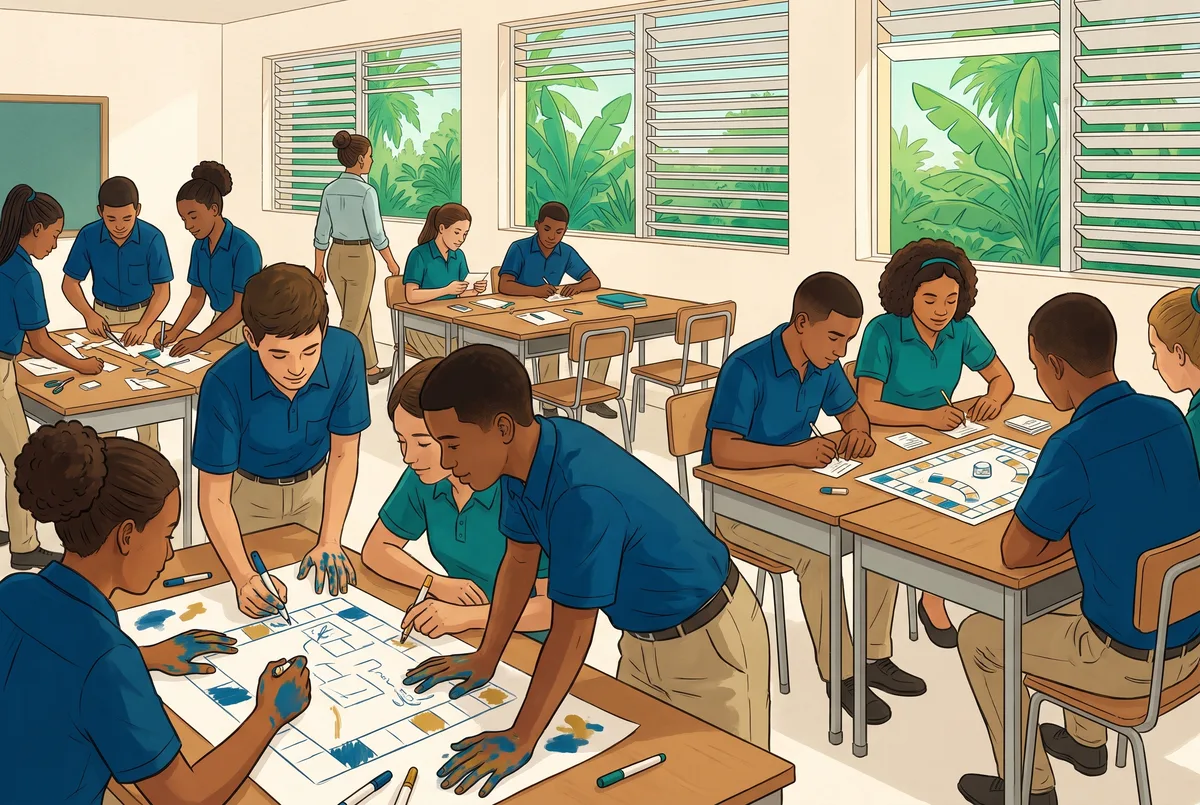
In February, your project will have a version someone else can try, play or hear. Today that version is born where you can cross things out and start again: on paper.
You write three rules, or three steps, so someone else can try your project without asking you anything. Then someone from another table tries it, and you watch in silence where they get stuck.
Your project doesn’t have to be a game
Each project writes what fits it:
- A game: a board or paper game, with a board on a sheet, cut-out pieces and three rules. Hard to win, but not impossible.
- A tool or an app: the screens drawn by hand and three steps of use. Someone on your team —or you— “plays the screen”: swaps the sheets without speaking.
- A story: the path on cards, with three choices for whoever goes through it.
- A sound piece: three rules for how it’s heard or joined —when the listener comes in, what they do, how it ends—, tested with voice, clapping and the table.
- Money and data: a paper simulation, with paper money. Nothing real.
If your project doesn’t have rules to write yet —because you’re still researching, for example—, you make a three-rule paper game about your project’s topic. It gets tried just the same.
If your project is without AI, what you build today is already the start of your prototype: next week you grow it with your own technique, with the same time and the same criteria as everyone else.
Why it’s worth it
Asking a machine for something is easy. The hard part is knowing what you want. If your rules can’t be understood on paper, the tool won’t understand them either. Here you train what makes the difference later: saying clearly how something works that so far only exists in your head.
How the session goes
- Anticipate. The criteria and an example rulebook are read aloud. You sit at a table with projects similar to yours. You write on the card: “What I think will happen when someone else tries it”, and which criterion you’ll watch for.
- Act. You write your three rules or steps and build what you need to try them. Then, a table change: someone from another project tries yours without asking you anything, in short turns with a sound signal, and you note what you see.
- Reflect. One minute of silence to write where the tester hesitated. Then one sentence per project that starts with C1, C2 or C3, and a vote by knocking on the table. Did what you anticipated happen? Did the rule get better, or did the idea of the project get better?
The criteria
- C1. Someone else tries it —plays it, uses it, goes through it or follows it— without asking you anything.
- C2. The part of your project that AI can’t do —if your project is without AI, the part that makes it yours— is in a rule, not just in the drawing.
- C3. Whoever tries it has a challenge or a decision, and reaches the end: hard, but not impossible.
None of this is graded. The criteria are for looking and for talking.
What you decide
Today AI does nothing: a person decides everything, and that’s how you note it on your card. If one of your rules comes from a game or a work that already exists, note it in your project’s credits. In a group project, each person notes which rule they wrote and what they decided.
For inspiration
- Example: when one hit isn’t enough — from a vague idea to a game where the hard part is something else.
- Home run at the play (sandlot) — a neighborhood game with one clear central rule.
They’re examples of rules you can follow without asking, not recipes: they help even if your project isn’t a game. If you want to start preparing how you’ll ask the tool for your project next week, try the assistant for building your instruction. Today, though, everything goes on paper.
What this is, and what it isn’t
This Unit’s design is original: a design position, not a research finding. It promises no effect. Nothing is graded. Your rules stay in your project’s folder, in the room.