

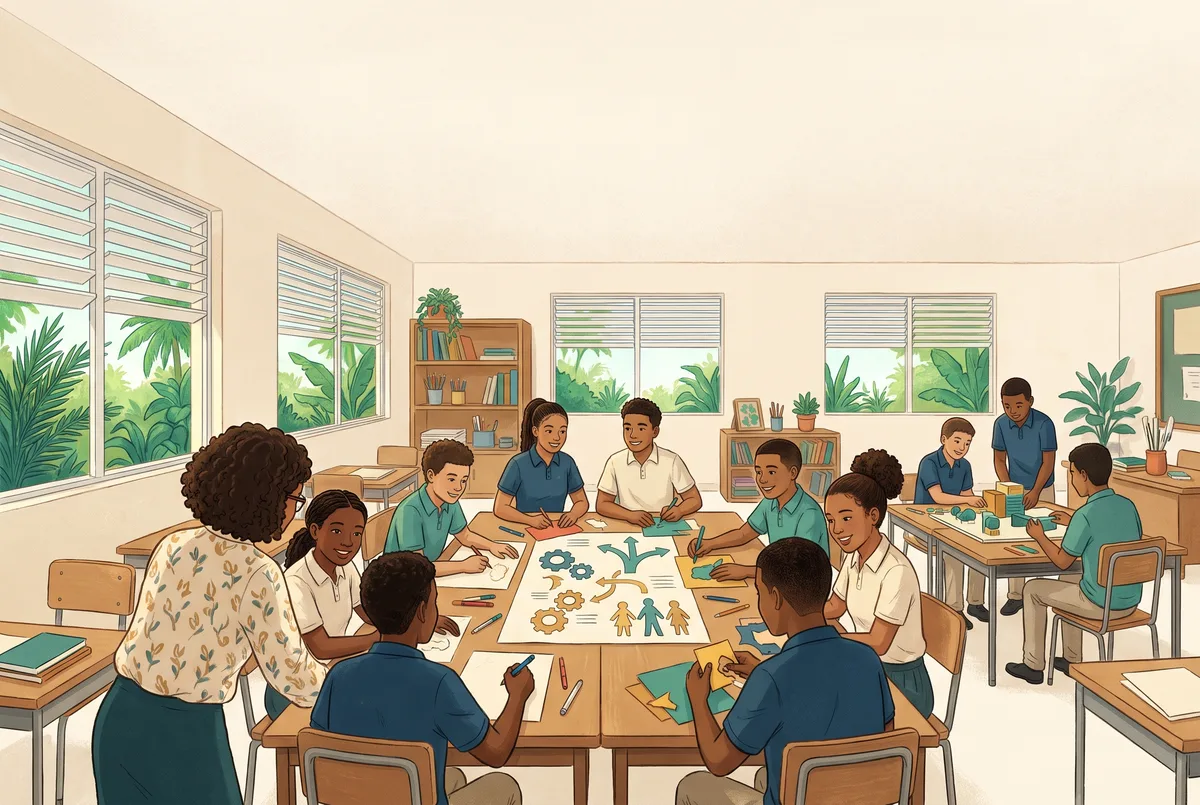
Unit 12 · Person or character?
Week 13 of the program · 45 minutes · 10th and 11th grade · every project, alone or in a group · no screens.
What you’re going to do
The road to February starts, when your project will have a version someone else can try. Many projects talk to the people who use them: a game’s narrator, an app’s guide, a tool’s voice, a rival, an assistant. Before you invent yours, you take a close look at how some “companion” apps manage to keep you talking to them. This Unit is for everyone. With made-up conversations, printed and read aloud, your table hunts for four tricks:
- emotional language,
- memory (“how did that thing from yesterday go?”),
- the mirror (it agrees with everything you say),
- open-ended lines that won’t let you close.
Then you write the rules of your project’s character or voice, so it’s a character and not a companion. Your project doesn’t talk to anyone —a song, an object, a design? Then you write the rules for the character of an imagined game about your topic; they stay in your folder in case you need them. If your project is without AI, the task is the same: the narrator of a board game, the guide of a visit or the voice of a leaflet can also hold someone or let them go. All on paper: no character is built today.
Why it’s worth it
A design you understand stops being in charge of you. And when your project has a character, you’ll know how to make it interesting without needing to hold on to anyone.
How the session goes
- Anticipate. You write what an app that doesn’t want you to leave would do.
- Act. You mark the tricks in the screenshots, with four colors or four symbols you can feel. Then you write your character’s rules: what it says, what it never says, how it says goodbye, what it doesn’t remember. And you make an infographic.
- Reflect. Did what you anticipated come out? Do your rules hold? And the usual question, this time about the screenshots: what was the made-up bot deciding instead of the person talking to it?
The criteria, as questions
- C1. Does each of the four tricks have a rule that rules it out?
- C2. Does your character let the person using your project go without guilt or a pull to stay? (11th: and does it avoid offering itself as a confidant?)
- C3. Is it still an interesting character for your project, one that serves what your project wants to do?
For inspiration
- Person or character? — an infographic made with made-up screenshots.
- For when your February version comes around: library assistant.
Careful
Nobody shows or tells their own conversations. At the start, you’re told who the program’s responsible adult is: if something today stirs something up for you, you can talk to that person, without explaining anything in the room. And from today, every character or voice in a project follows its rules: it can remember settings and preferences from one session to the next, but it’s never built as a companion —no simulated relationship, no emotional language to hold on to anyone—, and its rules are checked at every review of your project.
If you haven’t lived this Unit yet, don’t open it.
Reveal this Unit's perturbation
Toward the end an envelope arrives, read aloud: someone using your project has been at it for two hours and writes “just once more and that’s it.” With your rules, what does your character answer? Three minutes. If your team gets stuck, it carries on with its rules.
This is a plan: the Unit hasn’t run yet.