
Unit 07 · Our voice, not a voice
Week 8 of the program · 45 minutes · 10th and 11th grade · every project, alone or in a group.
What you’re going to do
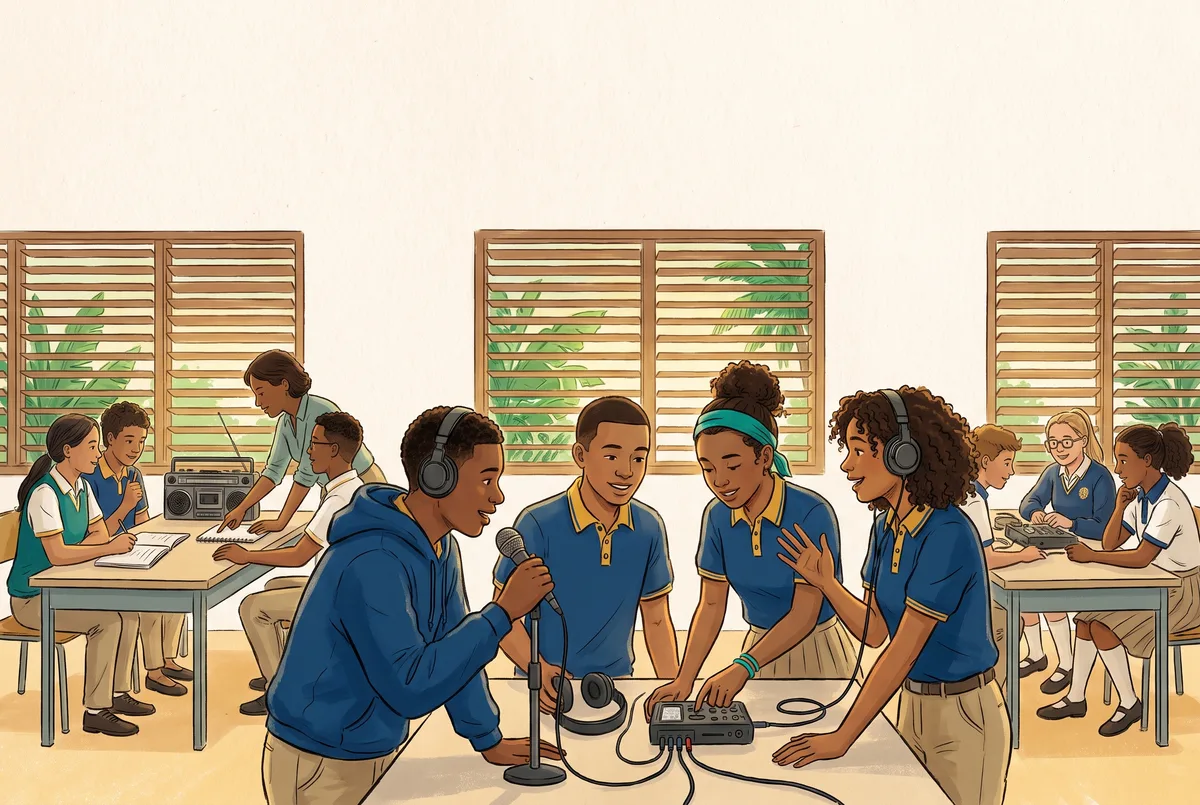
Your project already has words. Today it gets a voice: yours, or your team’s. In a song, the singing; in a podcast or a video, the narration; in an app or a tool, the voice that explains how to use it; in a game, the instructions read out. You record your part on the class device. Two takes: the first one, and another with one change you decide.
Your project won’t have a voice? Then you record your project, told in your voice: thirty seconds about what it is, who it’s for and why, the way you’d tell it to the person who’s going to use it.
Why it’s worth it
Any machine has a voice. None of them has yours. And directing your own voice —where you breathe, which word you lean on— is a craft you learn exactly like this: take, listen, another take.
How the session goes
- Anticipate. You listen to an example and notice where the machine-made part sounds perfect and says nothing. You split up the take, mark pauses and emphasis in your words, and write how you think it will sound.
- Act. Take 1, in turns. Listen. Take 2, with just one change.
- Reflect. Which one stays, and why? “What did the AI decide here that a person should have decided?” And on your card, the credits: whose voice, whose words, which beat.
- No screens. Before recording, about ten minutes with no phone, computer or AI: you split up the take, mark pauses and emphasis, rehearse quietly and fill in the direction sheet. The recorder only captures what your team has already decided.
The criteria, as questions
- C1. Can you understand every word?
- C2. Does your voice sound like you and like the people your project is for? (11th: can you tell someone believes what they’re saying?)
- C3. Did take 2 change one decided thing, and can you hear it?
If your project is without AI
Today you do exactly the same as everyone: the recording doesn’t use AI. If someone on your team doesn’t have the voice form, another person from your team or your table reads their part, and they direct the take; no synthetic voice needed. The mix, if there is one, with an audio editor without AI or with live instruments. In the listening, the question for you is: what did you decide, and why?
For inspiration
- Example: the science of concón (crispy rice)
- An artist’s eras
- What people listened to at your house
- And the library assistant for the beat.
Your voice is yours
- To record your voice, your family has to have signed the voice sheet. If they didn’t, you take part anyway: someone else reads your part, or a synthetic voice that belongs to nobody is used, and you direct the take. That synthetic voice counts as one generation, and its text is checked out loud first: no one’s name or data.
- Your voice is never uploaded to an AI tool or copied. It stays in your project’s folder, in the classroom.
- If you don’t want to record, you don’t. You don’t have to explain anything: directing the take is a full role.
This is a plan: the Unit hasn’t run yet.