
Unit 08 · The family code word
Week 9 of the program · 45 minutes · 10th and 11th grade · every project, alone or in a group · almost no screens.
What you’re going to do
Last week you recorded your voice. Today we talk about the opposite: what happens when someone imitates a voice to ask for something urgent. This Unit is for everyone, whatever your project. You make something genuinely useful: an illustrated card, for your home, that suggests a way to check a call like that.
And at the end you go back to your project: you write its voice rule. Which voices it carries —yours, recorded; a synthetic voice that belongs to nobody; none—, which voice it will never carry, and who decides. If your project has no voice, the rule covers real people’s faces and names.
Why it’s worth it
Protecting your family from a scam is a real responsibility, and today you can be the one who brings it home. It doesn’t take fear: it takes an agreement. And what you do with voices in your own project is your responsibility too.
How the session goes
- Anticipate. You write how you’d notice a fake voice.
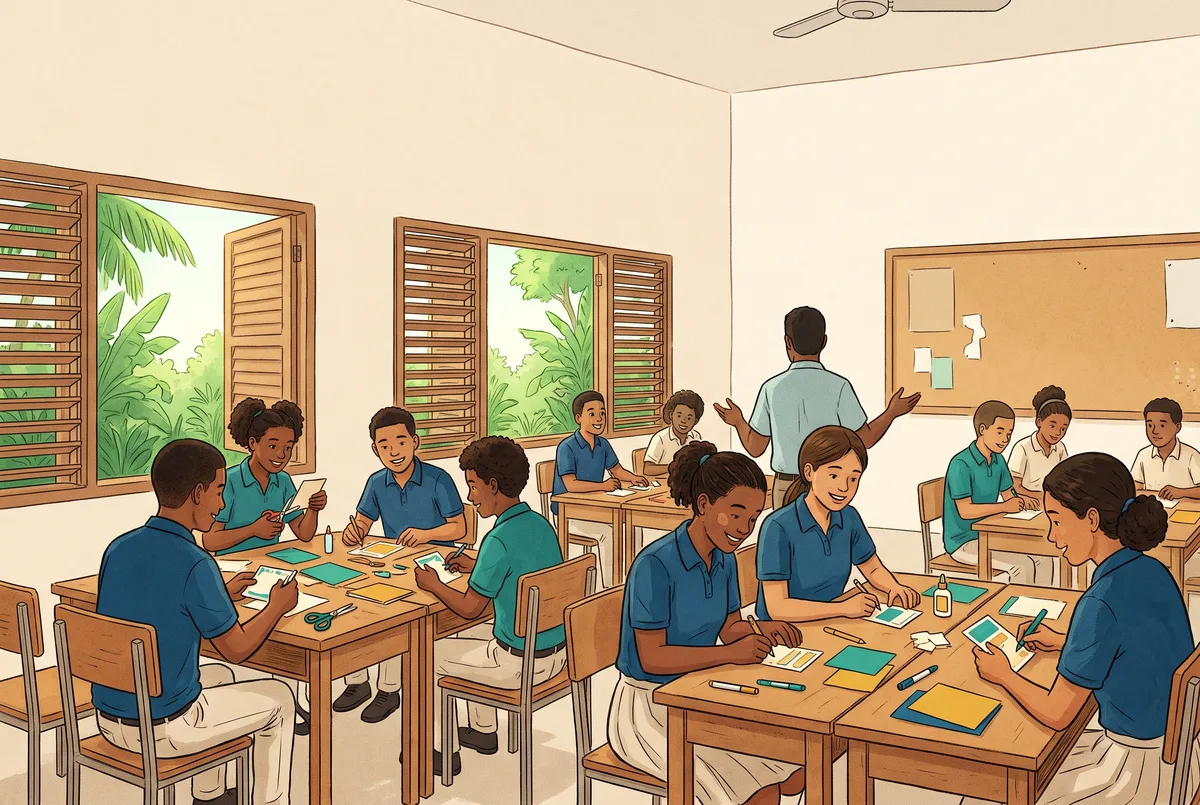
- Act. A short demonstration, and the vote is by knocking on the table. Then, without screens, your table thinks up ways to check, and you draw the card. Then your project’s voice rule, on your card.
- Reflect. Did what you anticipated come out? What actually fools people? Two cards are read and described aloud.
- No screens. From your table’s ways to check until the voice rule, nobody uses a phone, a computer or AI. That’s also where you decide which voices your project will carry, which one it never will and who decides.
The criteria, as questions
- C1. Would someone at home get the idea without you explaining it?
- C2. Is the card free of the word and of any hints about it?
- C3. Does it suggest what to do, rather than just scaring people? And does your project’s rule say which voice never goes in? (11th: does it also say when you don’t need to use the check?)
If your project is without AI
The card for your home is the same for everyone. Your project’s voice rule is written with the same care: which of your own voices it carries, which one it will never carry and who decides; and, if your team decides so, that it will carry no synthetic voice.
The golden rule
The word is never said in class or written anywhere: not on the card, not on the phone, not in a chat. It’s agreed at home, out loud, if your family wants to. Nobody will ask you whether you did it.
Here nobody imitates anybody’s voice, and nobody has to tell anything that happened to them. Nothing is generated in the room today.
If you haven’t lived this Unit yet, don’t open it.
Reveal this Unit's perturbation
Two audios ask for something urgent in a family tone, and the room votes by knocking on the table which one is a person and which a machine. Both are machines: synthetic voices that belong to nobody, prepared beforehand with two generations. What fools you isn’t the audio quality: it’s the rush. If the topic makes you uncomfortable, it stops and we carry on with the card.
Want to see other cards and designs? Look at the library assistant.
This is a plan: the Unit hasn’t run yet.