

Unit 30 · The poster and the invitation
Week 31 · 45 minutes · 10th and 11th grade · your project, alone or in a group · as we planned it.
What you’ll do
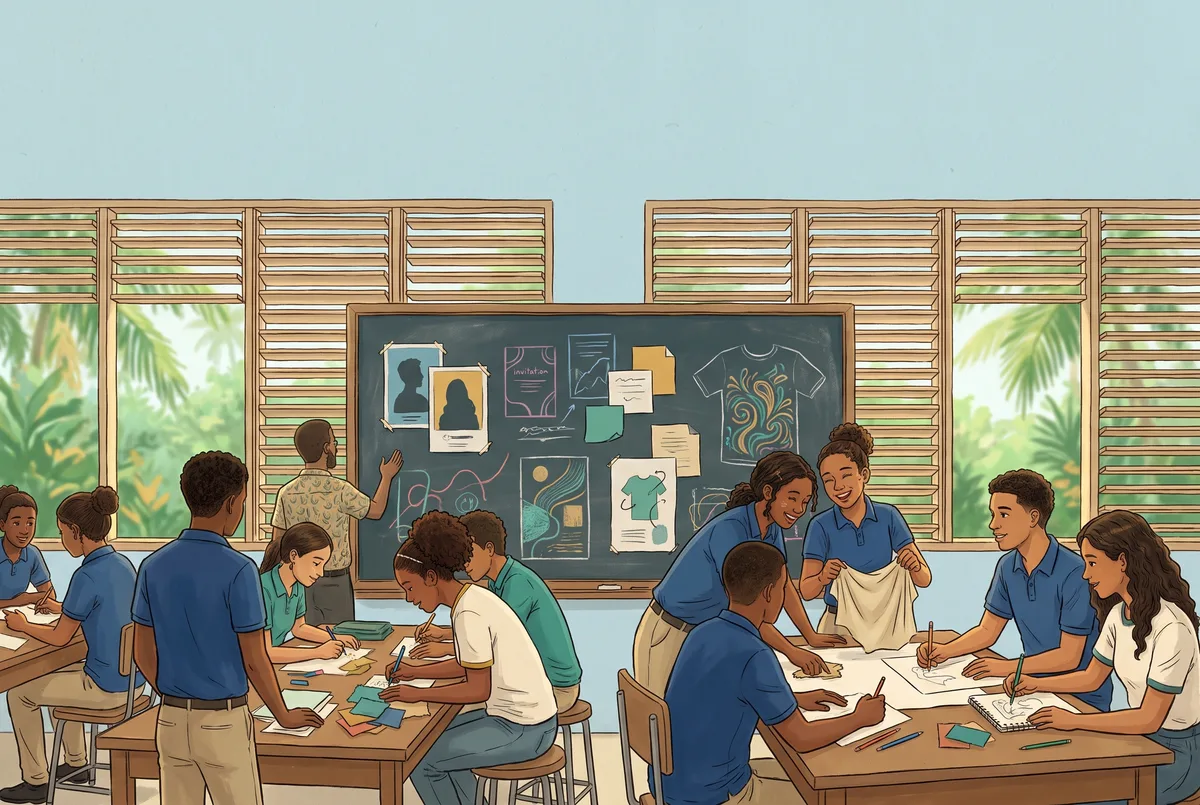
The June showcase needs a face, and every project needs its own. Your team designs one piece. It can belong to the shared identity —poster, invitation or T-shirt—, which 10th and 11th build together: each group works in its own session, but on the same board; the one that goes first leaves its proposal on large paper, and the other continues it, debates it or changes it, with a written reason. Or it can be your project’s sign, the face of its station: its name, today’s sentence and what visitors can do there —listen, play, use, read—, with no names of people.
If your project won’t have a station, you write by hand the one-line sentence that will go on the invitation about what people will see, and you bring it to the vote.
Why it’s worth it
In Unit 02 you designed for the wish of someone at home. Today you design for people who have never heard of this program and have to understand at a glance what it is and why they should come. And you do it with the other group, whom you hardly ever see.
How the session goes
- Anticipate. Without looking: what were the design criteria from Unit 02? You see the June showcase poster, described aloud, and where the generator failed: warped letters, made-up information. You hear the other group’s proposal and sketch by hand. Your team decides how many generations the piece justifies: one thought-through image, not random variations, and by hand when that’s enough. Card: what you think will come out.
- Act. First attempt, with a different tool from the one in Unit 02, after checking aloud that the card carries no one’s data or face. You write the text yourself and it’s laid out separately: it isn’t asked of the generator. Each project describes what came out and says one sentence starting with C1, C2 or C3. Second attempt, and the credits on the back of the card.
- Reflect. We vote with knocks on the table on which elements go into the shared identity, and it stays on paper for the other group. Did the instruction get better, or did the question get better? What did the AI decide here that a person should have decided? Which trade would have designed this poster, and which part of that trade stayed yours?
No screens. The sketches happen with no phone, no computer and no AI, for ten minutes: you draw or describe aloud, discuss with your team and decide which tool you use (or whether you compose it by hand), how many generations you spend, the text you write yourself and the first attempt’s card.
At least one team designs by hand, and its piece goes into the vote with the same weight. In a group, each person notes on their card the design decision they took.
Everything you design also has a spoken version: the invitation can be read aloud, the poster’s text makes sense without the image, and your station’s sign says what can be heard or touched, not just seen.
If your project is without AI. You design your piece with the same time, the same criteria and the same vote, with the technique you choose —drawing, collage, hand lettering, photos of the classroom without people, a design editor without AI—, switching technique from Unit 02 and with your materials and time budget instead of generations. In the listening, the question for you is: what did you decide, and why?
The criteria, as questions
- C1. Would someone who has never heard of the program understand what it is and when? (On the sign: what can they do at your station?)
- C2. Is there an element only your project or your group could have added? (In 11th: is there an idea that stands on its own?)
- C3. Is it free of the school’s name, addresses and faces, in case it’s shared outside?
For inspiration
The event T-shirt and a stage collection are options, not recipes. Prepare your instruction with the assistant for creating.
The showcase’s place and time are announced by the school through its own channel; nothing is posted on social media or online without written consent for the piece, and the school decides how it’s shared.