

Unit 31 · Rehearsal with a small audience
Week 32 · 45 minutes · 10th and 11th grade · your project, alone or in a group · as we planned it.
What you’ll do
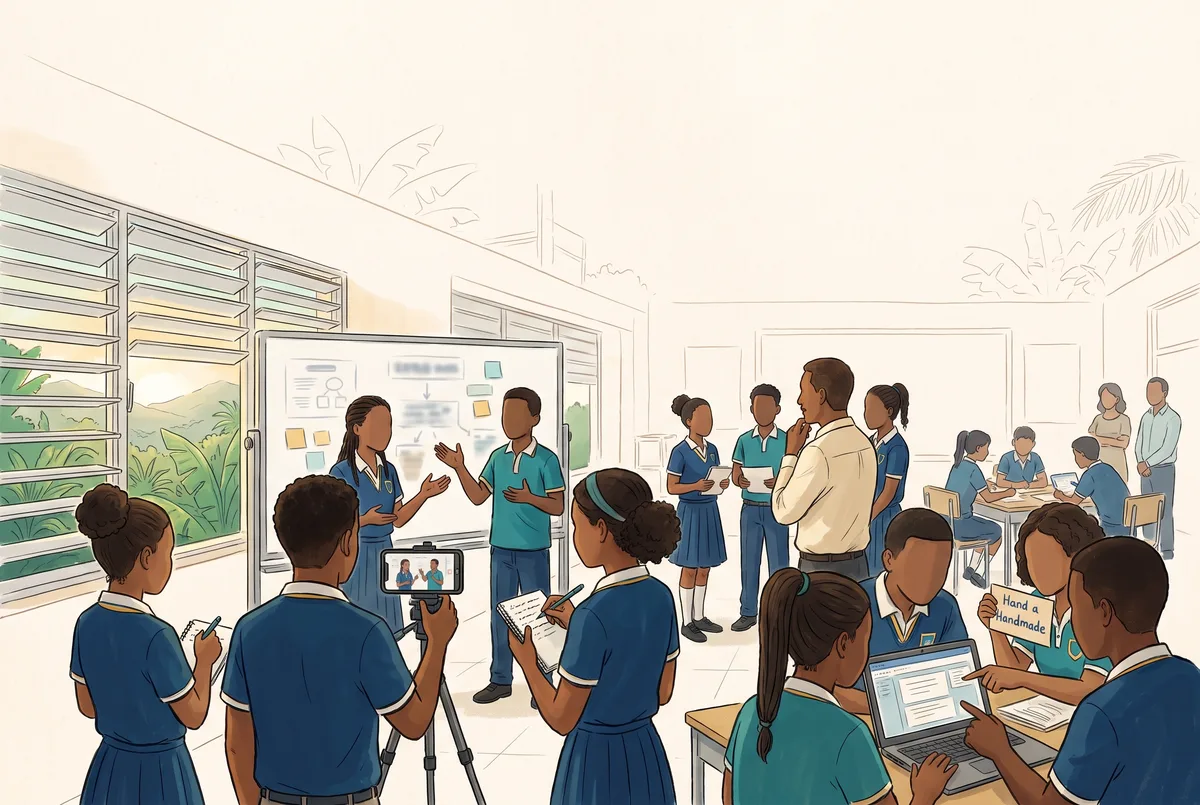
Your team rehearses its project’s two-minute presentation, with its process piece, for the other group or an invited group from the school. The script has four parts: what it is (today’s sentence) · how it got here (from when you chose it in Unit 02 to April) · where it failed · what belongs to whom, with the division of work and the credits. Then, one minute of questions from the audience.
If your project was without AI, you tell which method you chose and why; if it was about AI, what you found. And if you don’t want to present in June, you act as a prepared audience, with a written question for each project at your table, and you still rehearse thirty seconds about yours, without an audience.
Why it’s worth it
In June people are going to ask you things. Some you’ll know; others you won’t. Presenting well isn’t having every answer: it’s saying clearly what you know, and saying “I don’t know” without shrinking, with a next step. That can be rehearsed.
How the session goes
- Anticipate. Without looking: what were the six boxes of the process piece? Your team builds the script and chooses roles: speaking, showing, answering questions, keeping time. You write the three questions you think you’ll be asked.
- Act. Three short rounds at stations: in each one, some projects present for two minutes and answer one minute of questions. At a sound cue, the audience moves to another station. Everything shown on screen is also said aloud.
- Reflect. You cross out the questions that did come and note the ones you didn’t foresee. Did what you anticipated come out? What did the AI decide here that a person should have decided? —said by your team about its own project—. One change to the script, with its reason, and two lines: what you couldn’t answer and what you’ll do if it happens in June.
No screens. The first ten minutes happen with no phone, no computer and no AI: you write or dictate the script with your team and decide which part needs the device and which is told, who shows it, and how you’ll say what the AI did, what you did and what you decided.
Speaking isn’t mandatory: whoever doesn’t want to present doesn’t, and their role can be the screen or none, with no explanation. In a group, each person says or shows their part. If you work alone, someone at your table can handle your screen or your time. The rehearsal isn’t recorded, nothing is generated today, and only pieces with permission requested are shown.
If your project is without AI, in “what belongs to whom” you tell the technique you chose instead of what the AI did, and in the reflection the question for you is: what did you decide, and why?
The criteria, as questions
- C1. In two minutes, is it clear what your project is, how it was made and where it failed?
- C2. Did you answer with what you know, and say “I don’t know” when you didn’t, with a next step?
- C3. Does every member have a role they chose? (In 11th: did the person who asked with distrust get an answer, not a defense?)
To get ready
Go back to your process piece from Unit 29 and to the library if you want to see how others tell about their work.
A perturbation you see coming isn’t one. If you haven’t lived this Unit yet, don’t open it.
Reveal this Unit's perturbation
Someone in the audience has, on a sealed card, a question no team can answer with certainty —for example, exactly how much energy their project used, or who legally owns what the machine made—. It isn’t a trap to make you look bad: it’s to practice “I don’t know, and this is how we’d find out.” At the end of the rehearsal it’s revealed that the question was planted, and why. If your team gets stuck or someone isn’t OK, the Learning Facilitator withdraws the question on the spot, without comment.