

Unit 29 · How it was made, and where it failed
Week 30 · 45 minutes · 10th and 11th grade · your project, alone or in a group · as we planned it.
What you’ll do
All year, every time you saw something amazing, you also saw how it was made and where it failed. Today it’s your turn to show it. Your team makes a process infographic or short video about its project, to set next to it in June. It has six boxes:
- the journey: from the three possible projects of Unit 01 to what exists today;
- the instruction: one, copied exactly;
- what the AI did;
- what you did and what you decided (in a group, each person’s part);
- where it failed;
- the credits: what’s yours, what the tool made, whose work or style you started from and which trade would have done that work.
If your project was without AI, the instruction is the method step that mattered most, and the AI box becomes the technique you chose: which one, why, and what it couldn’t do. If it was about AI, your piece also shows how you researched. And if your project isn’t going to be shown, you make the short version: half a page about a single decision —what was decided, by whom, and what the machine would have done.
Why it’s worth it
Whoever sees your project in June is going to wonder, “Did a machine make this?” Your process piece answers with the truth: an instruction, a machine that guesses and people who decided what stayed. And it separates what’s yours from what isn’t, which is the honest way to sign your work.
How the session goes
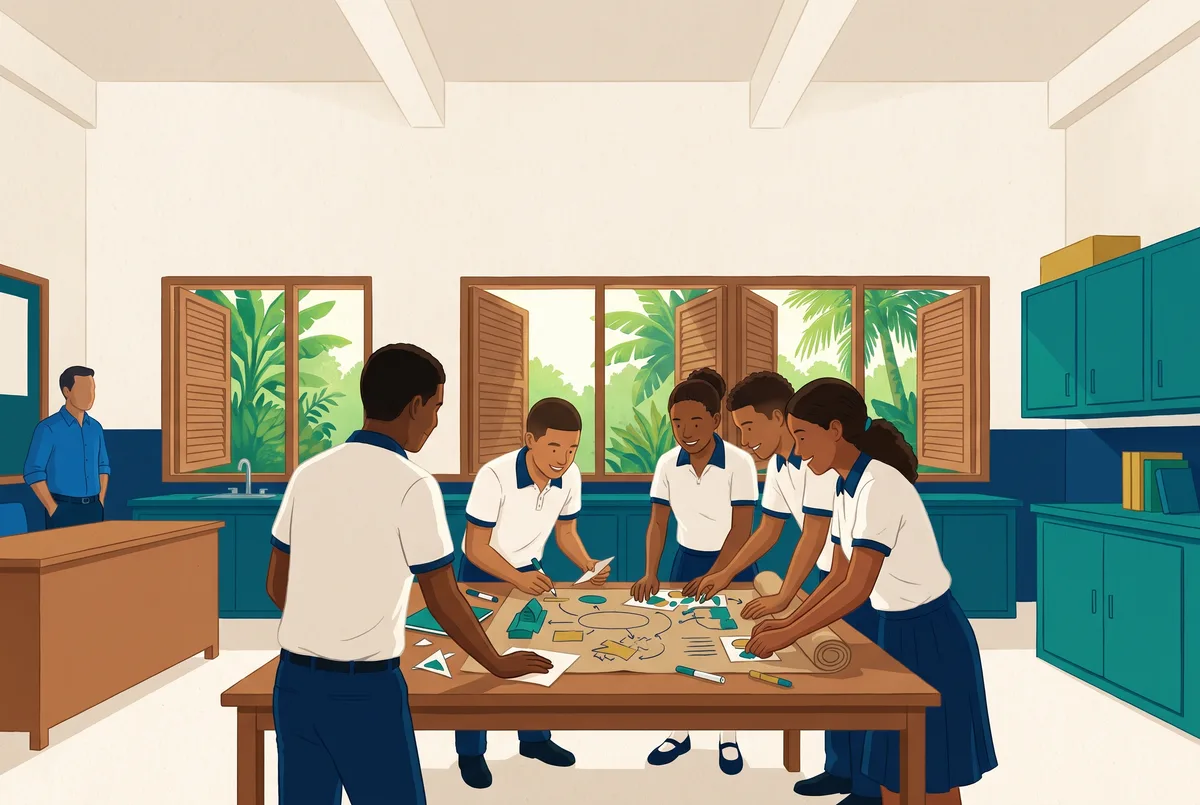
- Anticipate. You hear and see every shot, another universe, described aloud, and right after, how it was made and where it failed. Then how the three-pointer changed basketball as an example of a page that explains. Phone face down, you draw your outline by hand in the six boxes and write what you think someone from outside will understand. Your team decides how many generations the piece justifies: an infographic before a video, and what you already have from the year before generating anything new.
- Act. First attempt, with a different tool from the one you used in your project, and checking aloud that the card carries no one’s data. A team from another table looks at your piece and explains aloud how they think your project was made. With that, you make the second attempt.
- Reflect. Did the instruction get better, or did the question get better? And the usual question, which today goes inside your piece: what did the AI decide here that a person should have decided? Two lines: where the machine failed and where you failed.
No screens. Before the first attempt there are ten minutes with no phone, no computer and no AI: you draw the six-box plan by hand, discuss with your team what someone from outside will understand, and decide which tool you switch to, the lightest option and what the first attempt’s card says.
At least one team from a project with AI makes its piece by hand, on large paper, and it goes to the showcase with the same place as the others.
Your process piece also has to make sense heard: if it’s an infographic, its text can be read straight through; if it’s a video, the narration tells on its own what happens, and it has subtitles.
If your project is without AI. You make your full process piece, with the same six boxes and the same time, with the technique you choose —by hand on large paper, with photos of the process, with an editor without AI— and switching technique from the one in your project. Instead of generations, you set your materials and time budget. Your piece answers: what did you decide, and why? And your two closing lines say where the technique failed and where you did.
The criteria, as questions
- C1. Does someone from outside understand how it was made without you explaining it?
- C2. Can you see at least one point where the tool failed, and what you decided?
- C3. Do the credits say what’s yours, what’s the machine’s and what belongs to others? (In 11th: could someone who thinks using AI is cheating see it without feeling fooled?)
No faces or voices in anything that will leave the room, unless there’s express permission, and no full names in the credits: the project’s name and your group are enough.
To organize your instruction, you have the assistant for creating.