
Unit 05 · You write the lyrics
Week 6 of the program · 45 minutes · 10th and 11th grade · every project, alone or in a group.
What you’re going to do
Your project gets your words, the first ingredient of its November version. You write them by hand —or dictate them— from your list of details: a song’s lyrics, the script of an audio or a video, the text on your app’s first screen, your game’s rules, your story’s narration. The machine only adds what you don’t know how to do: the rhythm, the instruments, the production, the form. Never the words.
And the same words, in two forms. If your project is a song, two genres: bachata or dembow? Merengue or ballad? If not, two forms your project could take: spoken over a beat or read plain, as a screen or as audio, as rules or as a story.
Your project doesn’t know yet what it’s going to say? Then you write your project’s song: eight lines about what it is, who it’s for and why.
And today your project gets a home: a GitHub repository, inside the program’s organization, private and named after your project, never after a person. Its first commit is your words, with a message you write. Its README says what it is, who it’s for, the division of work and the credits. And you confirm or correct the tool decision you made last week.
Why it’s worth it
A machine can write a thousand texts about “a neighborhood” or “an app”. None of them knows what you know about yours. Today the part that counts is the part you bring.
How the session goes
- Anticipate. You recall what the agreement says. You listen to how an ordinary jingle became a merengue that could only be from here, and where the tool failed.
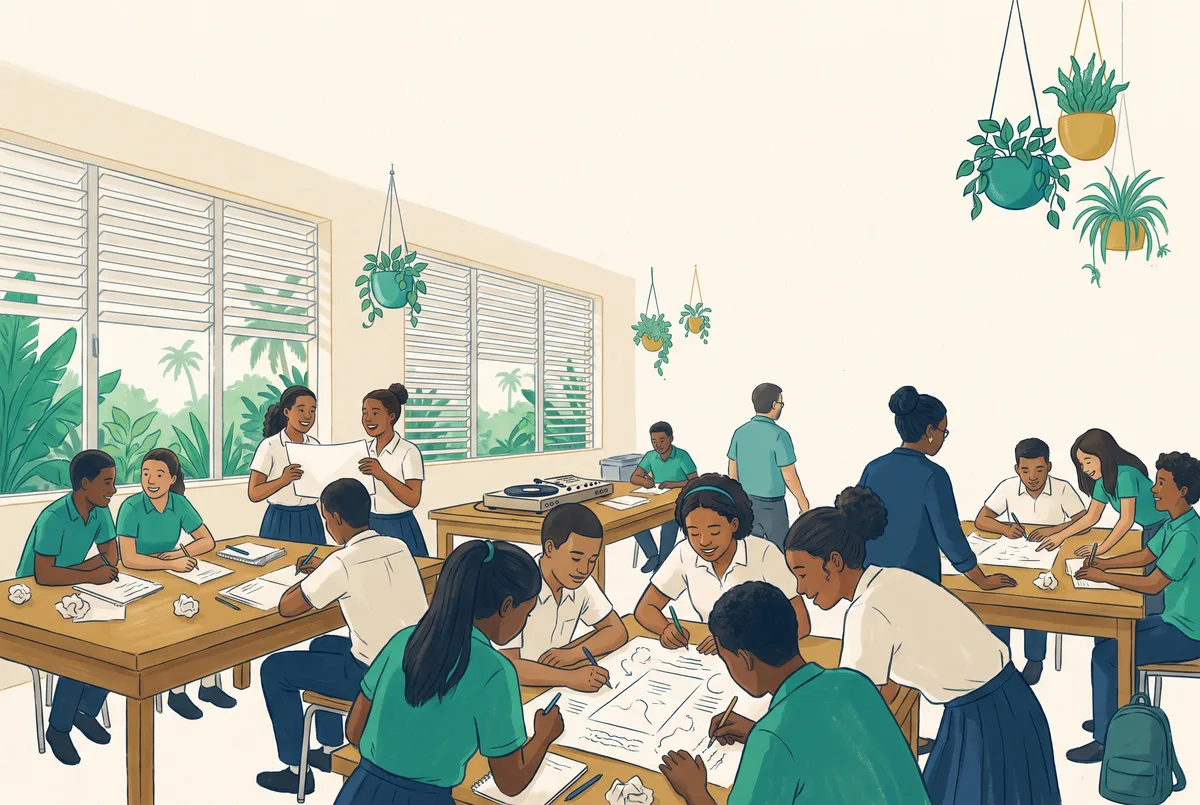
- Act. The words, by hand. Then, before generating anything: the session’s budget on the board and a check out loud that your words name nobody. Two attempts with the same words. A project that sings or says them with clapping and knocking on the table: that counts too.
- Reflect. One sentence per project with C1, C2 or C3. Which form works for your words? “What did the AI decide here that a person should have decided?” And on your card: the division of work, the credits and which trade would have done the production.
- Act again: the repository. You see how it’s done with one project, on screen. You write on paper the message of your first commit and the four lines of the README. Before uploading anything, you check out loud that there’s no key, password, personal data, voice or unlicensed material from someone else in it. The commit happens in turns, table by table.
- No screens. While you write your words and fill in the card, nobody uses a phone, a computer or AI. That’s where you decide, before touching any device, what you’ll ask the machine for and in which two forms, what you think will come out and how many generations fit in the budget.
The criteria, as questions
- C1. Can you tell what your project is about and who it’s for without naming it in the title?
- C2. Does it use at least two details from your list? (11th: is there a reason in your words?)
- C3. Are the words yours, word for word, or did the machine change something on you?
What you decide
- Budget: at most two generations per project that generates music, one per form. If the second form can be tried spoken or read, nothing is generated.
- Division of work: the words are always yours; which form stays is your decision.
- Credits: whose words, which tool did the production, which work or style you started from.
- The message of every commit: you write it, never the machine. The repository’s history shows who decided what; in a group, each person signs their own.
- If your project has no digital part (a sung piece, something on paper): the repository still keeps your words and your README. If your team decides not to have one, the README is written on paper, in the folder, and the decision is noted. You lose nothing.
If your project is without AI
You do the same full task: your words, in two forms, with the technique you chose last week — an instrument or a beat played in the room, clapping and the table, an audio editor without AI, read plain, as a drawn screen or as a rulebook. Instead of generations, your materials and time budget. You go to the listening in the same turn as your table, with the same criteria. Your division of work says what your technique did, what you did and what you decided. And your project has a home too: a repository, or its folder if your team decides so. In the listening, the question for you is: what did you decide, and why?
For inspiration
- Example: the colmado jingle
- A bachata of love for something everyday
- A stadium chant that doesn’t insult
- Build your instruction in the library assistant.
Careful
Your words name nobody, not the school, no addresses. Your voice isn’t uploaded to any tool. Nothing secret ever goes into the repository: no keys, no passwords, no personal data, no recorded voices. It’s private; making it public is publishing a piece, and that needs written permission from your family and your own agreement. You sign in with your own account only if the service’s terms admit your age and your family signed the accounts-and-publishing sheet; if not, you work through the program’s account and your authorship stays in the README. And remember: in two weeks voices get recorded; your family has to sign the sheet.
This is a plan: the Unit hasn’t run yet.