

Unit 02 · What someone at home wants to exist
Week 3 of the program · 45 minutes · 10th and 11th grade · every project, alone or in a group.
What you’re going to do
Today you choose your project for the year. You arrive with your three possible projects from Unit 01 and with what someone at home told you: which one they’d like to exist and what it should have. With the criteria in view and another person’s opinion, you choose one, or a new one born from the three. Alone or in a group. And once you have it, the conditions change.
Why it’s worth it
Choosing among three, after talking it over at home, is choosing better than sticking with your first idea. And another person’s wish, if you write it as a criterion you can see, becomes a guide for your project before you ask a machine for anything.
How the session goes
- Anticipate. You share what you brought from home, without names: “someone at home wants…”. You write down which one you think you’ll choose. You see a worked example —a logo that got fixed when a wish became a criterion: “it has to look good small”— and you write your home’s criterion for your project.
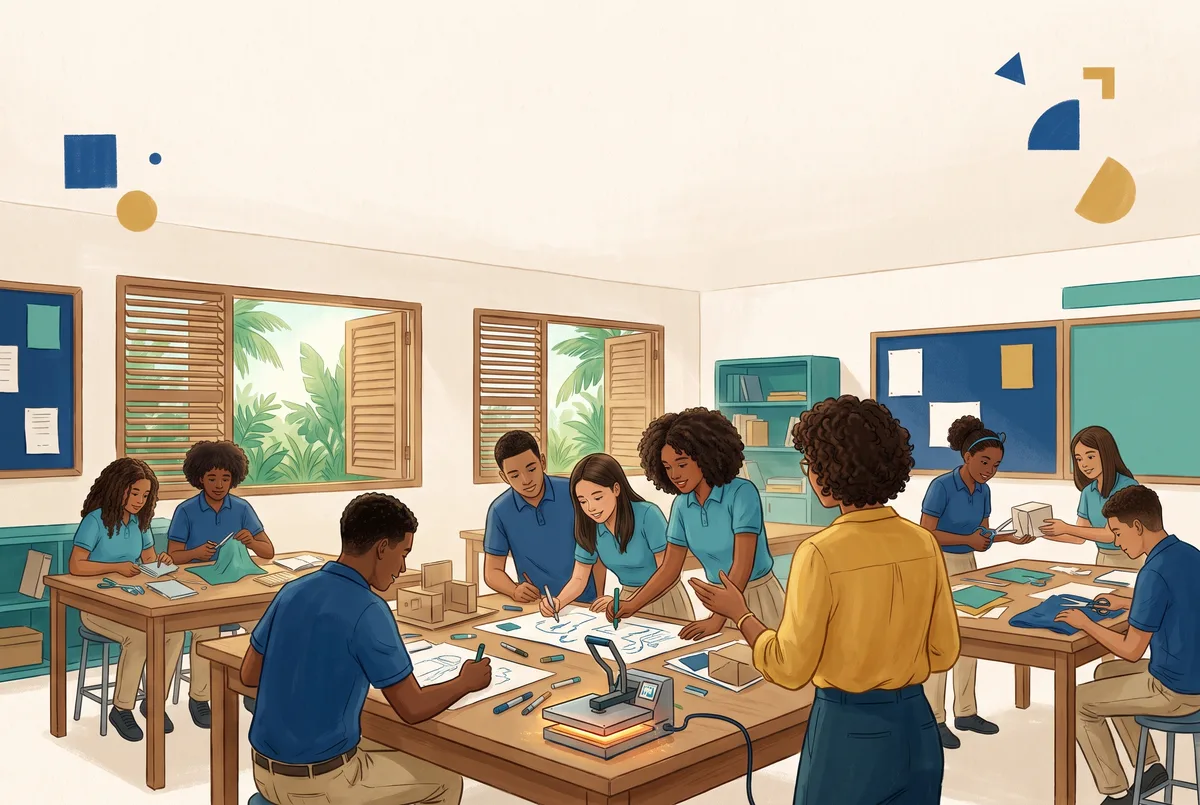
- Act. In pairs, one minute per project against the criteria. You choose. If someone else wants something similar, you can team up, if everyone wants to. Then the perturbations arrive, and you rewrite your sentence. At the end you fill in your card.
- Reflect. Some projects read their sentence from before and from now. The room answers by knocking on the table. “My project was…” / “Now it’s…”.
- No screens. From the perturbations until you’ve filled in your card, nobody uses a phone, a computer or AI. You discuss what changes, rewrite your sentence by hand or dictated, and decide what you’ll do with technology and how: what the AI does, what you do, what you decide, and how many generations you plan to work with.
The criteria, as questions
- C1. Does it come from something of yours, and not from what was shown in class?
- C2. Does it have a first step you can take next week?
- C3. Will someone other than you use it, hear it, play it or see it?
And one you write yourself: your home’s criterion. “The person who asked for it would recognize their wish if…”.
Alone or in a group
A group is born from a shared interest and from everyone wanting it. It writes a single sentence —“We want to make…”— and each person notes on their card their part and what they decide: nobody is left without something of their own. Nobody has to join, and it can change later, by talking it over. From today, similar projects sit together at affinity tables —sound, games, tools, money and data, story and image—, without merging.
Your card, from today
On your card you write your sentence, the part AI can’t do for you, your card from the deck and the division of work: what the AI does, what you do and what you decide. What gets made, for whom, what stays and when it’s finished is always decided by a person. You also note your generation budget: the lightest option that does the job. And your first step for next week.
If your project is without AI
It’s a full year-long project, with the same support, the same perturbations and the same milestones as any other. You fill in the same card: instead of the part AI can’t do, the part only you can do, the one no technique or tool would do for you; in the division of work, the first column is what your technique or your tool without AI does; and instead of generations, a materials and time budget. In the reading, the question for you is: what did you decide, and why?
For inspiration
- Example: the tournament logo — how a wish becomes a criterion you can see.
- The event T-shirt
- The cover of an album that doesn’t exist
Careful
What you bring from home comes in without anyone’s name or data: “someone at home wants…” yes; their name, no. Your card carries initials or a pseudonym and stays in the room. Nothing is generated today.
A perturbation you see coming isn’t one. If you haven’t lived this Unit yet, don’t open it.
Reveal this Unit's perturbations
Everyone’s, read aloud: “There’s a part of your project that AI can’t do for you. Find it and write it down. That part is yours all year.”
One card per project, whether it’s yours alone or your group’s, read aloud. Constraints: no screen (it can be enjoyed or used through sound, touch or words) · understood in under a minute, without explaining it · only with free tools and what’s in the room · an important part made without AI. Aspirations: useful to someone of another age · to someone at school who isn’t in this class · it teaches one true, verified thing · it works in two languages. Requirements: with data you gathered yourself · it shows where the AI got it wrong · connected to someone else’s project in the room · with a detail from your home or neighborhood. If your card is impossible for your project, you hand it back and draw another, just once.
Sometimes, one made to measure, on paper, just for your project. If your project is impossible today —flying, teleporting—, it isn’t thrown out: you choose a route, simulate it, get closer or understand it. If your project carries a risk —betting, real money, a character that personalizes itself—, what interests you is kept and the form changes: probability instead of betting; real public data, always cited, with simulated money and, if your project recommends investments, a visible notice (“not financial advice; for learning purposes”) and no promise of returns; characters that can remember settings between sessions but are never built as a companion. If your answer is “nothing,” that counts too: a project without AI, or one about AI and what you don’t like about it.
If the perturbation gets your project stuck, it carries on with its sentence as it was. That’s fine.
This is a plan: the Unit hasn’t run yet.