

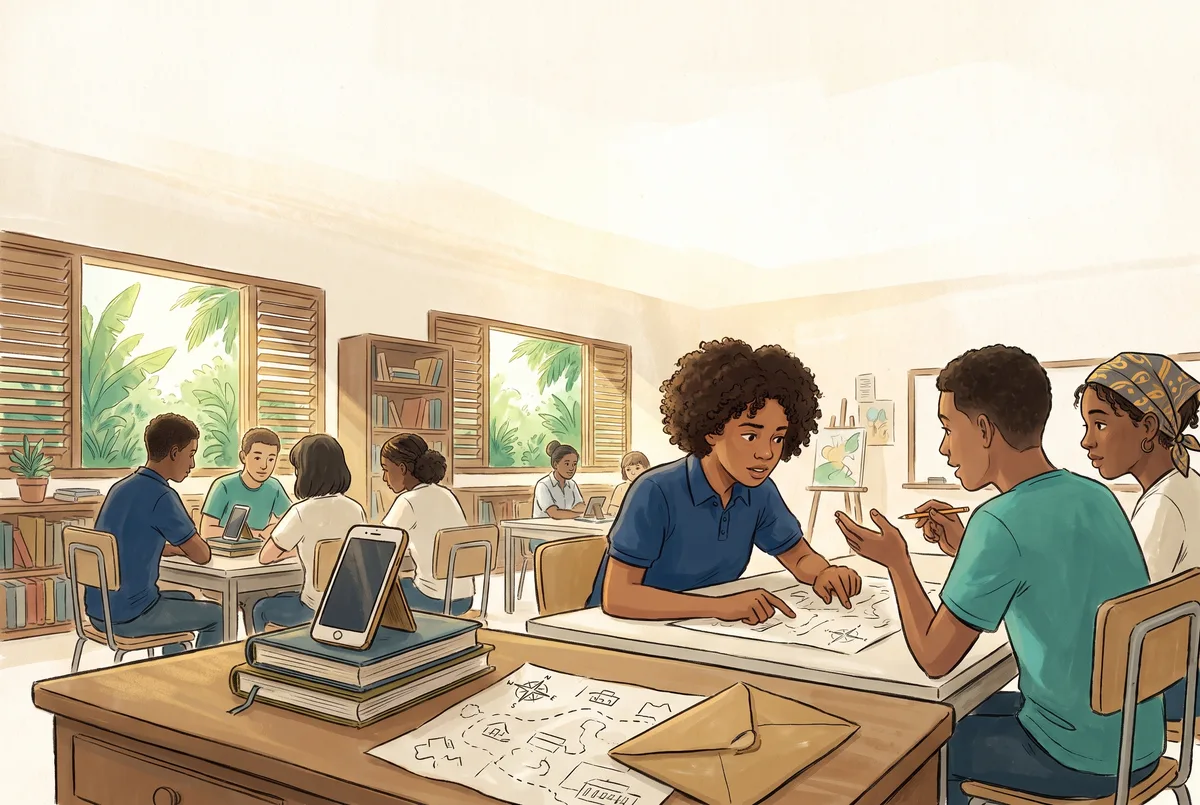
Unit 01 · What didn’t exist last month
Week 2 of the program · 45 minutes · 10th and 11th grade · three possible projects per person.
What you’ll do
Today you propose three possible projects for the year: three things you want to exist that don’t exist yet. You don’t choose yet: you look at them with criteria, get questions, talk them over at home, and in Unit 02 you choose one —alone or in a group— to work on until June. Nothing is graded, not today and not later.
Want to see what other groups chose? It’s behind the “What other groups answered” button, above. This Unit stays blank so you can choose for yourself.
1. What you already do with AI
First, without looking at anything: what did we say last week? The answers from Unit 00 are read aloud, and each one goes into one of two columns. On the left, faster or easier: the same as always, in less time. On the right, more, better, beyond: something that wasn’t within your reach. Almost everything we do with AI today falls on the left. Your project goes on the right.
Bring your line from Unit 00 too: the thing from your list you wanted to take to the right. And before going on, write or dictate one thing you’d like to exist: what the AI would do there, what you would do and what you would decide. It can be the seed of one of the three possible projects you propose today.
2. Things that didn’t exist until recently
Work made with AI by CEMI and by the person guiding the session: music, video, apps and games. They aren’t templates: they show what’s possible. What matters here is what you would make. Each piece is described aloud while it’s shown, and after each one you write a single word.
Open them and explore at your own pace; each one opens right here, full size. Games are best at home.
3. Is it great? What’s wrong with it?
The vote is by sound, everyone at once: one knock on the table, it’s great; two knocks, it has flaws; silence, not sure. Then one reason per vote, based on something you saw or heard. Finding the flaw counts as much as finding what’s great: it’s part of the craft. And at the end, someone explains how one of the pieces was made, and where it failed.
4. Yours first
Phone face down. Before proposing anything, write by hand —or dictate— three short lists:
- something you do without anyone asking you to;
- something that bothers you or is missing at home, in your neighborhood or at school;
- something you’d like to know how to do.
Your projects come from there, not from what we just saw. Hard to get started? Warm up your imagination with the idea dice at the end of the page: absurd is fine.
From here to the end of the questions in pairs, no screens: no phone, no computer, no projector, no AI. You think, write or dictate, discuss and decide, for each project, what the AI would do, what you would do and what you would decide, and whether it would go with AI, without AI or be about AI. It all stays on your card and comes back in Unit 02.
5. Your three possible projects
Write three, each in one sentence, and make them three different things, not three versions of the same one:
I want to make ______ for ______ because ______.
Anything goes as long as it has that shape. Something that seems impossible today? Write it down. Don’t want to do anything with AI? That counts too: you can propose things without AI, or about what you don’t like in it. A project without AI is a full year-long project, with the same support, the same criteria and the same milestones as any other. And if one looks like one of CEMI’s pieces, think about what yours would have that ours doesn’t.
These are the three criteria they’re looked at with:
- C1. It comes from something of yours —what you love, what bothers you or what’s missing—, not from what we saw today.
- C2. It has a first step you can take next week.
- C3. Someone other than you will use it, hear it, play it or see it.
6. Questions, not grades
In pairs, evaluate each other’s three projects against each criterion: does it meet it already, or not yet? And why. Then ask one question per project that helps the other person think it through: who would it be for? What would you do next week? What would the AI do there, and what would you do? Nobody decides for the other or ranks their projects.
At the end, in a round: did you hear a project similar to one of yours? Say so. In Unit 02 you can work together, if you both want to.
What the AI decides, and what you decide
On your card, three columns: what the AI does, what you do and what you decide. AI can do a lot, and it’s fine that it does: the repetitive parts, what you can’t produce yet, a first version to criticize. But what gets made, for whom, what stays, what goes and when it’s finished is always decided by a person. At every review you’ll hear the same question: “What did the AI decide here that a person should have decided?”
What worries you counts. If you’re worried about the energy AI uses, every session has a generation budget: you use the lightest option that does the job —text before image, image before video, thinking on paper before generating— and you count what you use. If you’re worried about privacy, no data of yours or anyone else’s goes into an instruction. And every piece carries its credits: what’s yours, what the tool made and whose work you started from.
7. Before you go
One line on your card: “The one that pulls me most is… because…”.
And the first step, which you can take tonight without asking anyone’s permission: tell someone at home about your three projects and ask which one they’d like to exist, and what it should have. Their answer goes into Unit 02, where you choose.
What this is, and what it isn’t
This Unit’s design is original: a design position, not a research finding. It promises no effect; whatever happens is seen in the room. Nothing is graded: not the projects, not the questions, not what you choose later.
Your card stays in the room and comes back every week. No project is published with names, and nothing you make leaves the room without the written consent, piece by piece, described in the note to families.
The idea dice
Roll the three dice and see what comes out. Absurd is fine: it loosens your imagination before you write your three projects. It isn’t your project; it’s a warm-up.