

Growth
The loop the business runs on, the route a customer travels, and what ships over the runway this round buys. All three are generated from one file, so none of them can disagree with the round or with the revenue page.
The business flywheel
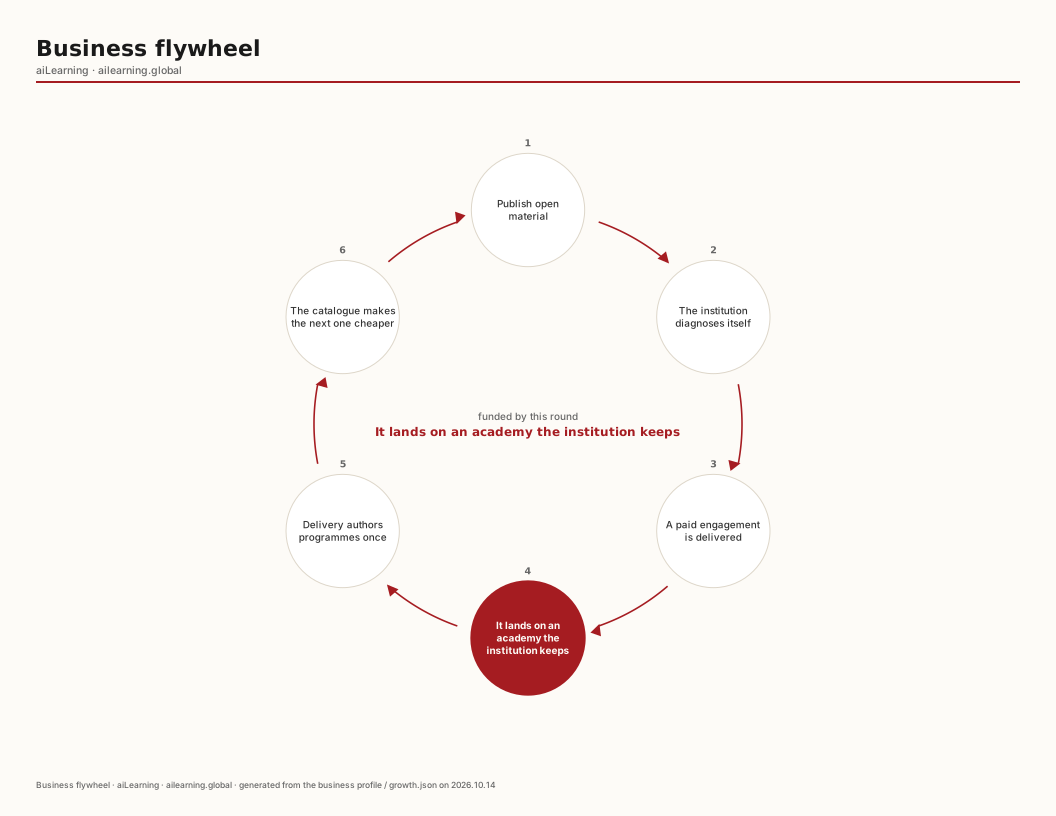
The loop both properties run on. Open material earns attention, attention becomes a diagnosed institution, the diagnosis becomes a paid engagement, and the engagement lands on a platform the institution renews instead of rebooking. Delivering it authors programmes once, which makes the next academy cheaper to fill and the open material deeper.
- Publish open material
Guides, learning paths, a prompt library, a glossary and tool directory, ethics scenarios, learning games and long-form Insights — free, ungated and in all three operating languages, by policy.
feeds → The institution diagnoses itself - The institution diagnoses itself
The free AI readiness self-assessment is the published front door of the paid assessment. An institution arrives at a conversation already knowing where it stands, which is what makes the next step a scoping call rather than a pitch.
feeds → A paid engagement is delivered - A paid engagement is delivered
Assessment, consulting, personalized training, the AI Suite for Education or a digital twin — each fixed-scope, each published with its own page and its own investment band or scoping statement.
feeds → It lands on an academy the institution keeps - It lands on an academy the institution keeps
Smoother Experiences deployed white-label: the institution's own domain, palette, logos, curated catalogue, managers and certificates. This is the stage the round funds, and the only one that renews without consuming delivery time.
feeds → Delivery authors programmes once - Delivery authors programmes once
Every academy is filled with programmes built on the Smoother learning-object model and cleared through the platform's published quality gate. The work is authored as reusable objects, not as one institution's slides.
feeds → The catalogue makes the next one cheaper - The catalogue makes the next one cheaper
A larger catalogue fills the next academy with less new authoring, and the parts that can be opened are published back into the free material — which is where the loop restarts.
feeds → Publish open material
The stage this round buys: It lands on an academy the institution keeps.
The round's largest line — 40% into Smoother Experiences platform engineering — buys exactly one stage of this loop: the multi-tenant white-label deployment that turns a finished engagement into an academy the institution keeps. Without it the loop stops at «engagement delivered» and has to start again from the top for every new institution.
The customer funnel
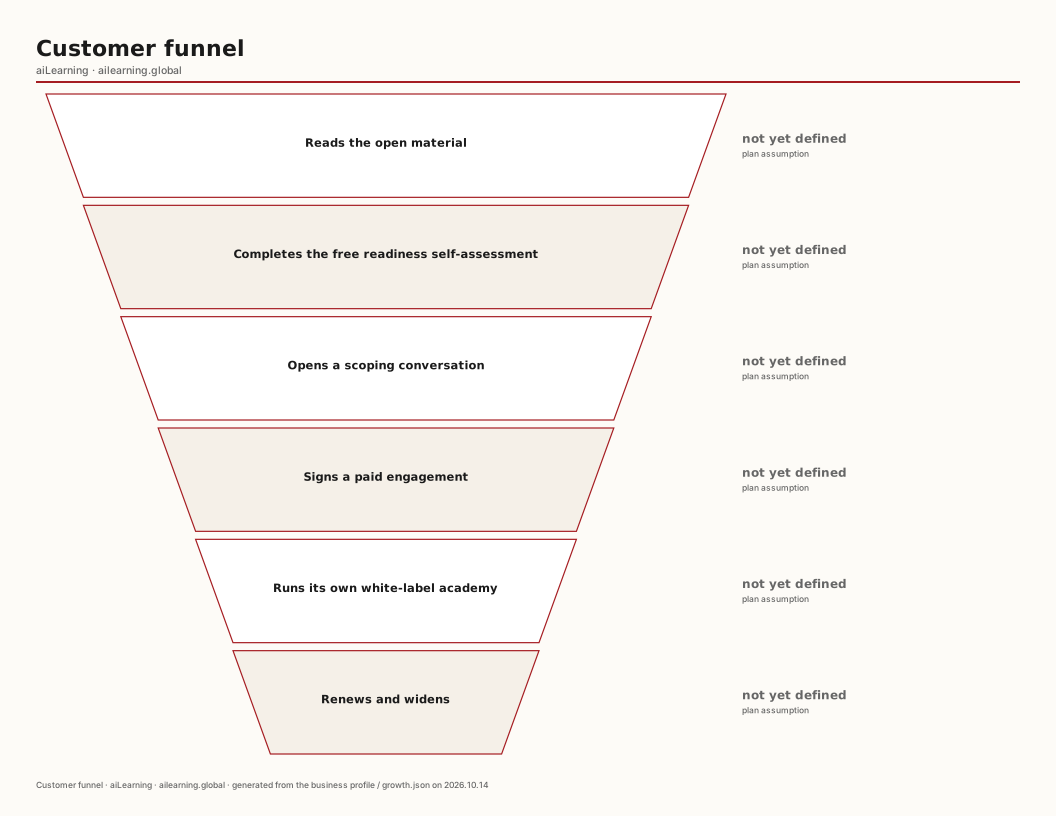
The route is the one the business plan publishes: open material, self-assessment, paid engagement, deployed academy, renewal. Every stage below is real and published. No conversion figure appears, because neither property publishes one and this kit does not state revenue to date, run rate or tenancy counts (§4). Each stage therefore reads «plan assumption» — the honest label — rather than a rate invented to fill the column.
| Stage | What it counts | Figure | Basis |
|---|---|---|---|
| 1. Reads the open material | Anyone reading the free, ungated library in any of the three languages. No account, no gate, no form. | — | plan assumption |
| 2. Completes the free readiness self-assessment | An institution that has put its own situation through the published instrument. This is the first stage at which a reader becomes identifiable as an institution with a problem. | — | plan assumption |
| 3. Opens a scoping conversation | A scoping call, on the institution's initiative or after a speaking engagement or the AI Learning Challenge — the two published routes into a school system or a ministry. | — | plan assumption |
| 4. Signs a paid engagement | A fixed-scope, fixed-fee engagement on one of the six published service lines. This is the first paid stage, and the point at which the delivery capacity the round funds becomes the constraint. | — | plan assumption |
| 5. Runs its own white-label academy | Smoother Experiences deployed as the institution's own platform. The first recurring line: it renews rather than being rebooked. No price for it is published, so the terms are on request. | — | plan assumption |
| 6. Renews and widens | More cohorts, more of the catalogue, further faculties, campuses or agencies on the same tenancy. This is the stage the whole plan is pointed at, and the one that would let a later round be underwritten on the recurring line alone. | — | plan assumption |
The roadmap
18 months, in 3 windows of 6. The horizon is the plan horizon in the round terms — it is derived from it, not chosen beside it — and each item names the use-of-funds line that pays for it.
48% of the round funds the platform and the infrastructure under it; 52% funds the programmes, the delivery capacity and the institutional reach.
Forward-looking, and identified as such. Periods are six-month windows relative to close, not calendar dates — the one exception is the AI Learning Challenge, whose first edition is already published for Saturday 28 November 2026. Every item names the use-of-funds line that pays for it; an item with no line behind it does not belong on the roadmap.
| Months 1–6 after close | Months 7–12 after close | Months 13–18 after close | |
|---|---|---|---|
| Product |
|
|
|
| Market |
|
|
|
| Team |
|
| Nothing planned in this window. |
| Finance |
|
|
|
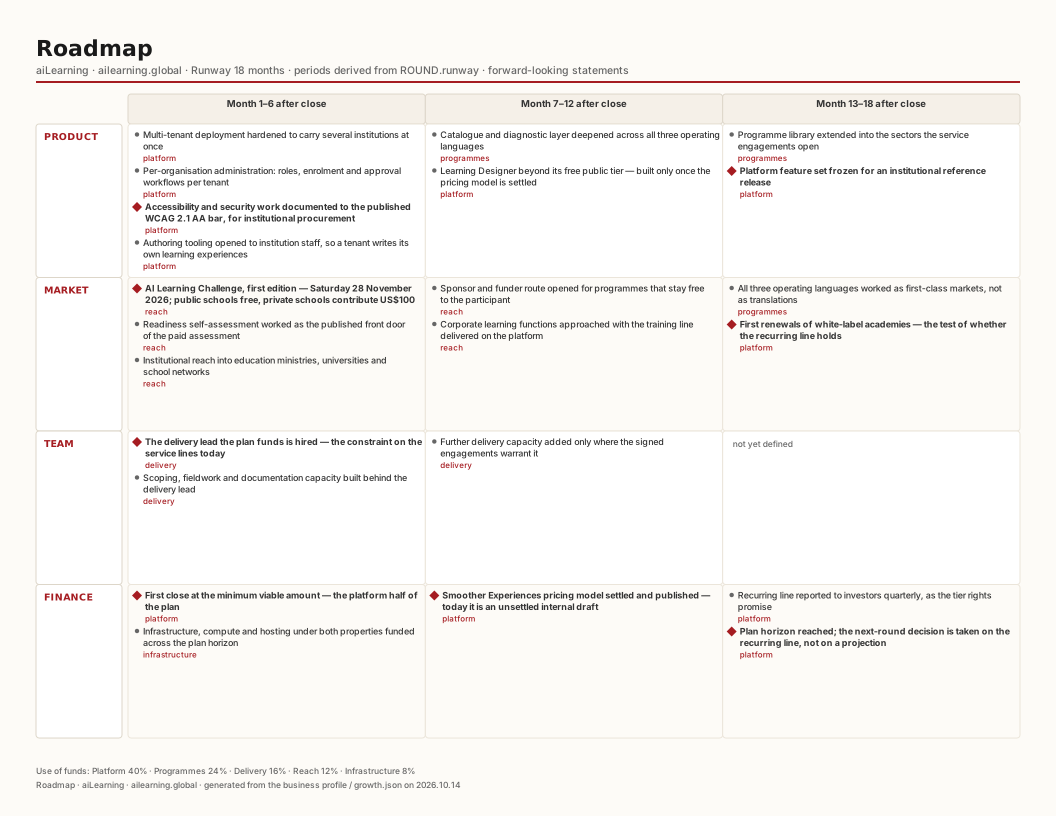
Forward-looking. The roadmap is a plan for the money this round raises, identified as such, and not a projection dressed as a record.
Every revenue stream, its buyer and its published price are set out in full on the revenue-streams page. Revenue streams →


Financial terms, revenue and detailed materials are available on request. Figures describe capacity built and operating today; forward-looking statements are identified as such.