

Canvases
The Business Model Canvas, the Lean Canvas and one Value Proposition Canvas for every customer segment served — for both properties this round raises for. Every block is generated from the business profile, so a canvas here cannot contradict the revenue page, the plan or the round.
Generated, not drawn. Each canvas appears twice: as the labelled grid and as the SVG of the same content. Neither is hand-edited — both are produced from the business profile by the one shared renderer.
A block with nothing true in it reads «not yet defined». It is never filled to look complete.
aiLearning — ailearning.global
The site, the published learning material, the AI Learning Challenge and the six productized services.
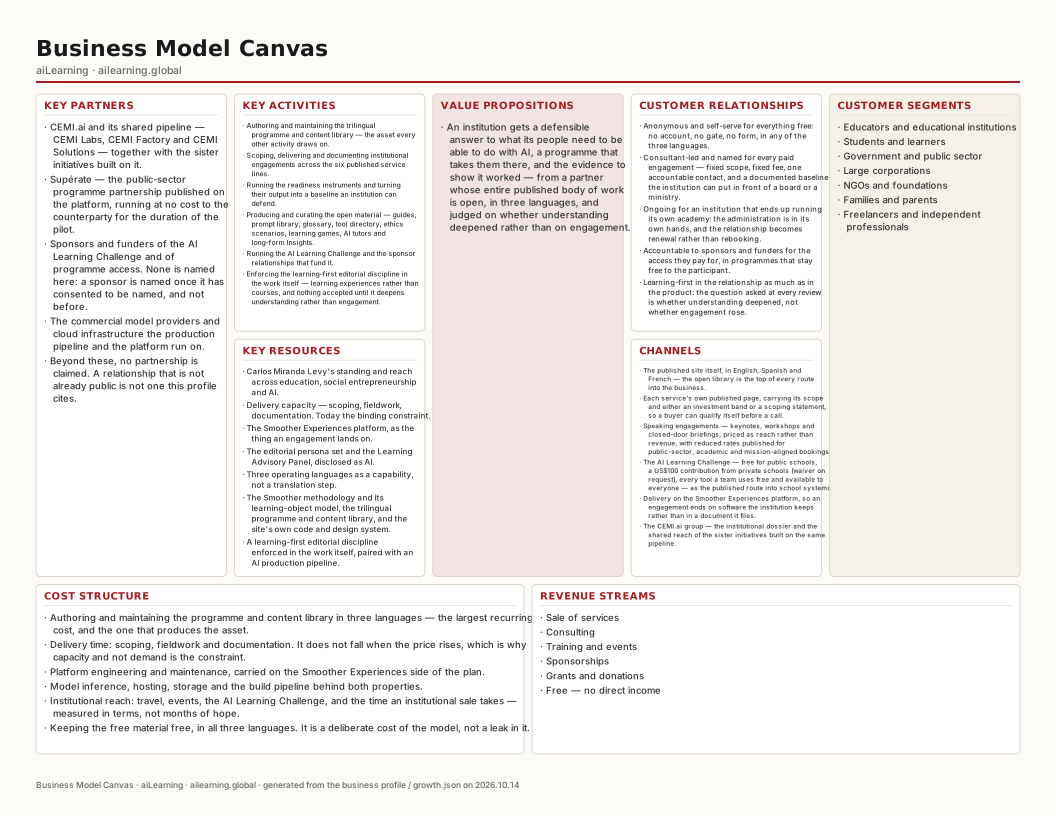
Business Model Canvas
Osterwalder’s nine blocks. Customer segments and revenue streams are the controlled vocabularies the revenue page uses, not free text.
- CEMI.ai and its shared pipeline — CEMI Labs, CEMI Factory and CEMI Solutions — together with the sister initiatives built on it.
- Supérate — the public-sector programme partnership published on the platform, running at no cost to the counterparty for the duration of the pilot.
- Sponsors and funders of the AI Learning Challenge and of programme access. None is named here: a sponsor is named once it has consented to be named, and not before.
- The commercial model providers and cloud infrastructure the production pipeline and the platform run on.
- Beyond these, no partnership is claimed. A relationship that is not already public is not one this profile cites.
- Authoring and maintaining the trilingual programme and content library — the asset every other activity draws on.
- Scoping, delivering and documenting institutional engagements across the six published service lines.
- Running the readiness instruments and turning their output into a baseline an institution can defend.
- Producing and curating the open material — guides, prompt library, glossary, tool directory, ethics scenarios, learning games, AI tutors and long-form Insights.
- Running the AI Learning Challenge and the sponsor relationships that fund it.
- Enforcing the learning-first editorial discipline in the work itself — learning experiences rather than courses, and nothing accepted until it deepens understanding rather than engagement.
- Carlos Miranda Levy's standing and reach across education, social entrepreneurship and AI.
- Delivery capacity — scoping, fieldwork, documentation. Today the binding constraint.
- The Smoother Experiences platform, as the thing an engagement lands on.
- The editorial persona set and the Learning Advisory Panel, disclosed as AI.
- Three operating languages as a capability, not a translation step.
- The Smoother methodology and its learning-object model, the trilingual programme and content library, and the site's own code and design system.
- A learning-first editorial discipline enforced in the work itself, paired with an AI production pipeline.
- An institution gets a defensible answer to what its people need to be able to do with AI, a programme that takes them there, and the evidence to show it worked — from a partner whose entire published body of work is open, in three languages, and judged on whether understanding deepened rather than on engagement.
- Anonymous and self-serve for everything free: no account, no gate, no form, in any of the three languages.
- Consultant-led and named for every paid engagement — fixed scope, fixed fee, one accountable contact, and a documented baseline the institution can put in front of a board or a ministry.
- Ongoing for an institution that ends up running its own academy: the administration is in its own hands, and the relationship becomes renewal rather than rebooking.
- Accountable to sponsors and funders for the access they pay for, in programmes that stay free to the participant.
- Learning-first in the relationship as much as in the product: the question asked at every review is whether understanding deepened, not whether engagement rose.
- The published site itself, in English, Spanish and French — the open library is the top of every route into the business.
- Each service's own published page, carrying its scope and either an investment band or a scoping statement, so a buyer can qualify itself before a call.
- Speaking engagements — keynotes, workshops and closed-door briefings, priced as reach rather than revenue, with reduced rates published for public-sector, academic and mission-aligned bookings.
- The AI Learning Challenge — free for public schools, a US$100 contribution from private schools (waiver on request), every tool a team uses free and available to everyone — as the published route into school systems.
- Delivery on the Smoother Experiences platform, so an engagement ends on software the institution keeps rather than in a document it files.
- The CEMI.ai group — the institutional dossier and the shared reach of the sister initiatives built on the same pipeline.
- Educators and educational institutions
- Students and learners
- Government and public sector
- Large corporations
- NGOs and foundations
- Families and parents
- Freelancers and independent professionals
- Authoring and maintaining the programme and content library in three languages — the largest recurring cost, and the one that produces the asset.
- Delivery time: scoping, fieldwork and documentation. It does not fall when the price rises, which is why capacity and not demand is the constraint.
- Platform engineering and maintenance, carried on the Smoother Experiences side of the plan.
- Model inference, hosting, storage and the build pipeline behind both properties.
- Institutional reach: travel, events, the AI Learning Challenge, and the time an institutional sale takes — measured in terms, not months of hope.
- Keeping the free material free, in all three languages. It is a deliberate cost of the model, not a leak in it.
- Sale of services
- Consulting
- Training and events
- Sponsorships
- Grants and donations
- Free — no direct income
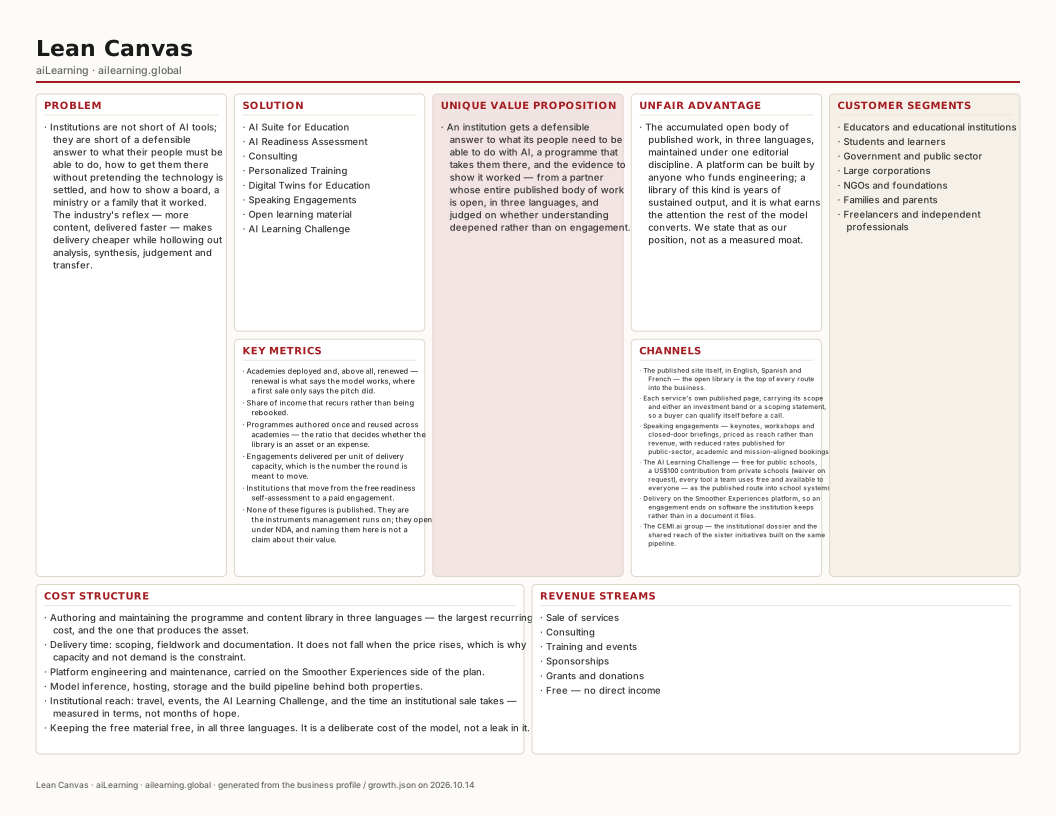
Lean Canvas
Maurya’s nine blocks. The unfair advantage is stated as a position held, never as a measured moat.
- Institutions are not short of AI tools; they are short of a defensible answer to what their people must be able to do, how to get them there without pretending the technology is settled, and how to show a board, a ministry or a family that it worked. The industry's reflex — more content, delivered faster — makes delivery cheaper while hollowing out analysis, synthesis, judgement and transfer.
- AI Suite for Education
- AI Readiness Assessment
- Consulting
- Personalized Training
- Digital Twins for Education
- Speaking Engagements
- Open learning material
- AI Learning Challenge
- An institution gets a defensible answer to what its people need to be able to do with AI, a programme that takes them there, and the evidence to show it worked — from a partner whose entire published body of work is open, in three languages, and judged on whether understanding deepened rather than on engagement.
- The accumulated open body of published work, in three languages, maintained under one editorial discipline. A platform can be built by anyone who funds engineering; a library of this kind is years of sustained output, and it is what earns the attention the rest of the model converts. We state that as our position, not as a measured moat.
- Educators and educational institutions
- Students and learners
- Government and public sector
- Large corporations
- NGOs and foundations
- Families and parents
- Freelancers and independent professionals
- Academies deployed and, above all, renewed — renewal is what says the model works, where a first sale only says the pitch did.
- Share of income that recurs rather than being rebooked.
- Programmes authored once and reused across academies — the ratio that decides whether the library is an asset or an expense.
- Engagements delivered per unit of delivery capacity, which is the number the round is meant to move.
- Institutions that move from the free readiness self-assessment to a paid engagement.
- None of these figures is published. They are the instruments management runs on; they open under NDA, and naming them here is not a claim about their value.
- The published site itself, in English, Spanish and French — the open library is the top of every route into the business.
- Each service's own published page, carrying its scope and either an investment band or a scoping statement, so a buyer can qualify itself before a call.
- Speaking engagements — keynotes, workshops and closed-door briefings, priced as reach rather than revenue, with reduced rates published for public-sector, academic and mission-aligned bookings.
- The AI Learning Challenge — free for public schools, a US$100 contribution from private schools (waiver on request), every tool a team uses free and available to everyone — as the published route into school systems.
- Delivery on the Smoother Experiences platform, so an engagement ends on software the institution keeps rather than in a document it files.
- The CEMI.ai group — the institutional dossier and the shared reach of the sister initiatives built on the same pipeline.
- Authoring and maintaining the programme and content library in three languages — the largest recurring cost, and the one that produces the asset.
- Delivery time: scoping, fieldwork and documentation. It does not fall when the price rises, which is why capacity and not demand is the constraint.
- Platform engineering and maintenance, carried on the Smoother Experiences side of the plan.
- Model inference, hosting, storage and the build pipeline behind both properties.
- Institutional reach: travel, events, the AI Learning Challenge, and the time an institutional sale takes — measured in terms, not months of hope.
- Keeping the free material free, in all three languages. It is a deliberate cost of the model, not a leak in it.
- Sale of services
- Consulting
- Training and events
- Sponsorships
- Grants and donations
- Free — no direct income
Value Proposition Canvases
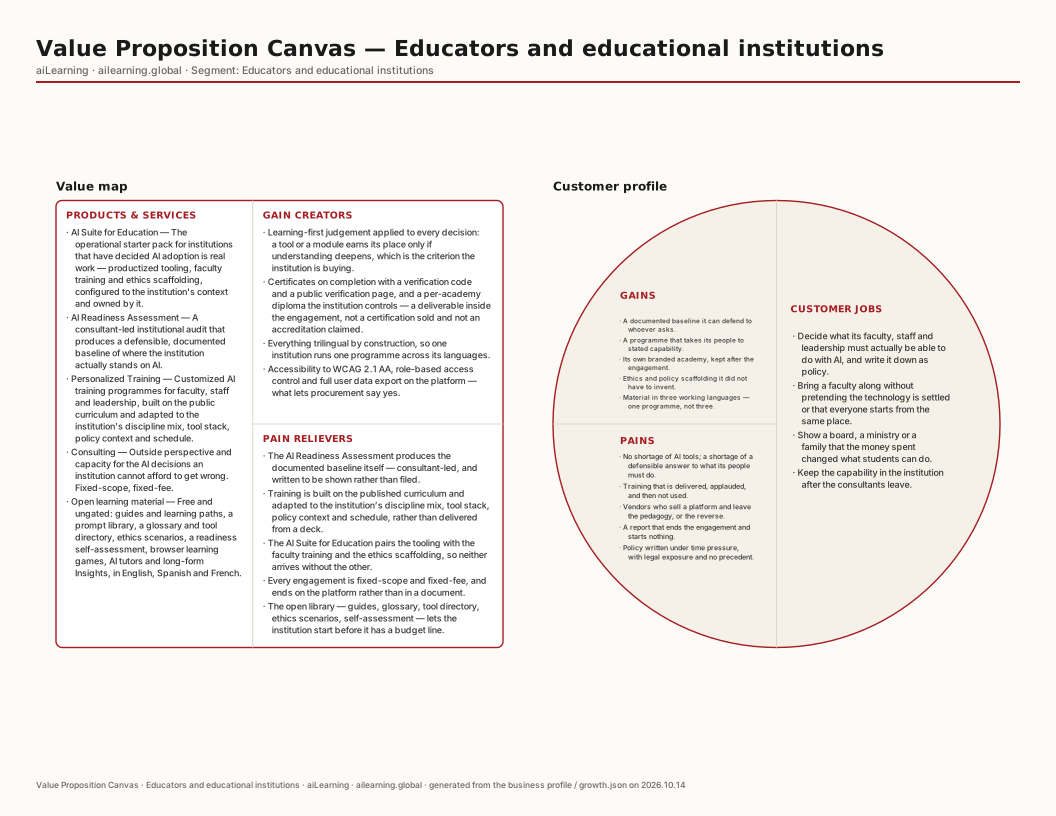
One per segment served — as many canvases as there are segments, and no more. Each pairs the customer profile (jobs, pains, gains) with the value map (products and services, pain relievers, gain creators).
Value Proposition Canvas — Educators and educational institutions
- Decide what its faculty, staff and leadership must actually be able to do with AI, and write it down as policy.
- Bring a faculty along without pretending the technology is settled or that everyone starts from the same place.
- Show a board, a ministry or a family that the money spent changed what students can do.
- Keep the capability in the institution after the consultants leave.
- No shortage of AI tools; a shortage of a defensible answer to what its people must do.
- Training that is delivered, applauded, and then not used.
- Vendors who sell a platform and leave the pedagogy, or the reverse.
- A report that ends the engagement and starts nothing.
- Policy written under time pressure, with legal exposure and no precedent.
- A documented baseline it can defend to whoever asks.
- A programme that takes its people to stated capability.
- Its own branded academy, kept after the engagement.
- Ethics and policy scaffolding it did not have to invent.
- Material in three working languages — one programme, not three.
- AI Suite for Education
- AI Readiness Assessment
- Personalized Training
- Consulting
- Open learning material
- The AI Readiness Assessment produces the documented baseline itself — consultant-led, and written to be shown rather than filed.
- Training is built on the published curriculum and adapted to the institution’s discipline mix, tool stack, policy context and schedule, rather than delivered from a deck.
- The AI Suite for Education pairs the tooling with the faculty training and the ethics scaffolding, so neither arrives without the other.
- Every engagement is fixed-scope and fixed-fee, and ends on the platform rather than in a document.
- The open library — guides, glossary, tool directory, ethics scenarios, self-assessment — lets the institution start before it has a budget line.
- Learning-first judgement applied to every decision: a tool or a module earns its place only if understanding deepens, which is the criterion the institution is buying.
- Certificates on completion with a verification code and a public verification page, and a per-academy diploma the institution controls — a deliverable inside the engagement, not a certification sold and not an accreditation claimed.
- Everything trilingual by construction, so one institution runs one programme across its languages.
- Accessibility to WCAG 2.1 AA, role-based access control and full user data export on the platform — what lets procurement say yes.
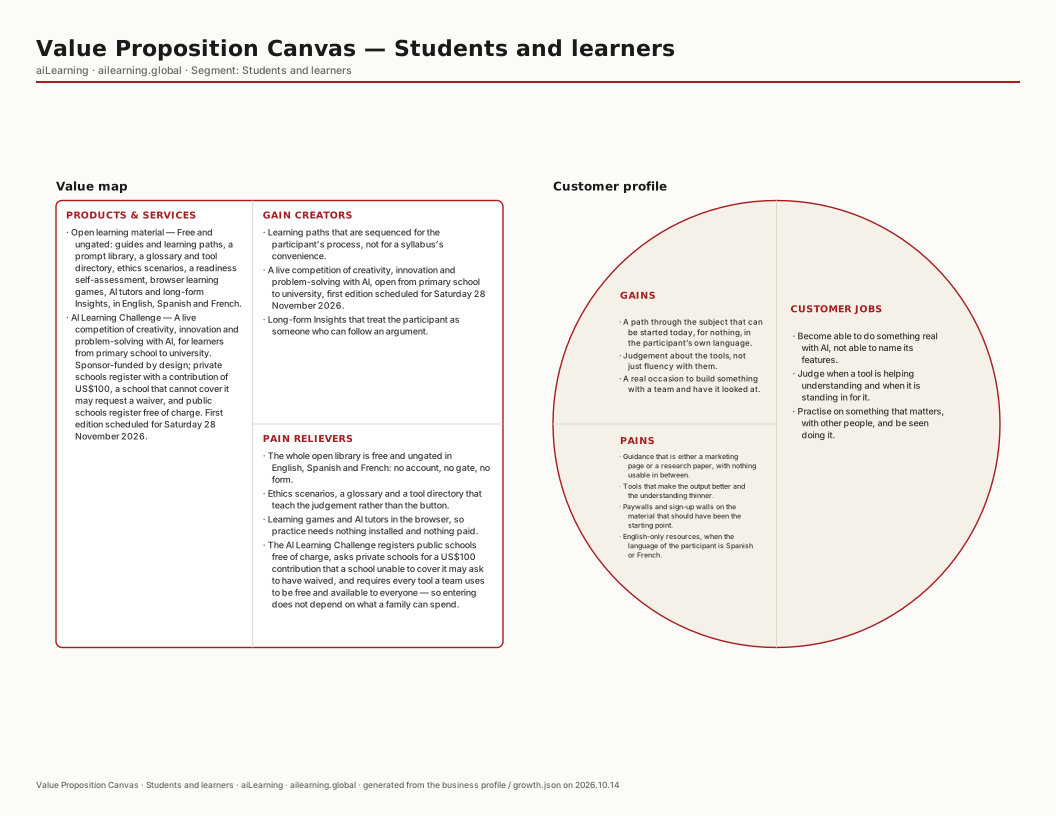
Value Proposition Canvas — Students and learners
- Become able to do something real with AI, not able to name its features.
- Judge when a tool is helping understanding and when it is standing in for it.
- Practise on something that matters, with other people, and be seen doing it.
- Guidance that is either a marketing page or a research paper, with nothing usable in between.
- Tools that make the output better and the understanding thinner.
- Paywalls and sign-up walls on the material that should have been the starting point.
- English-only resources, when the language of the participant is Spanish or French.
- A path through the subject that can be started today, for nothing, in the participant’s own language.
- Judgement about the tools, not just fluency with them.
- A real occasion to build something with a team and have it looked at.
- Open learning material
- AI Learning Challenge
- The whole open library is free and ungated in English, Spanish and French: no account, no gate, no form.
- Ethics scenarios, a glossary and a tool directory that teach the judgement rather than the button.
- Learning games and AI tutors in the browser, so practice needs nothing installed and nothing paid.
- The AI Learning Challenge registers public schools free of charge, asks private schools for a US$100 contribution that a school unable to cover it may ask to have waived, and requires every tool a team uses to be free and available to everyone — so entering does not depend on what a family can spend.
- Learning paths that are sequenced for the participant’s process, not for a syllabus’s convenience.
- A live competition of creativity, innovation and problem-solving with AI, open from primary school to university, first edition scheduled for Saturday 28 November 2026.
- Long-form Insights that treat the participant as someone who can follow an argument.
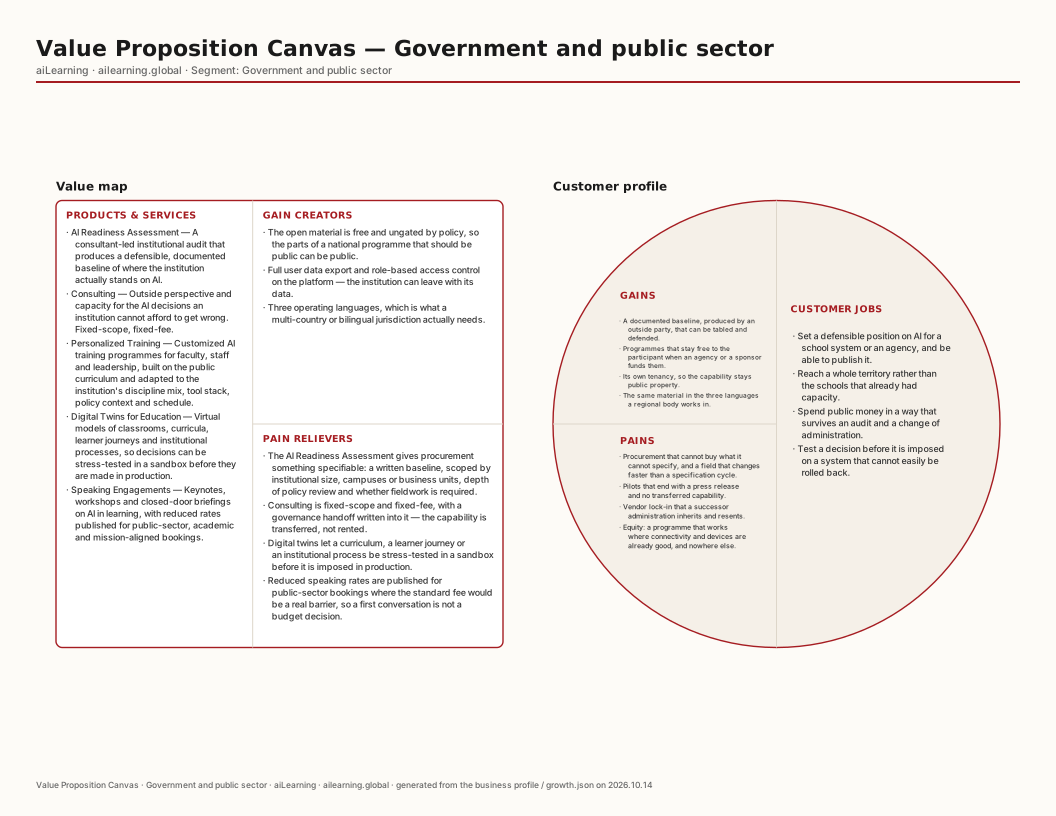
Value Proposition Canvas — Government and public sector
- Set a defensible position on AI for a school system or an agency, and be able to publish it.
- Reach a whole territory rather than the schools that already had capacity.
- Spend public money in a way that survives an audit and a change of administration.
- Test a decision before it is imposed on a system that cannot easily be rolled back.
- Procurement that cannot buy what it cannot specify, and a field that changes faster than a specification cycle.
- Pilots that end with a press release and no transferred capability.
- Vendor lock-in that a successor administration inherits and resents.
- Equity: a programme that works where connectivity and devices are already good, and nowhere else.
- A documented baseline, produced by an outside party, that can be tabled and defended.
- Programmes that stay free to the participant when an agency or a sponsor funds them.
- Its own tenancy, so the capability stays public property.
- The same material in the three languages a regional body works in.
- AI Readiness Assessment
- Consulting
- Personalized Training
- Digital Twins for Education
- Speaking Engagements
- The AI Readiness Assessment gives procurement something specifiable: a written baseline, scoped by institutional size, campuses or business units, depth of policy review and whether fieldwork is required.
- Consulting is fixed-scope and fixed-fee, with a governance handoff written into it — the capability is transferred, not rented.
- Digital twins let a curriculum, a learner journey or an institutional process be stress-tested in a sandbox before it is imposed in production.
- Reduced speaking rates are published for public-sector bookings where the standard fee would be a real barrier, so a first conversation is not a budget decision.
- The open material is free and ungated by policy, so the parts of a national programme that should be public can be public.
- Full user data export and role-based access control on the platform — the institution can leave with its data.
- Three operating languages, which is what a multi-country or bilingual jurisdiction actually needs.
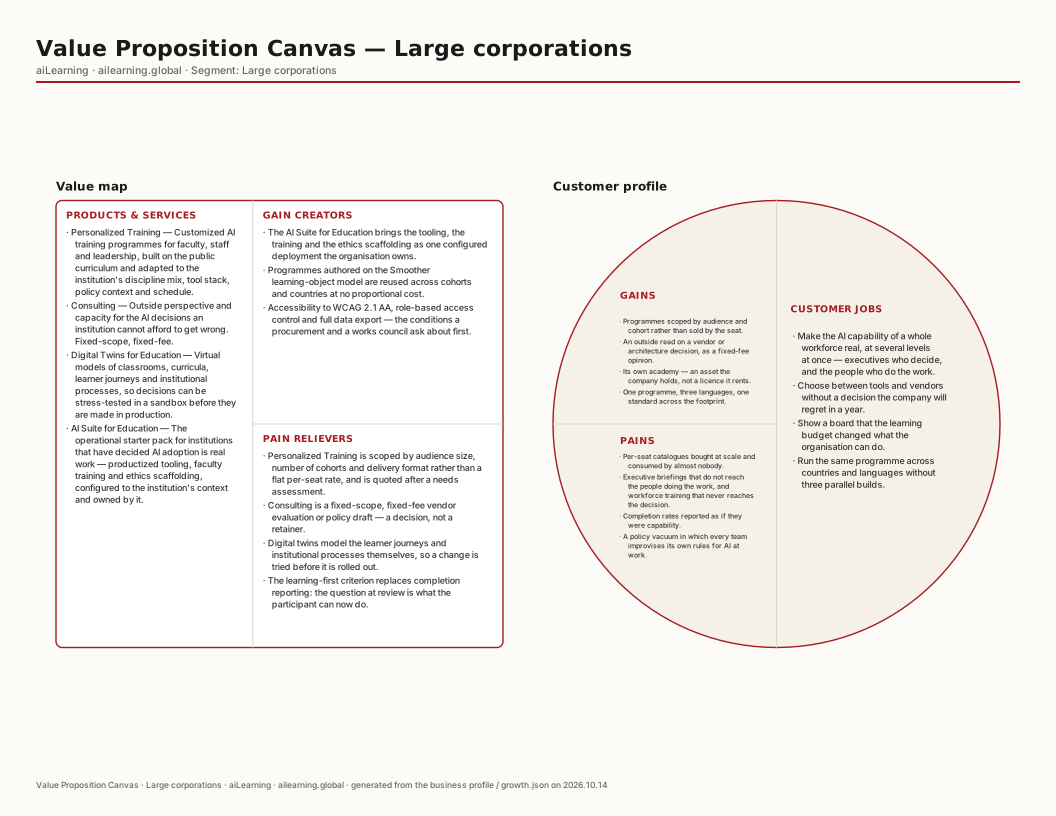
Value Proposition Canvas — Large corporations
- Make the AI capability of a whole workforce real, at several levels at once — executives who decide, and the people who do the work.
- Choose between tools and vendors without a decision the company will regret in a year.
- Show a board that the learning budget changed what the organisation can do.
- Run the same programme across countries and languages without three parallel builds.
- Per-seat catalogues bought at scale and consumed by almost nobody.
- Executive briefings that do not reach the people doing the work, and workforce training that never reaches the decision.
- Completion rates reported as if they were capability.
- A policy vacuum in which every team improvises its own rules for AI at work.
- Programmes scoped by audience and cohort rather than sold by the seat.
- An outside read on a vendor or architecture decision, as a fixed-fee opinion.
- Its own academy — an asset the company holds, not a licence it rents.
- One programme, three languages, one standard across the footprint.
- Personalized Training
- Consulting
- Digital Twins for Education
- AI Suite for Education
- Personalized Training is scoped by audience size, number of cohorts and delivery format rather than a flat per-seat rate, and is quoted after a needs assessment.
- Consulting is a fixed-scope, fixed-fee vendor evaluation or policy draft — a decision, not a retainer.
- Digital twins model the learner journeys and institutional processes themselves, so a change is tried before it is rolled out.
- The learning-first criterion replaces completion reporting: the question at review is what the participant can now do.
- The AI Suite for Education brings the tooling, the training and the ethics scaffolding as one configured deployment the organisation owns.
- Programmes authored on the Smoother learning-object model are reused across cohorts and countries at no proportional cost.
- Accessibility to WCAG 2.1 AA, role-based access control and full data export — the conditions a procurement and a works council ask about first.
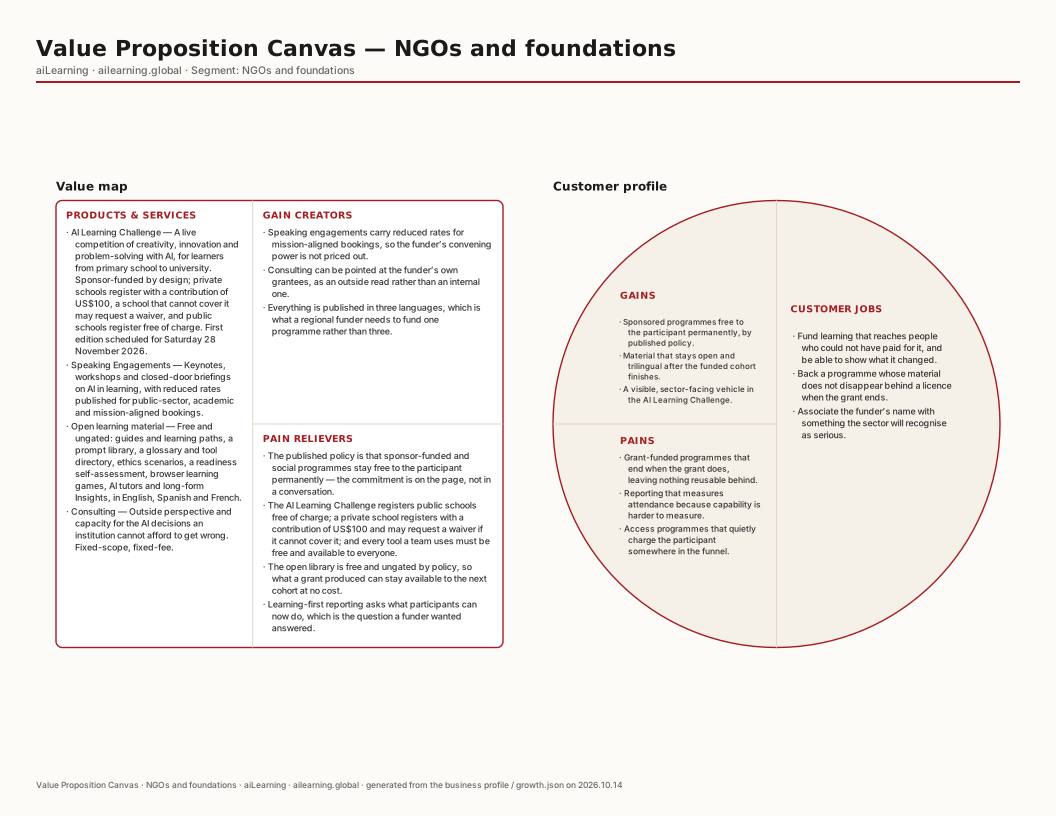
Value Proposition Canvas — NGOs and foundations
- Fund learning that reaches people who could not have paid for it, and be able to show what it changed.
- Back a programme whose material does not disappear behind a licence when the grant ends.
- Associate the funder’s name with something the sector will recognise as serious.
- Grant-funded programmes that end when the grant does, leaving nothing reusable behind.
- Reporting that measures attendance because capability is harder to measure.
- Access programmes that quietly charge the participant somewhere in the funnel.
- Sponsored programmes free to the participant permanently, by published policy.
- Material that stays open and trilingual after the funded cohort finishes.
- A visible, sector-facing vehicle in the AI Learning Challenge.
- AI Learning Challenge
- Speaking Engagements
- Open learning material
- Consulting
- The published policy is that sponsor-funded and social programmes stay free to the participant permanently — the commitment is on the page, not in a conversation.
- The AI Learning Challenge registers public schools free of charge; a private school registers with a contribution of US$100 and may request a waiver if it cannot cover it; and every tool a team uses must be free and available to everyone.
- The open library is free and ungated by policy, so what a grant produced can stay available to the next cohort at no cost.
- Learning-first reporting asks what participants can now do, which is the question a funder wanted answered.
- Speaking engagements carry reduced rates for mission-aligned bookings, so the funder’s convening power is not priced out.
- Consulting can be pointed at the funder’s own grantees, as an outside read rather than an internal one.
- Everything is published in three languages, which is what a regional funder needs to fund one programme rather than three.
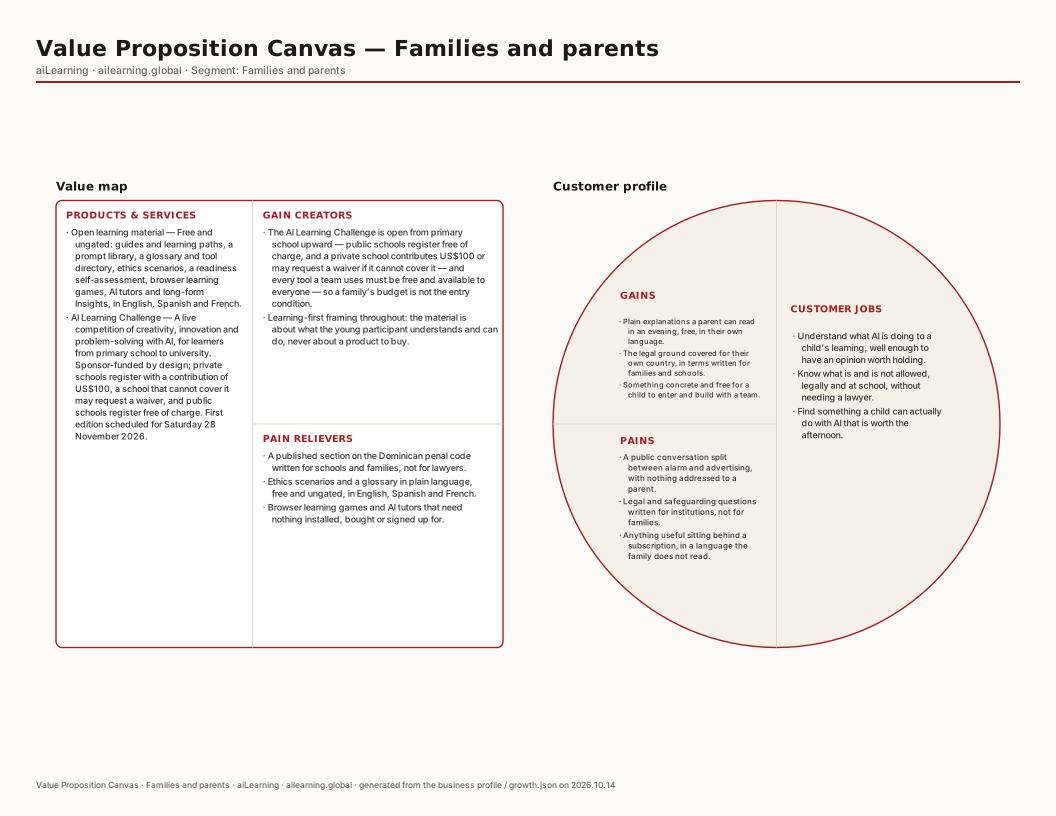
Value Proposition Canvas — Families and parents
- Understand what AI is doing to a child’s learning, well enough to have an opinion worth holding.
- Know what is and is not allowed, legally and at school, without needing a lawyer.
- Find something a child can actually do with AI that is worth the afternoon.
- A public conversation split between alarm and advertising, with nothing addressed to a parent.
- Legal and safeguarding questions written for institutions, not for families.
- Anything useful sitting behind a subscription, in a language the family does not read.
- Plain explanations a parent can read in an evening, free, in their own language.
- The legal ground covered for their own country, in terms written for families and schools.
- Something concrete and free for a child to enter and build with a team.
- Open learning material
- AI Learning Challenge
- A published section on the Dominican penal code written for schools and families, not for lawyers.
- Ethics scenarios and a glossary in plain language, free and ungated, in English, Spanish and French.
- Browser learning games and AI tutors that need nothing installed, bought or signed up for.
- The AI Learning Challenge is open from primary school upward — public schools register free of charge, and a private school contributes US$100 or may request a waiver if it cannot cover it — and every tool a team uses must be free and available to everyone — so a family’s budget is not the entry condition.
- Learning-first framing throughout: the material is about what the young participant understands and can do, never about a product to buy.
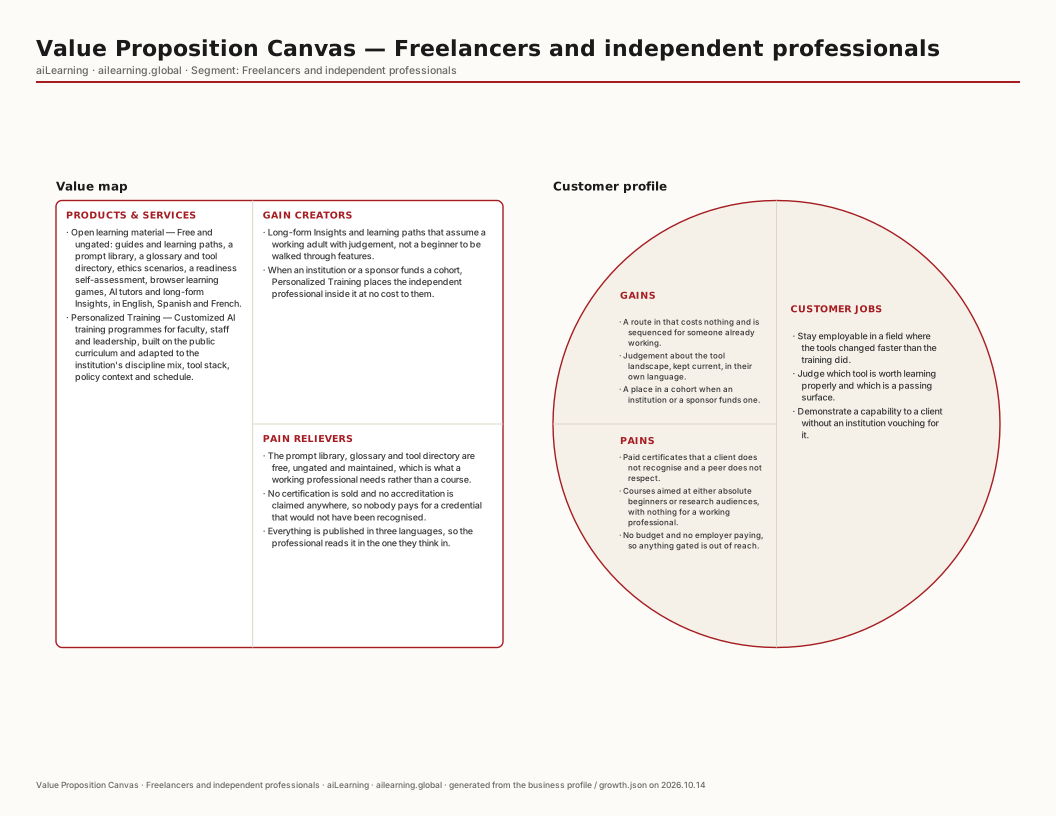
Value Proposition Canvas — Freelancers and independent professionals
- Stay employable in a field where the tools changed faster than the training did.
- Judge which tool is worth learning properly and which is a passing surface.
- Demonstrate a capability to a client without an institution vouching for it.
- Paid certificates that a client does not recognise and a peer does not respect.
- Courses aimed at either absolute beginners or research audiences, with nothing for a working professional.
- No budget and no employer paying, so anything gated is out of reach.
- A route in that costs nothing and is sequenced for someone already working.
- Judgement about the tool landscape, kept current, in their own language.
- A place in a cohort when an institution or a sponsor funds one.
- Open learning material
- Personalized Training
- The prompt library, glossary and tool directory are free, ungated and maintained, which is what a working professional needs rather than a course.
- No certification is sold and no accreditation is claimed anywhere, so nobody pays for a credential that would not have been recognised.
- Everything is published in three languages, so the professional reads it in the one they think in.
- Long-form Insights and learning paths that assume a working adult with judgement, not a beginner to be walked through features.
- When an institution or a sponsor funds a cohort, Personalized Training places the independent professional inside it at no cost to them.
Smoother Experiences — experiences.ailearning.global
The learning platform: the white-label academy, the catalogue, the sponsored and public-sector programmes, the AI Learning Designer and the public catalogue API.
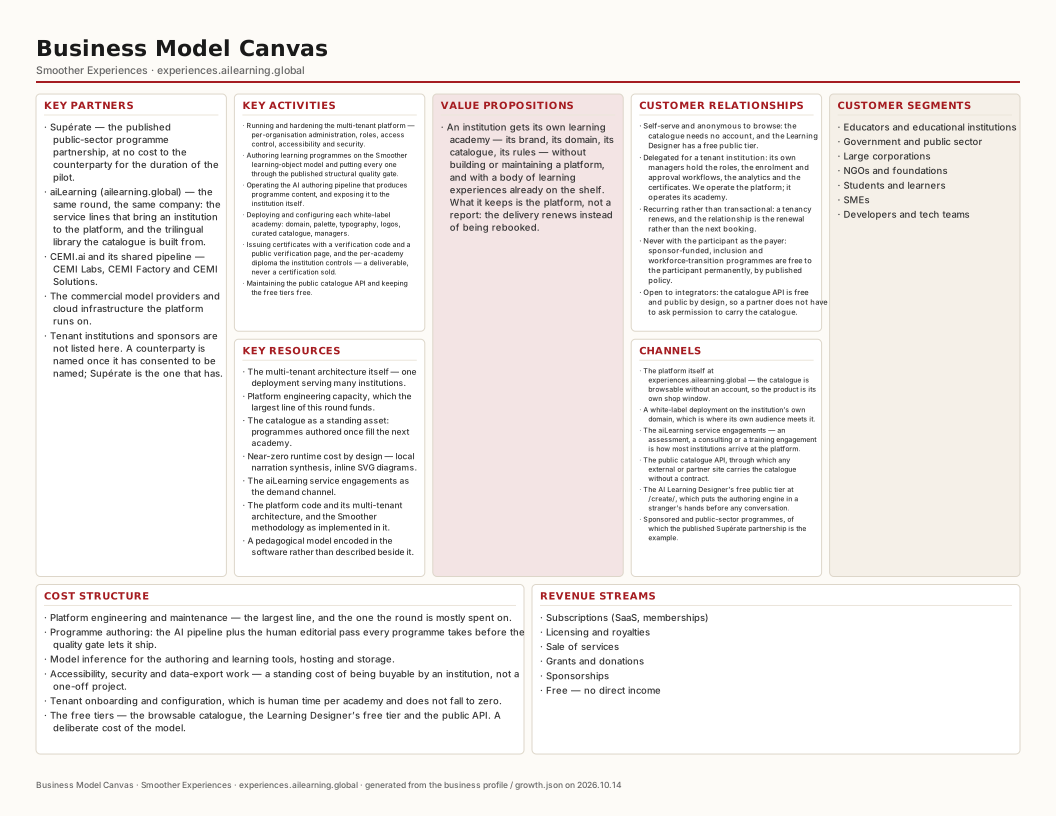
Business Model Canvas
Osterwalder’s nine blocks. Customer segments and revenue streams are the controlled vocabularies the revenue page uses, not free text.
- Supérate — the published public-sector programme partnership, at no cost to the counterparty for the duration of the pilot.
- aiLearning (ailearning.global) — the same round, the same company: the service lines that bring an institution to the platform, and the trilingual library the catalogue is built from.
- CEMI.ai and its shared pipeline — CEMI Labs, CEMI Factory and CEMI Solutions.
- The commercial model providers and cloud infrastructure the platform runs on.
- Tenant institutions and sponsors are not listed here. A counterparty is named once it has consented to be named; Supérate is the one that has.
- Running and hardening the multi-tenant platform — per-organisation administration, roles, access control, accessibility and security.
- Authoring learning programmes on the Smoother learning-object model and putting every one through the published structural quality gate.
- Operating the AI authoring pipeline that produces programme content, and exposing it to the institution itself.
- Deploying and configuring each white-label academy: domain, palette, typography, logos, curated catalogue, managers.
- Issuing certificates with a verification code and a public verification page, and the per-academy diploma the institution controls — a deliverable, never a certification sold.
- Maintaining the public catalogue API and keeping the free tiers free.
- The multi-tenant architecture itself — one deployment serving many institutions.
- Platform engineering capacity, which the largest line of this round funds.
- The catalogue as a standing asset: programmes authored once fill the next academy.
- Near-zero runtime cost by design — local narration synthesis, inline SVG diagrams.
- The aiLearning service engagements as the demand channel.
- The platform code and its multi-tenant architecture, and the Smoother methodology as implemented in it.
- A pedagogical model encoded in the software rather than described beside it.
- An institution gets its own learning academy — its brand, its domain, its catalogue, its rules — without building or maintaining a platform, and with a body of learning experiences already on the shelf. What it keeps is the platform, not a report: the delivery renews instead of being rebooked.
- Self-serve and anonymous to browse: the catalogue needs no account, and the Learning Designer has a free public tier.
- Delegated for a tenant institution: its own managers hold the roles, the enrolment and approval workflows, the analytics and the certificates. We operate the platform; it operates its academy.
- Recurring rather than transactional: a tenancy renews, and the relationship is the renewal rather than the next booking.
- Never with the participant as the payer: sponsor-funded, inclusion and workforce-transition programmes are free to the participant permanently, by published policy.
- Open to integrators: the catalogue API is free and public by design, so a partner does not have to ask permission to carry the catalogue.
- The platform itself at experiences.ailearning.global — the catalogue is browsable without an account, so the product is its own shop window.
- A white-label deployment on the institution’s own domain, which is where its own audience meets it.
- The aiLearning service engagements — an assessment, a consulting or a training engagement is how most institutions arrive at the platform.
- The public catalogue API, through which any external or partner site carries the catalogue without a contract.
- The AI Learning Designer’s free public tier at /create/, which puts the authoring engine in a stranger’s hands before any conversation.
- Sponsored and public-sector programmes, of which the published Supérate partnership is the example.
- Educators and educational institutions
- Government and public sector
- Large corporations
- NGOs and foundations
- Students and learners
- SMEs
- Developers and tech teams
- Platform engineering and maintenance — the largest line, and the one the round is mostly spent on.
- Programme authoring: the AI pipeline plus the human editorial pass every programme takes before the quality gate lets it ship.
- Model inference for the authoring and learning tools, hosting and storage.
- Accessibility, security and data-export work — a standing cost of being buyable by an institution, not a one-off project.
- Tenant onboarding and configuration, which is human time per academy and does not fall to zero.
- The free tiers — the browsable catalogue, the Learning Designer’s free tier and the public API. A deliberate cost of the model.
- Subscriptions (SaaS, memberships)
- Licensing and royalties
- Sale of services
- Grants and donations
- Sponsorships
- Free — no direct income
Lean Canvas
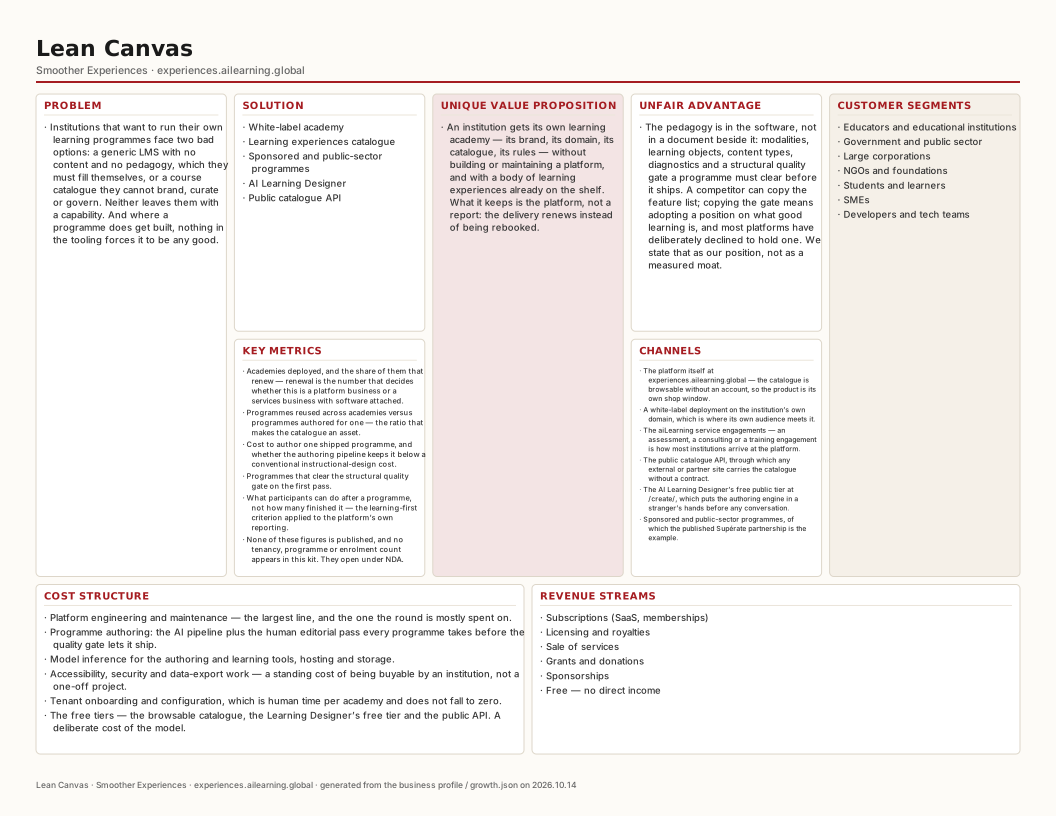
Maurya’s nine blocks. The unfair advantage is stated as a position held, never as a measured moat.
- Institutions that want to run their own learning programmes face two bad options: a generic LMS with no content and no pedagogy, which they must fill themselves, or a course catalogue they cannot brand, curate or govern. Neither leaves them with a capability. And where a programme does get built, nothing in the tooling forces it to be any good.
- White-label academy
- Learning experiences catalogue
- Sponsored and public-sector programmes
- AI Learning Designer
- Public catalogue API
- An institution gets its own learning academy — its brand, its domain, its catalogue, its rules — without building or maintaining a platform, and with a body of learning experiences already on the shelf. What it keeps is the platform, not a report: the delivery renews instead of being rebooked.
- The pedagogy is in the software, not in a document beside it: modalities, learning objects, content types, diagnostics and a structural quality gate a programme must clear before it ships. A competitor can copy the feature list; copying the gate means adopting a position on what good learning is, and most platforms have deliberately declined to hold one. We state that as our position, not as a measured moat.
- Educators and educational institutions
- Government and public sector
- Large corporations
- NGOs and foundations
- Students and learners
- SMEs
- Developers and tech teams
- Academies deployed, and the share of them that renew — renewal is the number that decides whether this is a platform business or a services business with software attached.
- Programmes reused across academies versus programmes authored for one — the ratio that makes the catalogue an asset.
- Cost to author one shipped programme, and whether the authoring pipeline keeps it below a conventional instructional-design cost.
- Programmes that clear the structural quality gate on the first pass.
- What participants can do after a programme, not how many finished it — the learning-first criterion applied to the platform’s own reporting.
- None of these figures is published, and no tenancy, programme or enrolment count appears in this kit. They open under NDA.
- The platform itself at experiences.ailearning.global — the catalogue is browsable without an account, so the product is its own shop window.
- A white-label deployment on the institution’s own domain, which is where its own audience meets it.
- The aiLearning service engagements — an assessment, a consulting or a training engagement is how most institutions arrive at the platform.
- The public catalogue API, through which any external or partner site carries the catalogue without a contract.
- The AI Learning Designer’s free public tier at /create/, which puts the authoring engine in a stranger’s hands before any conversation.
- Sponsored and public-sector programmes, of which the published Supérate partnership is the example.
- Platform engineering and maintenance — the largest line, and the one the round is mostly spent on.
- Programme authoring: the AI pipeline plus the human editorial pass every programme takes before the quality gate lets it ship.
- Model inference for the authoring and learning tools, hosting and storage.
- Accessibility, security and data-export work — a standing cost of being buyable by an institution, not a one-off project.
- Tenant onboarding and configuration, which is human time per academy and does not fall to zero.
- The free tiers — the browsable catalogue, the Learning Designer’s free tier and the public API. A deliberate cost of the model.
- Subscriptions (SaaS, memberships)
- Licensing and royalties
- Sale of services
- Grants and donations
- Sponsorships
- Free — no direct income
Value Proposition Canvases
One per segment served — as many canvases as there are segments, and no more. Each pairs the customer profile (jobs, pains, gains) with the value map (products and services, pain relievers, gain creators).
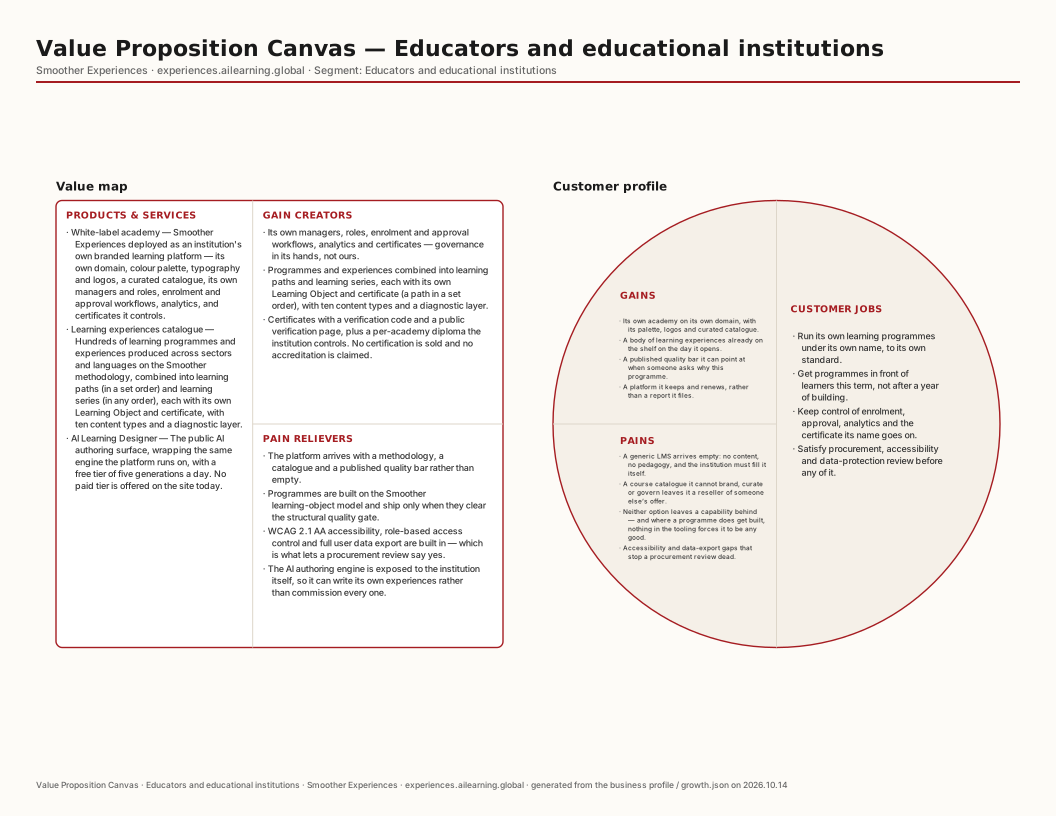
Value Proposition Canvas — Educators and educational institutions
- Run its own learning programmes under its own name, to its own standard.
- Get programmes in front of learners this term, not after a year of building.
- Keep control of enrolment, approval, analytics and the certificate its name goes on.
- Satisfy procurement, accessibility and data-protection review before any of it.
- A generic LMS arrives empty: no content, no pedagogy, and the institution must fill it itself.
- A course catalogue it cannot brand, curate or govern leaves it a reseller of someone else’s offer.
- Neither option leaves a capability behind — and where a programme does get built, nothing in the tooling forces it to be any good.
- Accessibility and data-export gaps that stop a procurement review dead.
- Its own academy on its own domain, with its palette, logos and curated catalogue.
- A body of learning experiences already on the shelf on the day it opens.
- A published quality bar it can point at when someone asks why this programme.
- A platform it keeps and renews, rather than a report it files.
- White-label academy
- Learning experiences catalogue
- AI Learning Designer
- The platform arrives with a methodology, a catalogue and a published quality bar rather than empty.
- Programmes are built on the Smoother learning-object model and ship only when they clear the structural quality gate.
- WCAG 2.1 AA accessibility, role-based access control and full user data export are built in — which is what lets a procurement review say yes.
- The AI authoring engine is exposed to the institution itself, so it can write its own experiences rather than commission every one.
- Its own managers, roles, enrolment and approval workflows, analytics and certificates — governance in its hands, not ours.
- Programmes and experiences combined into learning paths and learning series, each with its own Learning Object and certificate (a path in a set order), with ten content types and a diagnostic layer.
- Certificates with a verification code and a public verification page, plus a per-academy diploma the institution controls. No certification is sold and no accreditation is claimed.
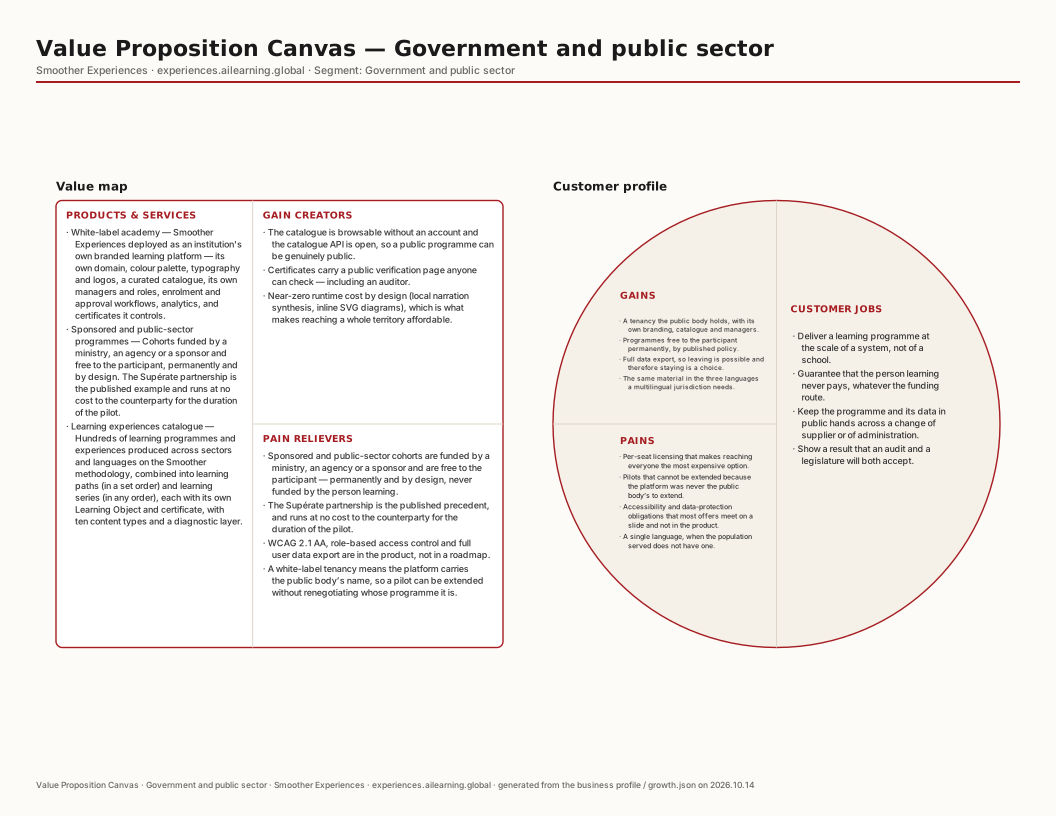
Value Proposition Canvas — Government and public sector
- Deliver a learning programme at the scale of a system, not of a school.
- Guarantee that the person learning never pays, whatever the funding route.
- Keep the programme and its data in public hands across a change of supplier or of administration.
- Show a result that an audit and a legislature will both accept.
- Per-seat licensing that makes reaching everyone the most expensive option.
- Pilots that cannot be extended because the platform was never the public body’s to extend.
- Accessibility and data-protection obligations that most offers meet on a slide and not in the product.
- A single language, when the population served does not have one.
- A tenancy the public body holds, with its own branding, catalogue and managers.
- Programmes free to the participant permanently, by published policy.
- Full data export, so leaving is possible and therefore staying is a choice.
- The same material in the three languages a multilingual jurisdiction needs.
- White-label academy
- Sponsored and public-sector programmes
- Learning experiences catalogue
- Sponsored and public-sector cohorts are funded by a ministry, an agency or a sponsor and are free to the participant — permanently and by design, never funded by the person learning.
- The Supérate partnership is the published precedent, and runs at no cost to the counterparty for the duration of the pilot.
- WCAG 2.1 AA, role-based access control and full user data export are in the product, not in a roadmap.
- A white-label tenancy means the platform carries the public body’s name, so a pilot can be extended without renegotiating whose programme it is.
- The catalogue is browsable without an account and the catalogue API is open, so a public programme can be genuinely public.
- Certificates carry a public verification page anyone can check — including an auditor.
- Near-zero runtime cost by design (local narration synthesis, inline SVG diagrams), which is what makes reaching a whole territory affordable.
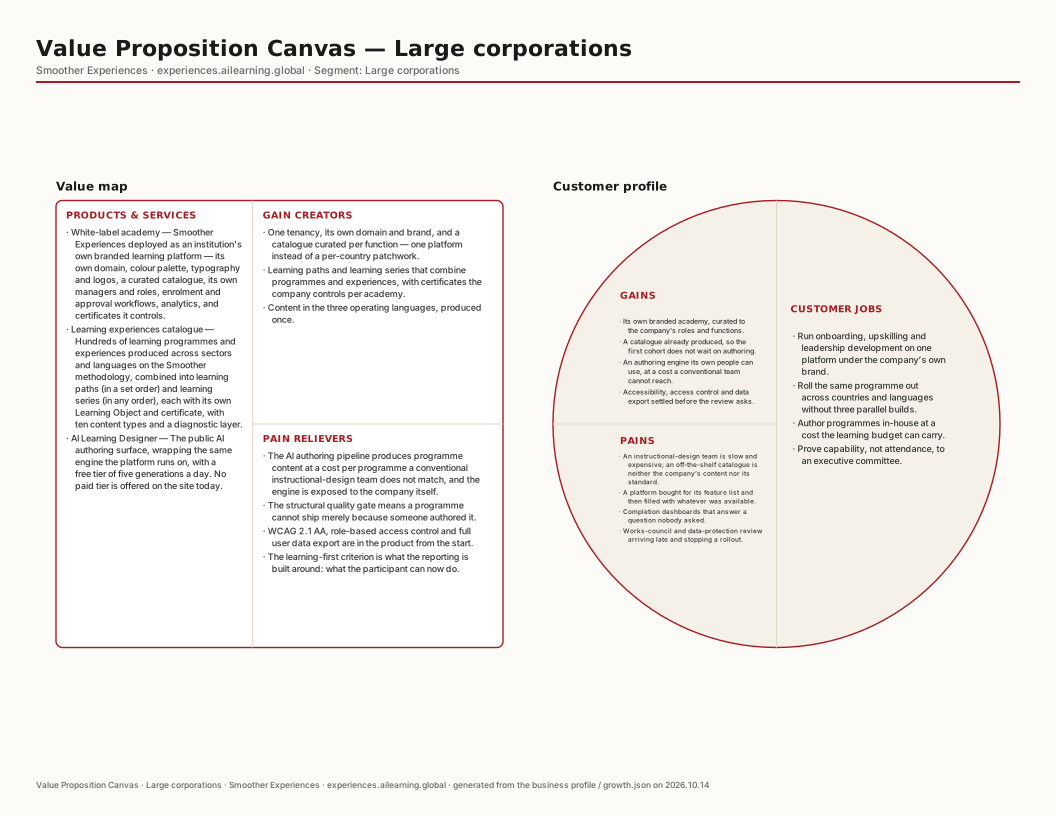
Value Proposition Canvas — Large corporations
- Run onboarding, upskilling and leadership development on one platform under the company’s own brand.
- Roll the same programme out across countries and languages without three parallel builds.
- Author programmes in-house at a cost the learning budget can carry.
- Prove capability, not attendance, to an executive committee.
- An instructional-design team is slow and expensive; an off-the-shelf catalogue is neither the company’s content nor its standard.
- A platform bought for its feature list and then filled with whatever was available.
- Completion dashboards that answer a question nobody asked.
- Works-council and data-protection review arriving late and stopping a rollout.
- Its own branded academy, curated to the company's roles and functions.
- A catalogue already produced, so the first cohort does not wait on authoring.
- An authoring engine its own people can use, at a cost a conventional team cannot reach.
- Accessibility, access control and data export settled before the review asks.
- White-label academy
- Learning experiences catalogue
- AI Learning Designer
- The AI authoring pipeline produces programme content at a cost per programme a conventional instructional-design team does not match, and the engine is exposed to the company itself.
- The structural quality gate means a programme cannot ship merely because someone authored it.
- WCAG 2.1 AA, role-based access control and full user data export are in the product from the start.
- The learning-first criterion is what the reporting is built around: what the participant can now do.
- One tenancy, its own domain and brand, and a catalogue curated per function — one platform instead of a per-country patchwork.
- Learning paths and learning series that combine programmes and experiences, with certificates the company controls per academy.
- Content in the three operating languages, produced once.
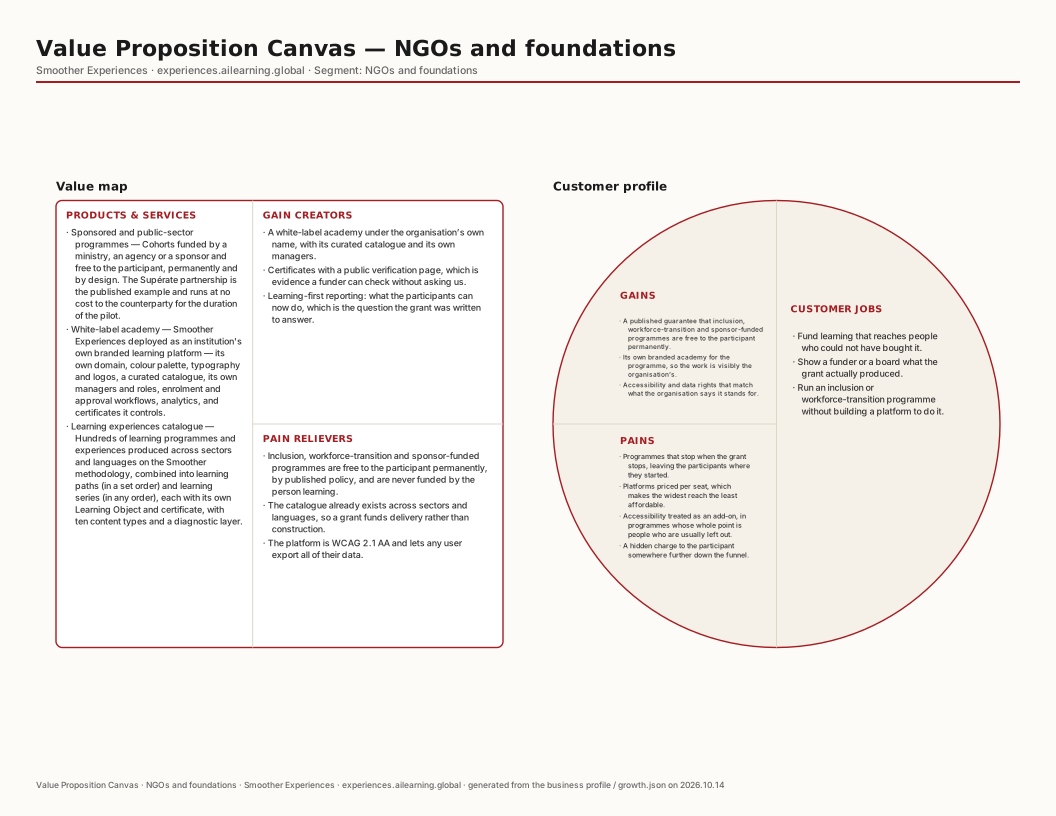
Value Proposition Canvas — NGOs and foundations
- Fund learning that reaches people who could not have bought it.
- Show a funder or a board what the grant actually produced.
- Run an inclusion or workforce-transition programme without building a platform to do it.
- Programmes that stop when the grant stops, leaving the participants where they started.
- Platforms priced per seat, which makes the widest reach the least affordable.
- Accessibility treated as an add-on, in programmes whose whole point is people who are usually left out.
- A hidden charge to the participant somewhere further down the funnel.
- A published guarantee that inclusion, workforce-transition and sponsor-funded programmes are free to the participant permanently.
- Its own branded academy for the programme, so the work is visibly the organisation’s.
- Accessibility and data rights that match what the organisation says it stands for.
- Sponsored and public-sector programmes
- White-label academy
- Learning experiences catalogue
- Inclusion, workforce-transition and sponsor-funded programmes are free to the participant permanently, by published policy, and are never funded by the person learning.
- The catalogue already exists across sectors and languages, so a grant funds delivery rather than construction.
- The platform is WCAG 2.1 AA and lets any user export all of their data.
- A white-label academy under the organisation’s own name, with its curated catalogue and its own managers.
- Certificates with a public verification page, which is evidence a funder can check without asking us.
- Learning-first reporting: what the participants can now do, which is the question the grant was written to answer.
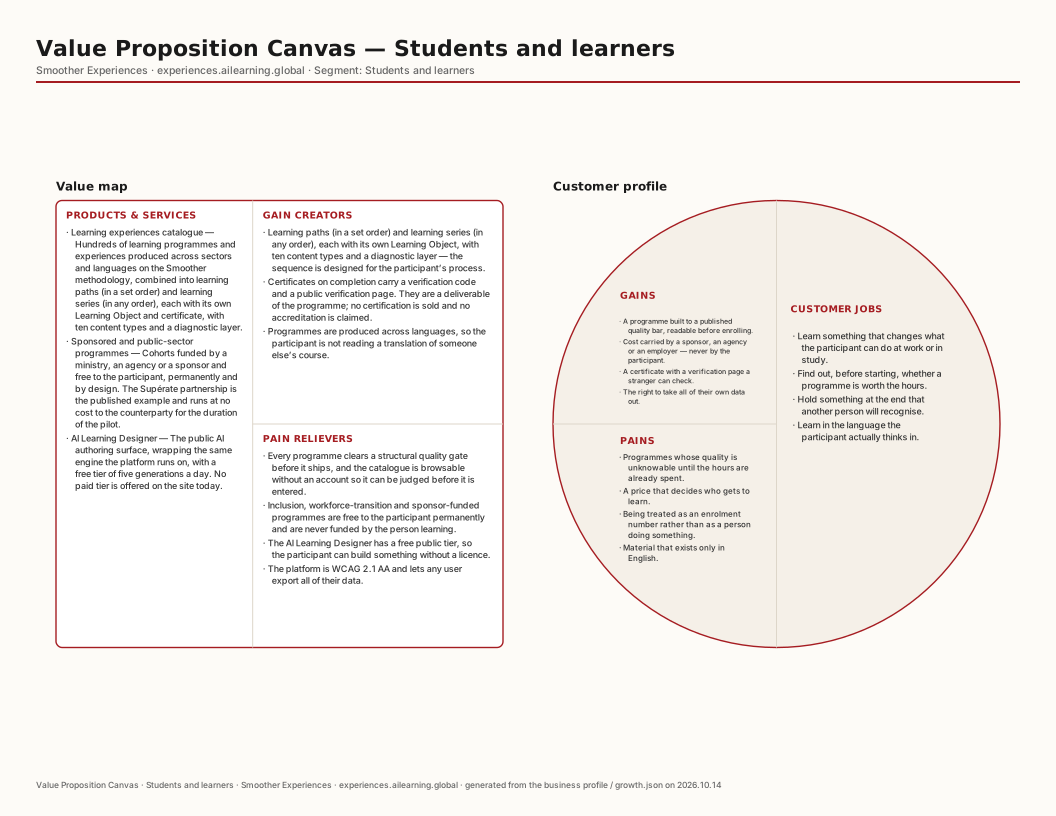
Value Proposition Canvas — Students and learners
- Learn something that changes what the participant can do at work or in study.
- Find out, before starting, whether a programme is worth the hours.
- Hold something at the end that another person will recognise.
- Learn in the language the participant actually thinks in.
- Programmes whose quality is unknowable until the hours are already spent.
- A price that decides who gets to learn.
- Being treated as an enrolment number rather than as a person doing something.
- Material that exists only in English.
- A programme built to a published quality bar, readable before enrolling.
- Cost carried by a sponsor, an agency or an employer — never by the participant.
- A certificate with a verification page a stranger can check.
- The right to take all of their own data out.
- Learning experiences catalogue
- Sponsored and public-sector programmes
- AI Learning Designer
- Every programme clears a structural quality gate before it ships, and the catalogue is browsable without an account so it can be judged before it is entered.
- Inclusion, workforce-transition and sponsor-funded programmes are free to the participant permanently and are never funded by the person learning.
- The AI Learning Designer has a free public tier, so the participant can build something without a licence.
- The platform is WCAG 2.1 AA and lets any user export all of their data.
- Learning paths (in a set order) and learning series (in any order), each with its own Learning Object, with ten content types and a diagnostic layer — the sequence is designed for the participant’s process.
- Certificates on completion carry a verification code and a public verification page. They are a deliverable of the programme; no certification is sold and no accreditation is claimed.
- Programmes are produced across languages, so the participant is not reading a translation of someone else’s course.
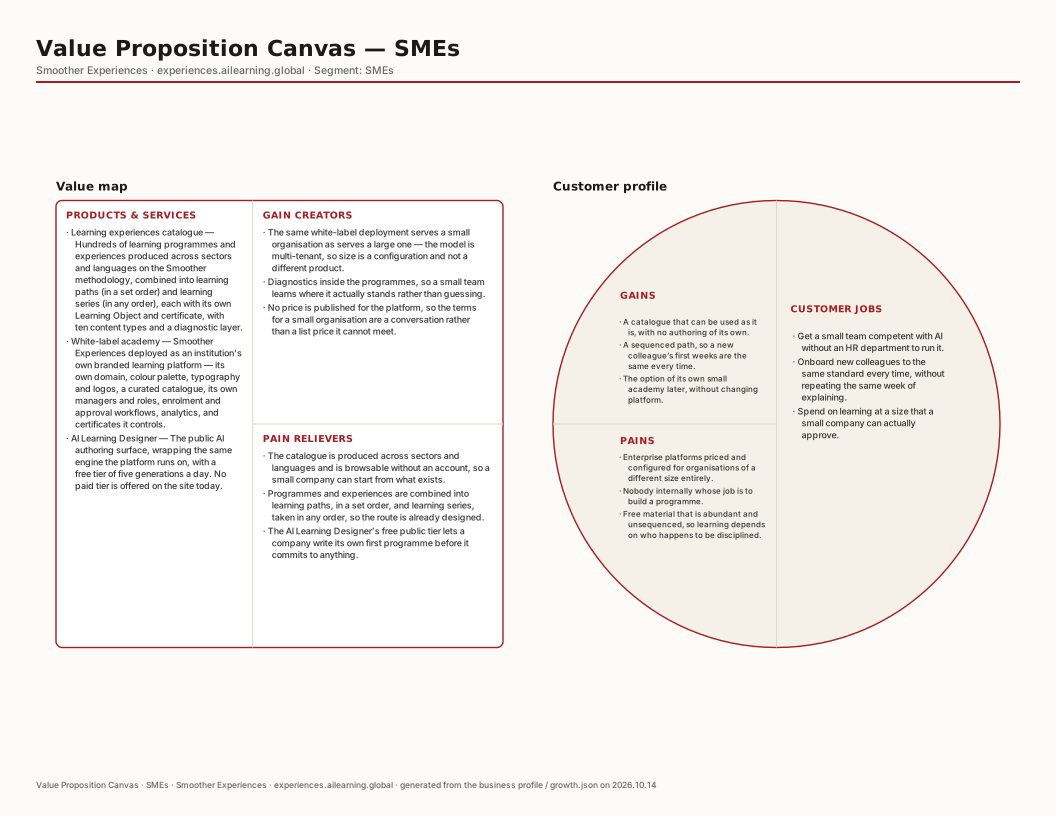
Value Proposition Canvas — SMEs
- Get a small team competent with AI without an HR department to run it.
- Onboard new colleagues to the same standard every time, without repeating the same week of explaining.
- Spend on learning at a size that a small company can actually approve.
- Enterprise platforms priced and configured for organisations of a different size entirely.
- Nobody internally whose job is to build a programme.
- Free material that is abundant and unsequenced, so learning depends on who happens to be disciplined.
- A catalogue that can be used as it is, with no authoring of its own.
- A sequenced path, so a new colleague’s first weeks are the same every time.
- The option of its own small academy later, without changing platform.
- Learning experiences catalogue
- White-label academy
- AI Learning Designer
- The catalogue is produced across sectors and languages and is browsable without an account, so a small company can start from what exists.
- Programmes and experiences are combined into learning paths, in a set order, and learning series, taken in any order, so the route is already designed.
- The AI Learning Designer’s free public tier lets a company write its own first programme before it commits to anything.
- The same white-label deployment serves a small organisation as serves a large one — the model is multi-tenant, so size is a configuration and not a different product.
- Diagnostics inside the programmes, so a small team learns where it actually stands rather than guessing.
- No price is published for the platform, so the terms for a small organisation are a conversation rather than a list price it cannot meet.
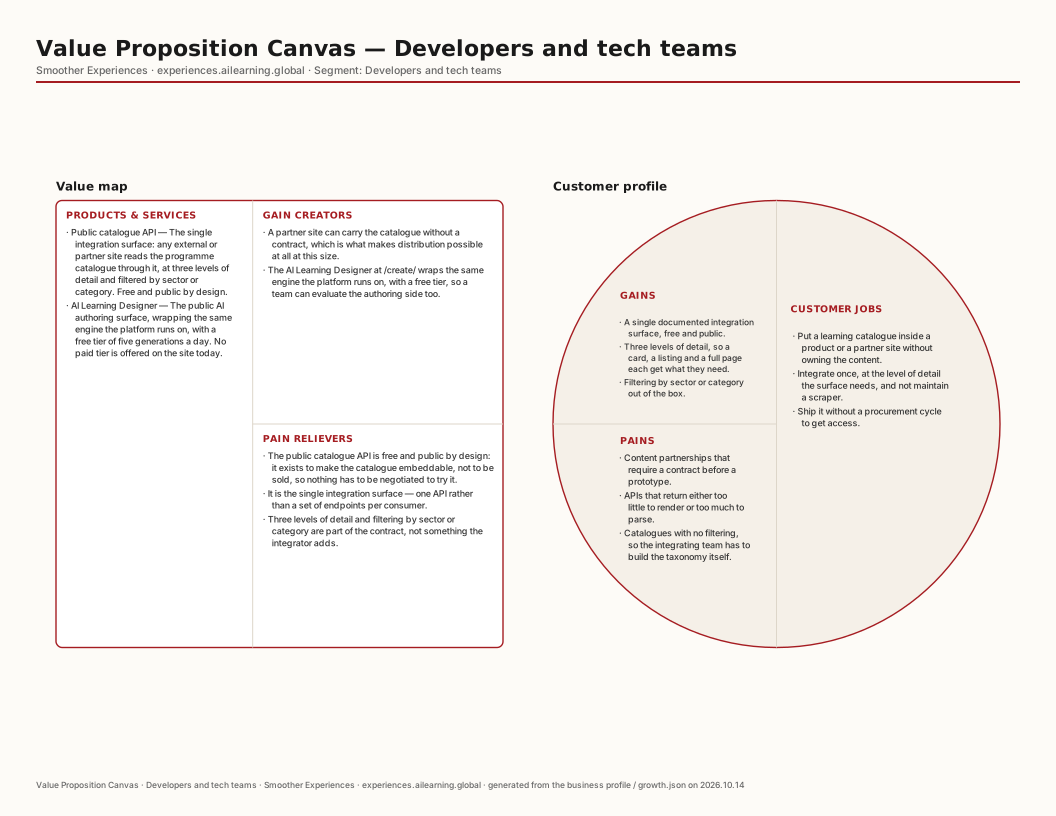
Value Proposition Canvas — Developers and tech teams
- Put a learning catalogue inside a product or a partner site without owning the content.
- Integrate once, at the level of detail the surface needs, and not maintain a scraper.
- Ship it without a procurement cycle to get access.
- Content partnerships that require a contract before a prototype.
- APIs that return either too little to render or too much to parse.
- Catalogues with no filtering, so the integrating team has to build the taxonomy itself.
- A single documented integration surface, free and public.
- Three levels of detail, so a card, a listing and a full page each get what they need.
- Filtering by sector or category out of the box.
- Public catalogue API
- AI Learning Designer
- The public catalogue API is free and public by design: it exists to make the catalogue embeddable, not to be sold, so nothing has to be negotiated to try it.
- It is the single integration surface — one API rather than a set of endpoints per consumer.
- Three levels of detail and filtering by sector or category are part of the contract, not something the integrator adds.
- A partner site can carry the catalogue without a contract, which is what makes distribution possible at all at this size.
- The AI Learning Designer at /create/ wraps the same engine the platform runs on, with a free tier, so a team can evaluate the authoring side too.
Every revenue stream, its buyer and its published price are set out in full on the revenue-streams page. Revenue streams →


Financial terms, revenue and detailed materials are available on request. Figures describe capacity built and operating today; forward-looking statements are identified as such.