

Unit 32 · The showcase
Week 33 · 45 minutes · 10th and 11th grade · your project, alone or in a group · as we planned it.
What you’ll do
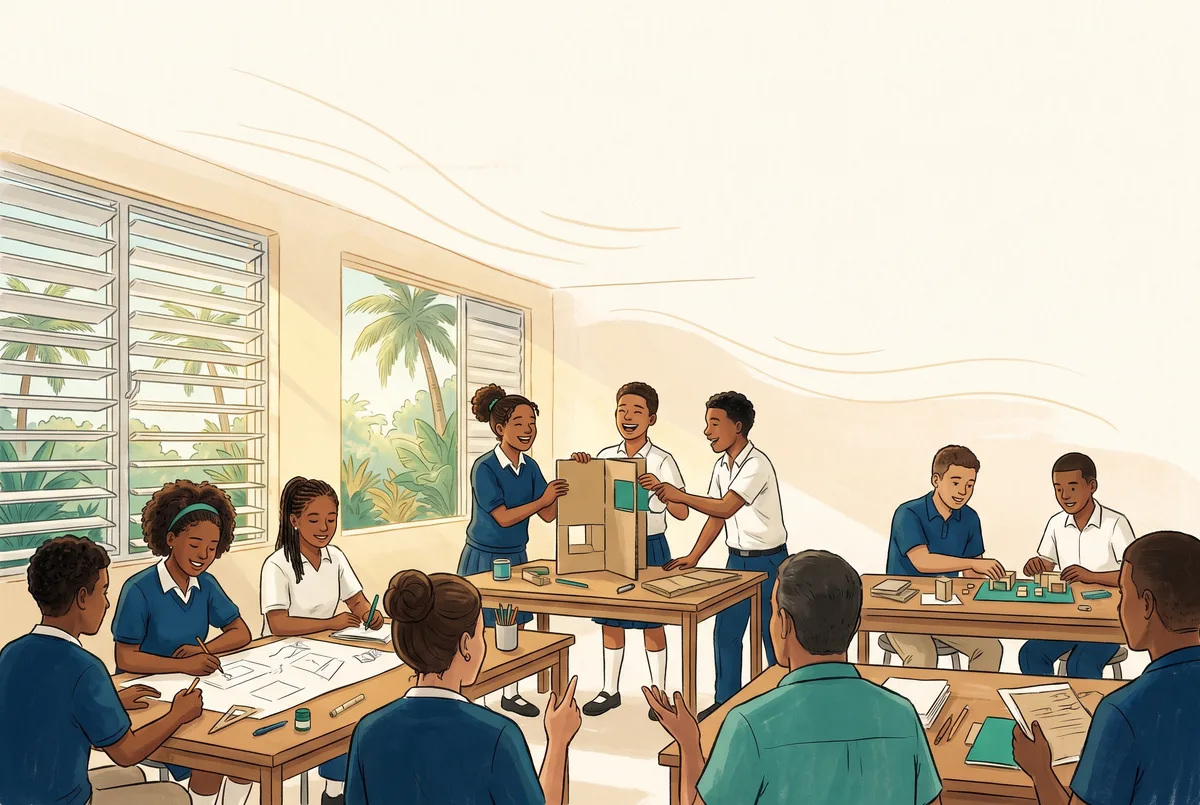
At the start of the year it was said: in June, show what we made to people from outside the classroom. Today is that day. Families, other groups, guests: the school decides the format. Your project has its station, with its sign, its process piece next to it and its journey: where it came from, how it changed and what exists today. A song is heard, a game is played in short turns, a tool is used as a demonstration —without collecting anyone’s data—, a story is read, an explanation is told.
If your project was published with consent, your sign carries its address, and visitors can open it on their own phone. If your repository has consent to be shown, your station shows its history: the first commit, what it learned to remember, the day it was published; it’s the evidence of who decided what. If your project wasn’t published, it’s shown just the same, on the program’s device or on paper, with the same place.
If your project doesn’t leave the room, you help at another station in the role you choose, or you welcome people as they arrive. Nobody comments on it.
Why it’s worth it
All year you worked for a room that already knew you. Today people who don’t are looking at you. Showing what you made, saying what’s yours and what the machine made, and holding up under a hard question is exactly what no tool can do for you.
How the session goes
- Anticipate. Before anyone comes in, with just your group: you recall the rehearsal criteria, check your station —that it works, that its address opens if it was published, that it makes sense heard too, and that it collects no personal data— and write what you think you’ll be asked.
- Act. The showcase, in turns of about eight minutes. At each sound cue, visitors move to another station and, if your team agreed to it, roles rotate: whoever spoke takes a rest.
- Reflect. After a minute of silence, again with just your group: did what you anticipated come out? Which questions came and which didn’t. Did anyone ask what the AI decided and what you decided? Two lines: what you said was yours, and the question that helped you most. And on your card, the June milestone line: what mattered most to the people from outside.
No screens. The last ten minutes, with just your group, happen with no phone, no computer and no AI: you discuss what happened, write or dictate your lines and decide what happens next with what you showed: what stays published, what stays in the room or on paper, and what is taken down.
What’s taken care of
- Only pieces with your family’s written consent, piece by piece, checked the day before, are shown; the same goes for every public address and every repository.
- No full names next to any piece: the project’s name and your group are enough.
- Photos or video of participants, only with consent.
- If you, someone on your team or your family asks to withdraw a piece that same day, it’s withdrawn; if it was published, it’s unpublished that same day. No explanation.
- Whoever doesn’t want to be at a station, isn’t.
If your project is without AI, it has its station with the same place. If it’s digital, it shows its address and its repository just the same; if it’s physical, your portfolio or archive is the proof of who decided what. Visitors can tell what’s yours and which technique you used, and in the reflection the question for you is: what did you decide, and why?
The criteria, as questions
- C1. Can your visitor tell what’s yours and what the machine made?
- C2. Did you answer, or say “I don’t know” with a next step?
- C3. Does everything you showed have permission and no full name?
Nobody wins prizes today. The showcase has no planted surprises: the real audience is enough.
If you want to look again at where you started from, your references are in the library.