

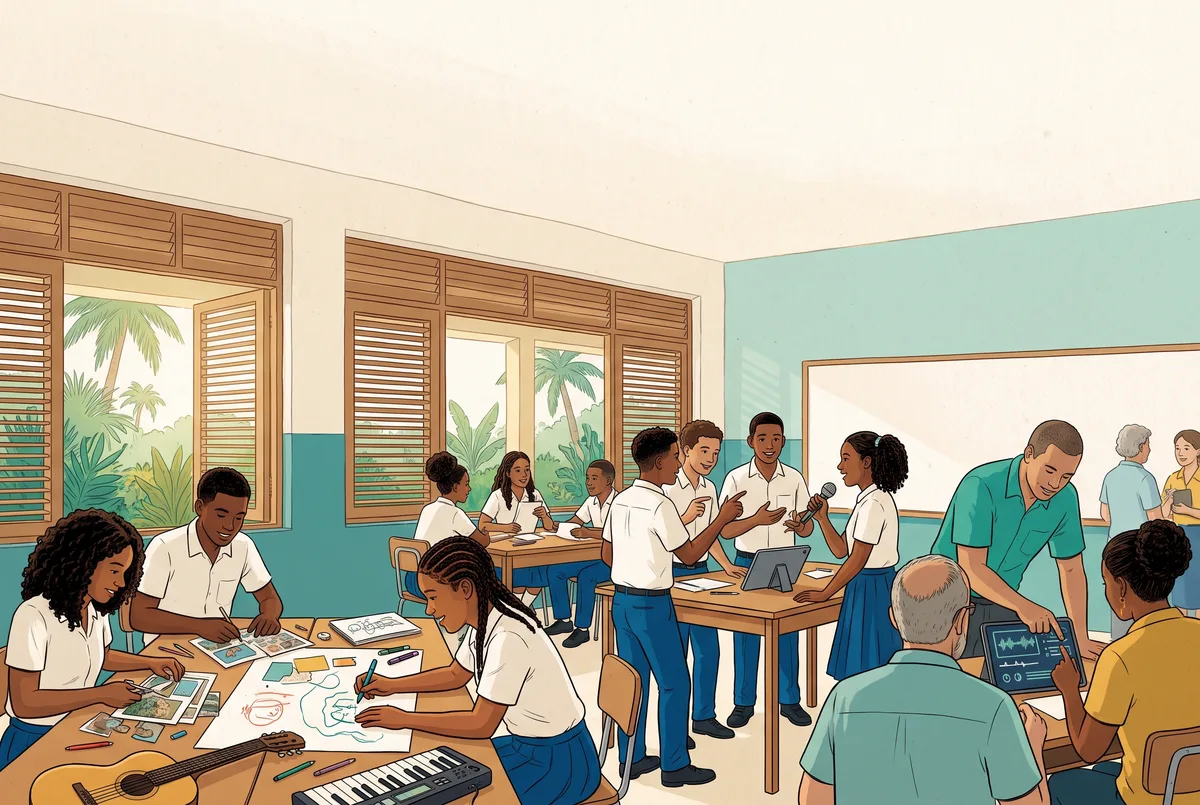
Unit 10 · The edit
Week 11 of the program · 45 minutes · 10th and 11th grade · every project, alone or in a group.
What you’re going to do
You open your project’s folder and find everything you’ve made since September: your words, what you corrected from the machine, your voice, your answer to the question AI can’t close. Today you put together your project’s first version, the November one: a song with your voice, a podcast, a short video, your app’s first screen with its text and its voice, your game’s rules with their instructions read out, an illustrated page.
Your first version can’t be put together in the room? Then you make your project’s 60-second trailer: your voice, two or three of your lines and hand drawings in sequence.
Why it’s worth it
Making is half of it. The other half is editing: looking at what you made and deciding what’s too much. That’s what separates a project from a pile of things stuck together.
How the session goes
- First, no screens. The first ten minutes, with no phone, no computer and no AI, before you open your folder: you recall, think and write your editing plan on paper. That’s where you decide what you’ll do with technology and how: what goes in, what you reuse before generating, how many generations you spend, what the tool will do, what you do and what you decide.
- Anticipate. You see a 20-second ad made in two attempts, described aloud, and where the visual failed. You write your plan and how long you think it will run. The budget goes on the board, and before any image you check out loud: no real faces, no names, not the school.
- Act. Editing in turns, table by table. While you wait, you work on paper. One project edits without a machine: voices, clapping and drawings.
- Reflect. Listening against the criteria. Something is going to change halfway through, and at the end each project gives the reason for one cut. “What did the AI decide here that a person should have decided?” On your card, the full credits.
If your project is without AI
You don’t make the short trailer: you build your full first version with your techniques —an audio editor without AI, instruments, voices and clapping, hand drawings in sequence, your screen or your rulebook on paper, an object—, in the same time and without waiting for a turn in the queue. Instead of generations, you set your materials and time budget. You go through the same envelope, the same cut and the same listening. The question for you is: what did you decide, and why?
The criteria, as questions
- C1. Can you tell what your project is about and who it’s for, without explaining it?
- C2. Is the detail only you knew still there? (11th: is the reason still there?)
- C3. Does every cut have a reason you can say?
What you decide
At most two generations per project, and the lightest one that does the job: reuse what you already have before generating again; image before video; video only if your project is a video. What stays and what goes is your decision. And the craft you practice today —choosing what stays— belongs to the people who edit.
For inspiration
- The ad that doesn’t lie
- Your lyrics, your rhythm
- The invincible hero waits in line
- Build your visual’s instruction with the library assistant.
Careful
Your voices are mixed with an editor that has no AI and are never uploaded to a machine. No visual carries a real person’s face. Nothing leaves the room or gets published without written permission for that piece, piece by piece. Everything is kept in your project’s folder and its private repository; your recorded voices stay on the class device.
If you haven’t lived this Unit yet, don’t open it.
Reveal this Unit's perturbation
Halfway through the session an envelope is opened: your first version has to fit in half —half the time, the screens, the rules or the words—. Eight minutes to decide what stays, first on paper, then by cutting. The cut generates nothing new. Your long version is saved first: it isn’t lost. And if your team gets stuck, it carries on with the full version.
This is a plan: the Unit hasn’t run yet.