

Unit 09 · The question AI can’t close (1)
Week 10 of the program · 45 minutes · 10th and 11th grade · every project, alone or in a group.
What you’re going to do
Some questions close: “when was… founded?”. And some don’t: “what would this neighborhood lose if…?”. This Unit is for everyone, and the question is about your project:
- 10th: from the place where your project lives.
- 11th: from the opinion your project stands for.
- Anyone: from the people it’s for: “what does the person who’ll use this really need?”.
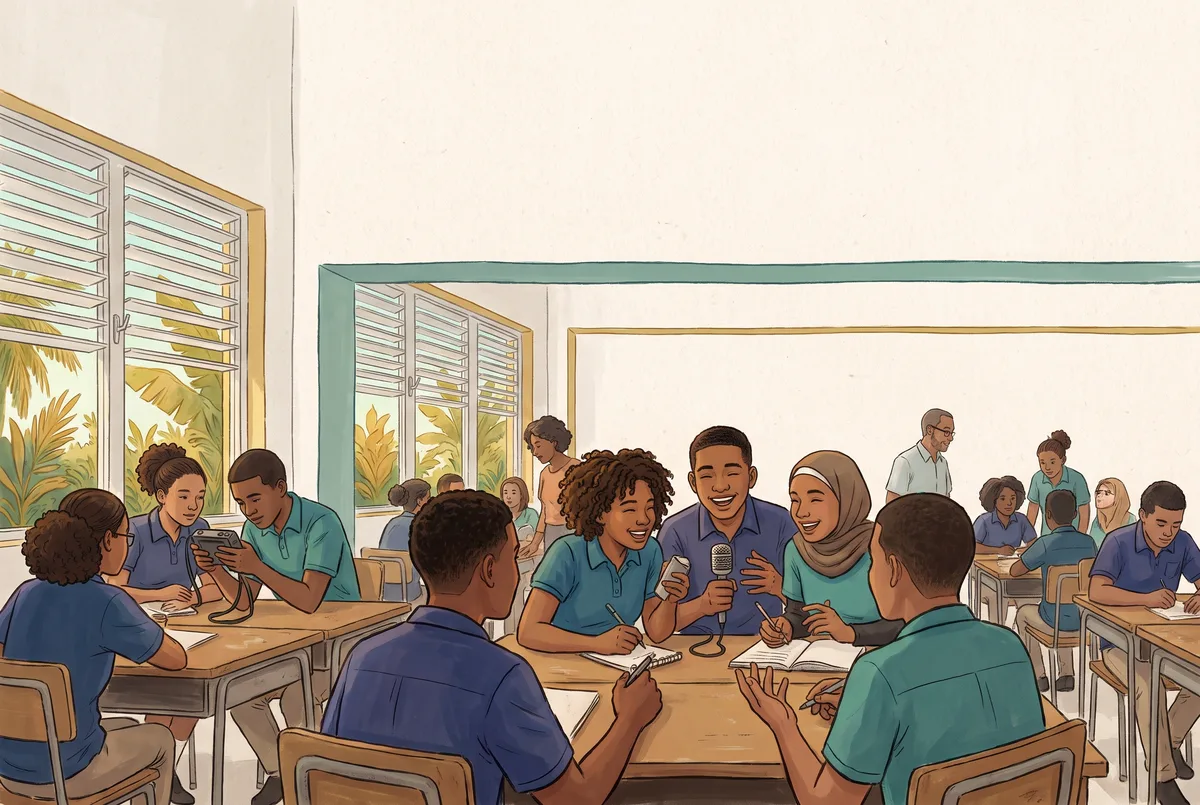
You ask the machine, note why its answer falls short and answer it yourself, in a short 60- to 90-second podcast. If your project doesn’t have an open question yet, you use your table’s: one about the school or the neighborhood, with no one’s data.
Why it’s worth it
Asking a machine to improve an answer is one thing. Asking a deeper question is another. Anyone can do the first; the second is the one that changes your project.
How the session goes
- Anticipate. An example of a question that closes and one that doesn’t, read aloud. You write three questions about your project, pick the one you think the machine can’t close, and anticipate what it will answer. Before asking, you check out loud that it carries no names and no one’s situation.
- Act. Your question and one follow-up, in turns. The answer is read aloud.
- Reflect. Why does it fall short? Is it missing a fact that only exists here, a value that a person decides, or did it answer a different question? You write your podcast: the machine is asked, you answer. “What did the AI decide here that a person should have decided?” And on your card: what from your answer goes into your November version.
- No screens. From the example until your question is chosen, nobody uses a phone, a computer or AI. That’s where you decide the one question that goes to the machine, whether a follow-up will be needed and which part of the answer will always be yours.
If your project is without AI
You do the same interview, with the same time and the same criteria, with a source you choose: a person from another table, a book, an archive. You anticipate what it will answer, ask your question and one follow-up, and look at the answer with the same lens: is it missing a fact, a value, or did it answer another question? In your podcast, the source answers and then you answer. In the listening, the question for you is: what did you decide, and why?
The criteria, as questions
- C1. Is your question about your project, and not about “neighborhoods” or “projects” in general? (11th: does it come from what your project stands for?)
- C2. Did you write down why the machine’s answer falls short?
- C3. Does your answer add something the machine didn’t have, and does it go into your project? (11th: does it hold up against someone who thinks the opposite?)
What you decide
Two generations per project: the question and one follow-up, text only, counted on the board. If the first answer already shows why it falls short, the follow-up isn’t asked. The question and the answer are yours; the machine only responds.
For inspiration
This Unit has no example in the library: the question is yours. If you want to practice first, try the library assistant and see where it falls short.
Careful
No personal data and no situations of anyone who could be recognized. If your question is very personal, the person guiding the session helps you make it general before it goes into the machine. Only people with the signed sheet record their voice, and no voice is uploaded to the tool.
This is a plan: the Unit hasn’t run yet.