
Unit 00 · What you already do with AI, and what you don’t yet
First session · 45 minutes · 10th and 11th grade · a conversation, almost no screens.
What you’ll do
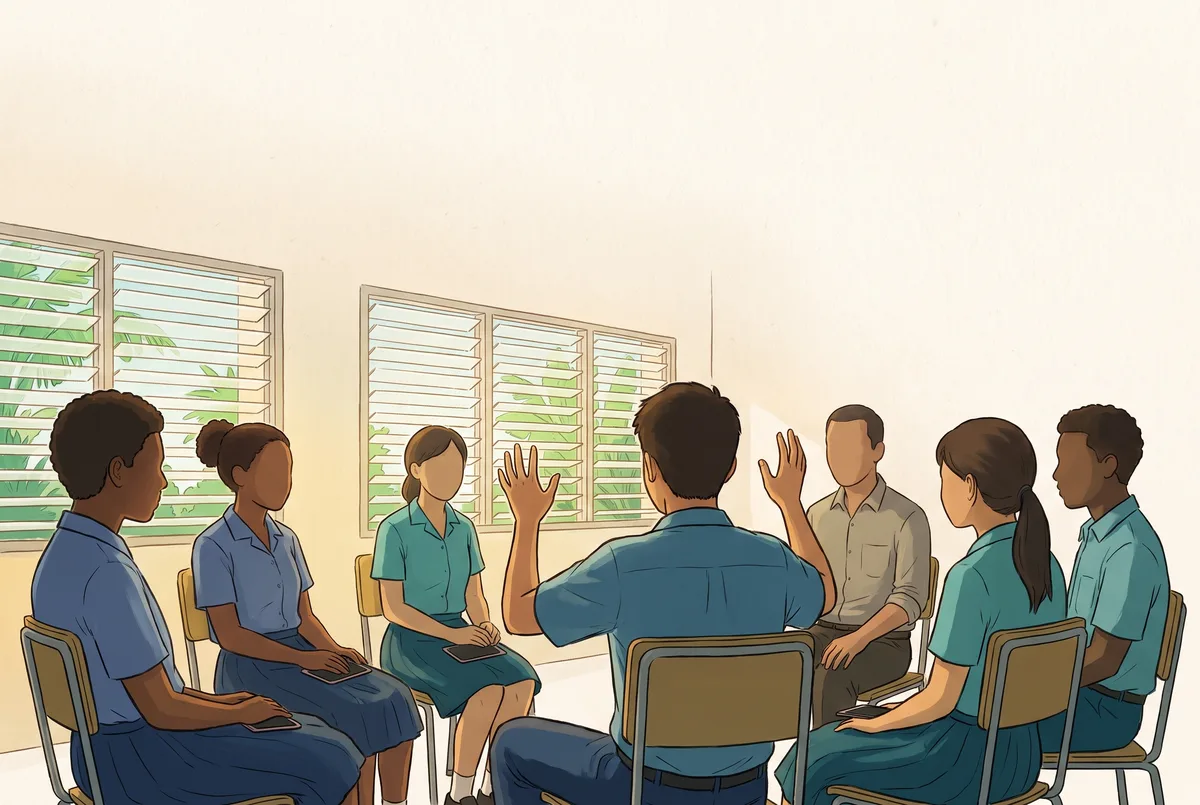
A conversation, not a class. With your group you answer one question, out loud, and what is said goes on a list that belongs to the group, not to the person facilitating:
- 10th grade: what bothers you about AI?
- 11th grade: what do you use it for today?
Then, on paper, you place each answer on a two-column board, and you take away one line of your own. Nobody generates anything with AI today, and nothing is graded.
Want to see what other groups answered? It is behind the «What other groups answered» button above. This Unit stays blank so you can answer it yourself.
Why it’s worth it
Someone is almost always telling you what to do with AI: use it, don’t use it, be careful with it. Today it’s the other way round: first we hear what you think and what you do. That is where the year starts.
And if AI seems too easy to you, if it doesn’t make you think, say so. It isn’t a small complaint: it’s one of the most important questions you can bring.
How the session goes
1. Your question, no screens
Phone away, computer closed, no AI. You answer your group’s question and discuss it. Everything counts: what you don’t like, what worries you, what seems unfair or too easy; or how you really use it, no polish, for homework, to create, for anything. There are no right answers. Everything is said out loud, and you can write or dictate.
2. The two columns, on paper
Still with no screens, a two-column board is drawn. On the left, faster or easier: the same old thing, in less time. On the right, more, better, beyond: something that was out of your reach. Each answer on the list goes into one of the two, and where it landed, and why, is said out loud.
3. Your line for the right-hand column
You write or dictate one thing from your list that you’d like to take to the right-hand column: something you do faster or more easily today and would like to do more, better or beyond. Just one line. It’s yours, and it comes back later.
4. What is shown
Now, a screen. So the right-hand column doesn’t stay abstract, the Learning Facilitator shows work of their own made with generative artificial intelligence: music, video, games and apps, and a learning sample, for studying with AI without it handing you the answers. Not to be admired, but as proof that the right-hand column exists, and that the person standing in front of you makes it. Each piece is described out loud while it’s shown. Each one opens right here, full size: explore it at your own pace.
5. Before you go
One line, out loud or on your sheet: «What surprised me most about the board was…».
What stays open
What each group answers usually fits, almost whole, in the left-hand column. The right-hand one can be filled in two ways: by making something that didn’t exist, or by learning more and better what you already study. Or both.
If you haven’t lived this Unit yet, don’t open what follows.
Reveal where each list ended up
The criteria, as questions
- C1. Did you say what you really think or do, and not what people expect to hear?
- C2. Did you put each answer in one of the two columns, with a reason?
- C3. Does your line for the right-hand column name something concrete from your list?
If you don’t use AI, or don’t want to
Your answer counts just the same. In 11th grade, «I don’t use it» is an answer, and so is why. In 10th grade, what bothers you may be exactly your reason not to use it. Your line for the right-hand column can be something you’d like to do more, better or beyond without AI, or a question about AI. Nobody uses AI today, so the session is the same for everyone.
Careful
What you say doesn’t carry your name. You don’t need to share anything personal, about you or anyone else, to answer: what you do and what you think are enough.
What this is, and what it isn’t
The first time it ran, on 2026-09-16, this session was improvised. What those groups answered is behind the button above: it’s what they thought, not proof of any effect. The Unit’s design is a design position, authored by Carlos Miranda Levy, not a research finding. Nothing is graded, no account is created in anyone’s name, no piece is generated, and nothing you say carries your name.
Facilitating this Unit? For the Learning Facilitator (in Spanish) →