

Unit 33 · What didn’t exist in September
Week 34 · 45 minutes · 10th and 11th grade · your project, alone or in a group · without AI · as we planned it.
What you’ll do
The first Unit was called “What didn’t exist last month.” This one answers it. What didn’t exist in September is your project and what you can do now.
Today you go through your project from end to end, with your card in hand: the three possible projects from Unit 01, the one you chose in Unit 02 and what each perturbation did to it, and its milestones —November, February, April and June—. And you write, one last time, the two lines everything started with: “My project was…” / “Now it’s…”. It counts just the same if your project changed direction, joined another one, split, took an impossible-project route or was without AI: the journey is what happened, not what was planned. And if you joined the year late, your journey starts where yours started.
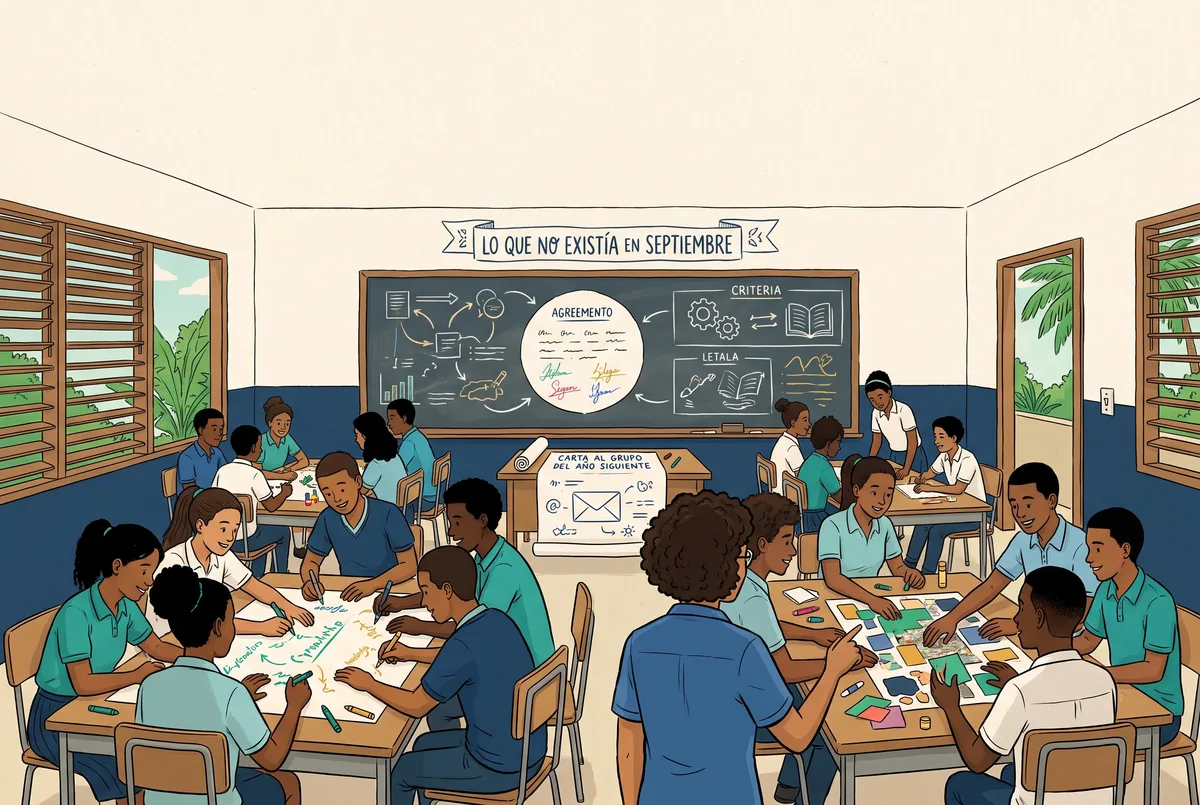
Then the whole year goes onto the board, you sign the room agreement one last time and you write a letter to the group that starts next year. No AI tool is used today: what remains is what you know.
Why it’s worth it
Naming what you can do, with evidence from your own work, is different from feeling that you learned something. And writing to whoever comes after you is the last way to answer for what you made: leaving the path a little clearer for them.
How the session goes
- Anticipate. Without looking at anything: what were the three criteria of Unit 01? You compare them with the photo of that board, described aloud. You write, on your own, what you think you’ll put in the right-hand column.
- Act. You go through your project and write your two lines; in a group, each person names their part and one decision of theirs. Then, standing at the board, each project places its milestones under FASTER / EASIER or under MORE, BETTER, BEYOND, with a reason. The three competencies are named: where you created something, where you reconciled a dilemma, where you answered for something. And the milestone where the machine failed most, and one decision it didn’t take because you took it. Final signing of the agreement. Then the letter, by hand or dictated: what you’d tell whoever chooses their project, what you recommend, what you’d avoid, what you didn’t know.
- Reflect. Aloud: which part of your project changed most since September? And your two final lines, on your card: “what I can do now” and “what I’d do next year”.
No screens. After looking at the photo of the board, the rest of the session happens with no phone, no computer and no AI: you write or dictate, discuss and decide; in the letter and in “what I’d do next year” you also say what you’d do with AI, what without it and what you would always decide yourself.
If your project is without AI, on the year’s board you name the method decision that mattered most to you and the milestone where your technique failed most, and what you did with that.
The criteria, as questions
They’re the three from Unit 01, now looking back:
- C1. Does what exists in June still come from something of yours? Can you point to where yours is?
- C2. Does it define a first step that someone —you, or whoever receives it— can take next week?
- C3. Did someone other than you use it, hear it, play it or see it? What changed because of that?
The letter fits on one page, carries no one’s name, and whoever starts next year could read it without feeling lectured.
If your project stays published, before the year closes your team knows who maintains it and until when; if no one maintains it, it’s unpublished. You or your family can ask for it to be taken down at any time, and it comes down that same day. And if your project has a character, it can remember settings, but it’s never a companion.
Your first step
This week, without asking anyone’s permission: show someone at home one thing you can do now and couldn’t in September. And if you want to keep creating on your own, the library and the assistant for creating stay open.