
Unit 20 · Is it still true?
Opening of the Tool phase · 45 minutes · 10th and 11th grade · for every project · no screens.
What you’ll do
In 2019, an OECD document stated that AI can’t do three things: create new value, reconcile tensions and take responsibility. It isn’t a fact to memorize: it’s a dated statement, and you’re going to put it to the test. You take a position —still true, no longer true, or partly— and back it with a debate script written by hand.
Why it’s worth it
You’ve had your project for half a year, and your card tells the story: week after week you noted what the AI did, what you did and what you decided, the credits for each piece and the trades that would have done that work. That’s evidence, and it’s yours. In 10th grade you’ll connect it to work and trades; in 11th, to what you want to study. And it’s the step just before someone else uses your project.
How the session goes
- Anticipate. The statement is read aloud and stays on the board. You write “What I think we’ll conclude”.
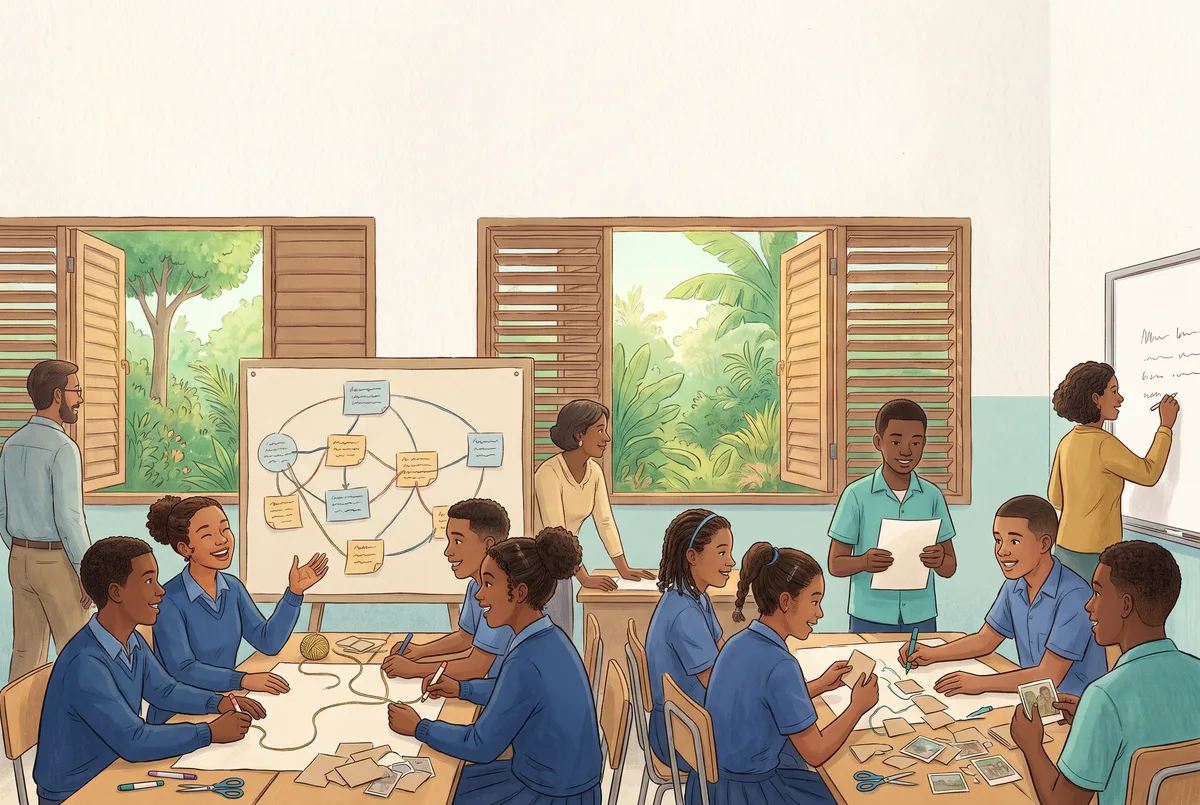
- Act. You open your card and mark three moments in the year when the tool created, reconciled or took charge of something, or didn’t. Then you take a position standing up, in one of three zones of the room, and write your script with your three pieces of evidence.
- Reflect. A debate round, one minute per team. And a question turned around: what did you decide this year that the AI should never have decided? To close, three lines: “what I still think”, “what I now doubt” and “what from now on we won’t hand over to the tool”.
No screens. Today the whole session happens with no phone, no computer and no AI: you think, discuss, write and debate with what’s already on your card. And you decide what you won’t hand over to the tool from now on, when someone else uses your project in April.
The criteria
- C1. Your position is understood without you explaining it.
- C2. Each reason points to something you did or decided in your project, not something you heard.
- C3. It says what’s left for a person: in 10th grade, in a trade; in 11th, in what you want to study.
If your project is without AI, or about AI
It takes part just the same. If your project is without AI, your evidence is first-hand: why you chose not to use it, what your technique made you decide, the trades your own work practised, and three moments when a tool could have come in and you decided to do it yourself. If it’s about AI, your evidence is what you researched. And if your project still has little evidence of its own, you can read the card of another project at your table —with its authors’ permission— and say it’s someone else’s evidence.
This Unit doesn’t use the library or generate anything: the evidence is your own work.
A warning
A perturbation you see coming isn’t one. If you haven’t lived this Unit yet, don’t open it.
Reveal this Unit's perturbation
Halfway through the session an envelope is opened and read aloud: “Now defend the position opposite to the one you just took. With evidence from your own work, not from what people say.”
It’s the same for every project and it isn’t scored. If your team gets stuck, the person guiding the session can lift it and you carry on with your first position.
What this is, and what it isn’t
This Unit’s design is original: a design position, not a research finding. The 2019 statement is presented as a claim to put to the test, not as a fact of today. Nothing is graded. We talk about trades, never about the job of someone in your family, and whoever doesn’t want to speak in the round doesn’t speak.