
Unit 04 · The rules of this room
Week 5 of the program · 45 minutes · 10th and 11th grade · every project, alone or in a group · no screens.
What you’re going to do
Three things, all by hand:
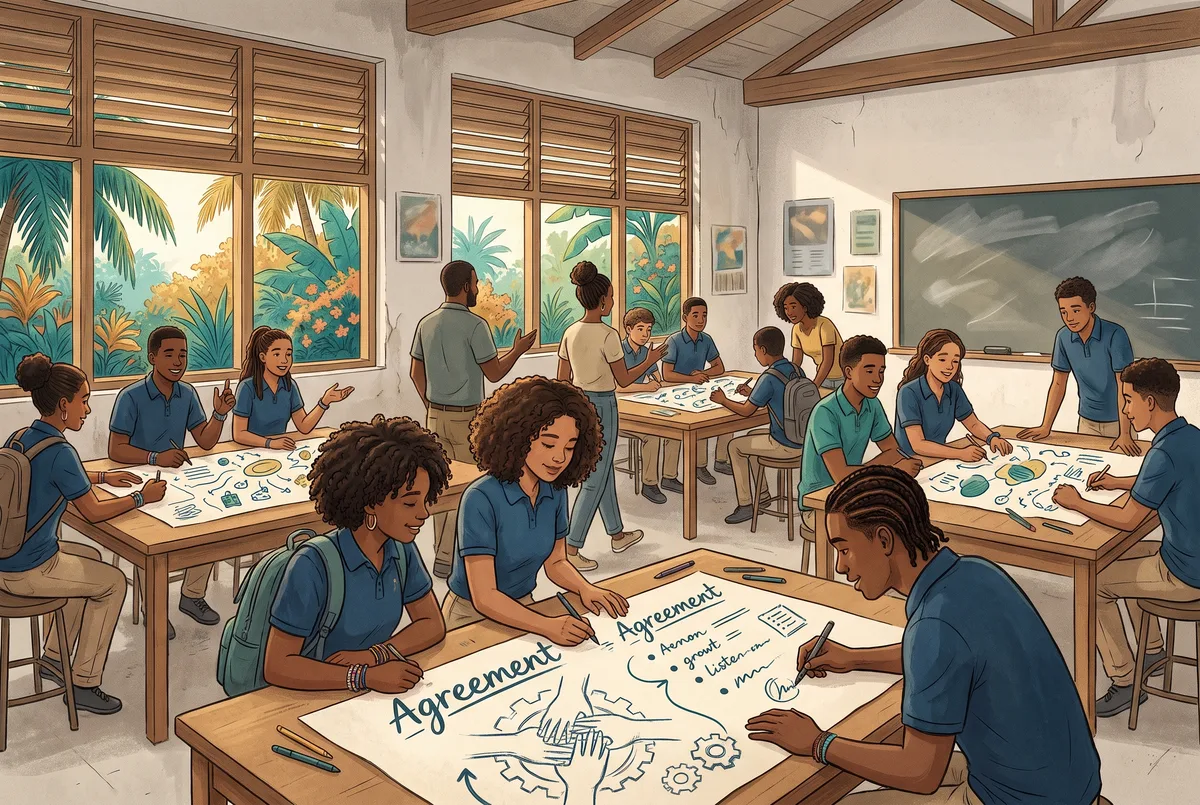
- The room agreement. How we use AI here: when yes, when no, what happens if someone doesn’t want to. The group discusses it, writes it and signs it. The person guiding the session signs as one more.
- Your first version. By November, your project needs a first version that exists, with your own words or voice. Today you decide what it will be —a song, a spoken script, a game’s rules on paper, the first screen drawn by hand, a page, an audio— and you write at least five details about your project that only you know.
- Your tool decision. What your project will be built with, in five questions: what form does your first version take (a page, an app, a sound piece, a game, something you install)? What does it need to save, and where? Does it use AI inside? From which provider, and why that one? Where will it live once published, if it’s published? Which part do you make without any of these tools? The Learning Facilitator comes round the tables and suggests options; your team decides. “We don’t know yet” gets written down too. It goes on your project card, with the date and your reasons, and it can change at every milestone.
Why it’s worth it
Rules other people set for you get followed halfway. The ones you discuss and sign are yours. And the list of details is what the machine doesn’t have: without it, your project would sound like any other.
How the session goes
- Anticipate. You recall your rule from “is this cheating?” and the line you wrote for your project. Before discussing, you write what you think the agreement will say.
- Act. Four questions, in short stretches; sharing; the agreement read aloud in full; signing. Then today’s no-screens stretch, with the agreement’s 10-minute block: nobody uses anything, not the person guiding the session either. From today on, the group decides where that block goes each week. In it, with your affinity table, you write or dictate your list of details and your first version; as it closes, on paper, you answer the five questions of your tool decision: what you’ll do with technology, with which tool and how, and which part is done with none.
- Reflect. Did what you anticipated come out? The room knocks on the table once for each detail a machine could never invent.
The criteria, as questions
- C1. Can you say the agreement in your own words?
- C2. Is each detail about your project, and not about “any similar project”? (11th: does one of them say why your project matters?)
- C3. Does any detail identify a person? Then it’s out.
If you don’t know yet what your first version will be, that’s fine: write five details about the person your project is for, without naming them, and the first version gets decided next week.
If your project is without AI
You answer the same five questions, with the same care and the same help: what form your first version takes, which techniques, materials and tools without AI you’ll use and why, where you keep your work — a repository, which works just the same for you, or a physical portfolio —, where it will be published or exhibited, and your materials and time budget. Your project not using AI is a decision about method, and it’s written down with your reasons like any other.
What isn’t put to a vote
Some rules protect you and aren’t up for discussion: no account in your name on any service unless its terms admit your age and your family signs for it; no personal data in an instruction; nothing leaves the room or gets published without written permission from your family and your own agreement, piece by piece. They’re read out at the start.
What the agreement can say
How the things the group worries about will be kept, every week: the generation budget (the lightest option that does the job, counted on the board), the division of work (what the AI does, what you do, what you decide) and the privacy check out loud before running any instruction card.
Two heads-ups for your family
In Unit 07 every project records its voice. For that, your family has to sign one more sheet. If they don’t sign it, you take part anyway: someone else reads your part, or a synthetic voice that belongs to nobody is used, and you direct the take.
And one more sheet: the one on accounts, memory and publishing. Your project will be kept in a repository, it can connect to AI models from several providers and, if you and your family want, it can be published on the web. Having your own account on a service, or publishing, needs that signature. Without it, you do everything the same way, with the program’s accounts, and nothing of yours is published.
Meanwhile, you can look through the library to imagine what your first version could turn into.
This is a plan: the Unit hasn’t run yet.