
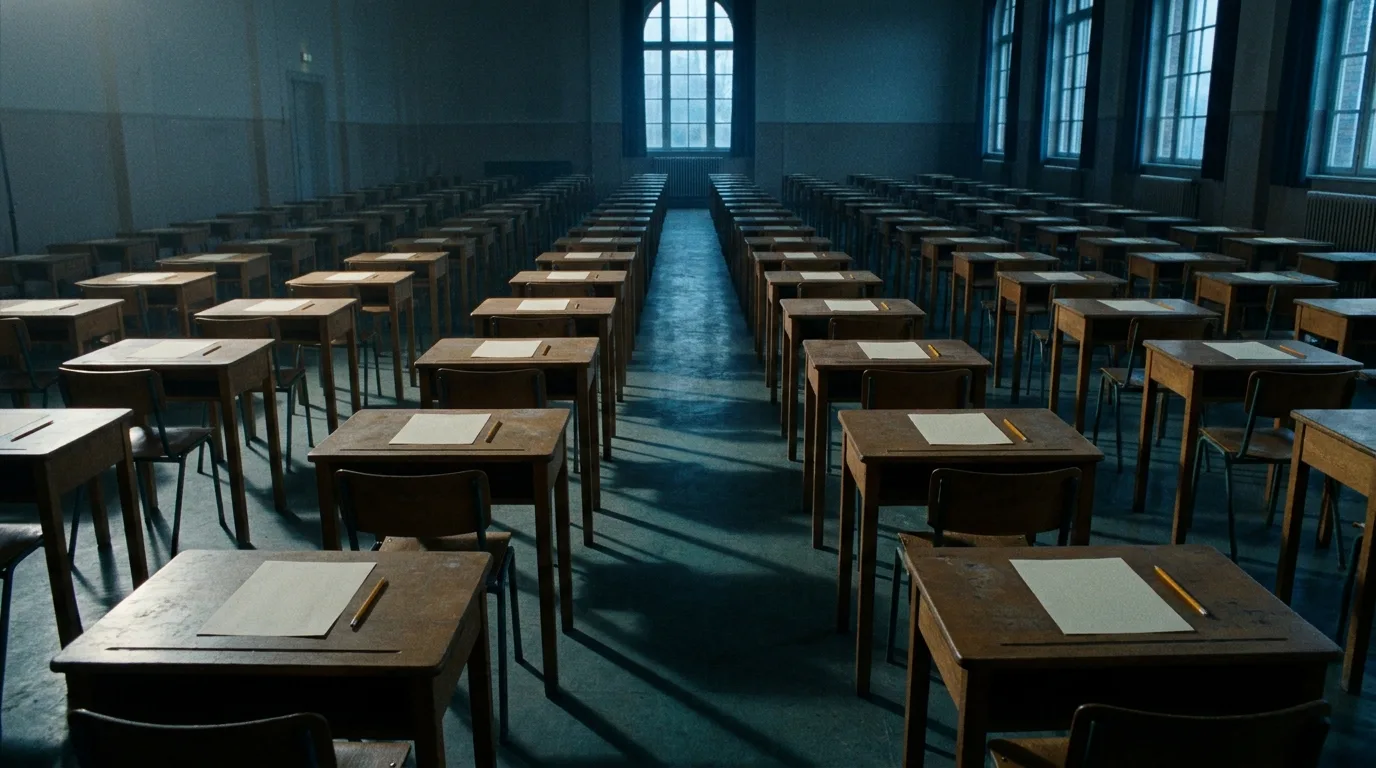
Rows of Ugly Desks
The year is 1895. A spectacled, mustachioed thirty-something teacher is trying to buy furniture for his new school. He was looking for desks and chairs suitable “from all points of view—artistic, hygienic, and educational—to the needs of the children,” and he could not find them. Then a dealer, he says, “more intelligent than the rest,” told him why: “I am afraid we have not what you want. You want something at which the children may work; these are all for listening.”1
The young teacher persevered in his quest to create learning environments unlike the typical “rows of ugly desks placed in geometrical order, crowded together so that there shall be as little moving room as possible, desks almost all of the same size, with just space enough to hold books, pencils and paper”1 everyone associates classrooms with.
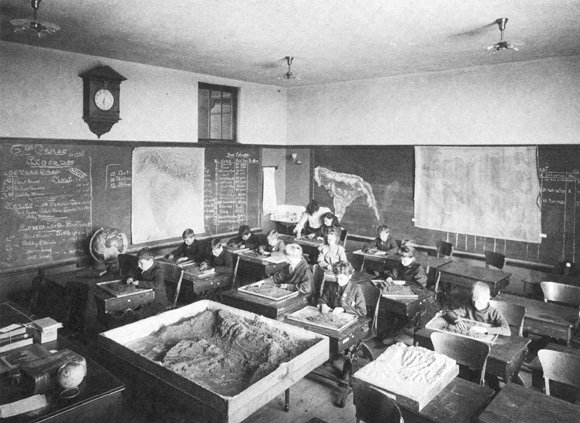
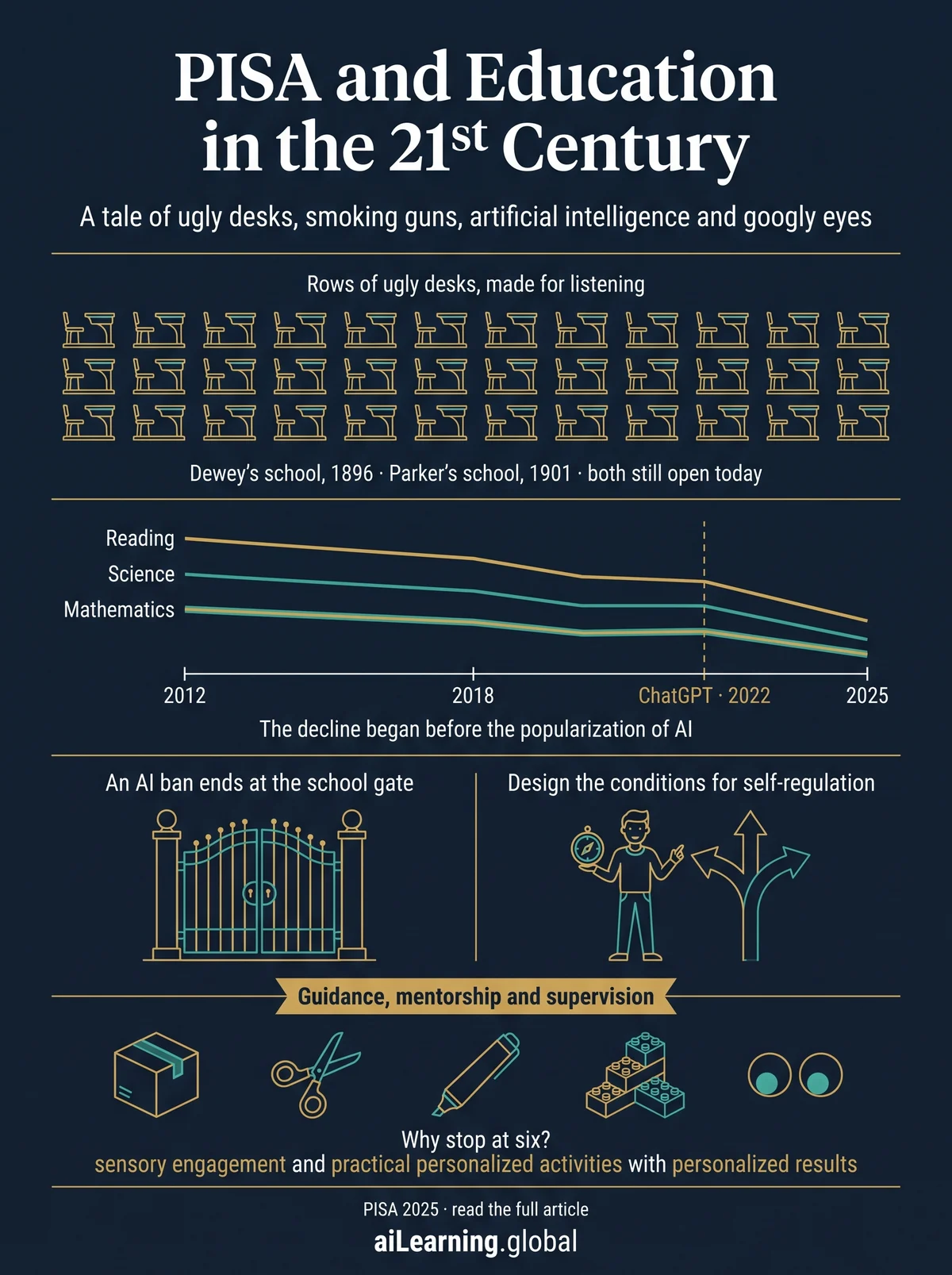
In January 1896, John Dewey opened his laboratory school in a small house on the South Side of Chicago.2 In a picture of a geography lesson from its earlier years we can still see the ugly desks in the classroom, but there’s a tray of sand and clay on each of them, a large relief model on the floor, and the walls are covered with blackboards and maps. And perhaps more telling, the teacher is at the back of the room, not at the front, assisting a student up close, not from afar.3
Not far away, in October 1901, Colonel Francis Wayland Parker founded yet another progressive school,4 and in pictures from its earlier years the children can be seen on the floor around a shared sheet of paper, perched on tables, standing, working.
Both schools are still operating today, more than a century and a quarter later.2 4
Yet most classrooms around the world are still configured with the same “rows of ugly desks placed in geometrical order” made “for listening” that Dewey described in The School and Society in 1899, 127 years ago.1
Some have gained a shelf of books nobody opens. Some have an interactive screen at the front, which is a blackboard that costs more. Some have tablets and wifi. But in most cases the “rows of ugly desks” are still there and they are still, overwhelmingly, made for listening.
A Smoking Gun, but whose gun is it?
There has been a lot of talk, opinions and reactions to the latest PISA results, released on 8 September 2026.5 The OECD’s Programme for International Student Assessment is a standardized test applied around the world that “measures 15-year-olds’ ability to use their reading, mathematics and science knowledge and skills to meet real-life challenges.”6 Its 2025 results show a decline in learners’ performance in reading, science and mathematics across the OECD.7
Everyone seems to have jumped at the same time to point the finger at artificial intelligence. Yet the report itself says that reading “has declined after peaking around 2012,” science “declined more gradually over the past decade,” and mathematics has “fallen especially sharply after 2018.”8 ChatGPT was released in November 2022. Whatever is happening to reading, science and maths has been happening since a fifteen-year-old sitting the 2025 test was two years old.
The report is careful where the headlines were not. On the students who use AI and those who do not, it says these relationships “do not necessarily imply a negative impact of AI use on science performance, but may reflect a complex mix of who adopts AI and how they use it.”9 And in the foreword, the OECD’s own framing is this: “perhaps the greatest challenge facing education is not how to use new technologies in the classroom. It is deciding what knowledge, skills and values students will need to flourish in a world of AI.”10
Going back to our spectacled, mustachioed teacher: Dewey describes education as “a continuous process of growth”11 and as “a process of living and not a preparation for future living.”12 Yet we insist on preparing learners as able “candidates”11 for skills of the past.
Instead of Regulating Artificial Intelligence, why not empower learners to regulate themselves
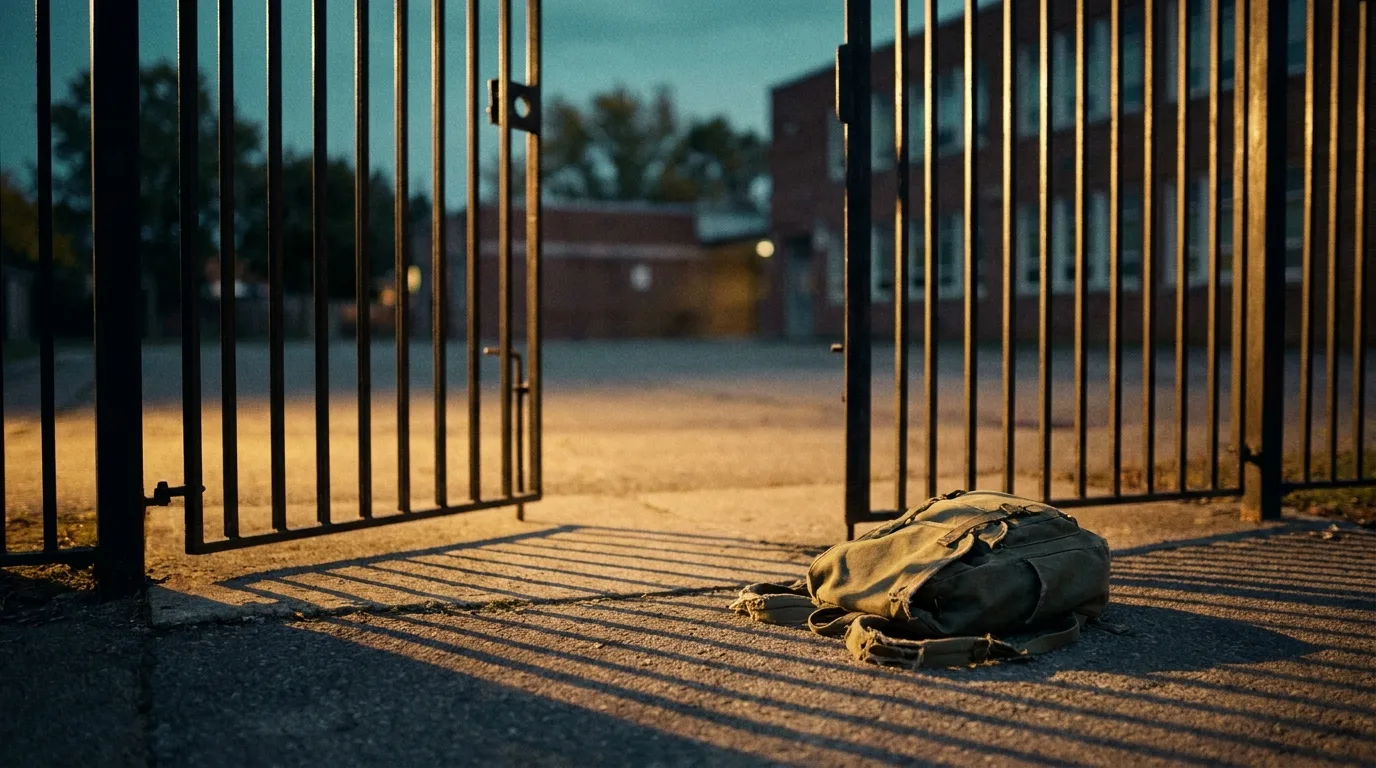
While it may be obvious to most people that restriction works — and research actually backs some of it13 — I hold that it is not sufficient, and the reason is embarrassingly simple: the restriction ends at the school gate and the instrument does not. A child who cannot use a chatbot between 8am and 3pm will use one at four. The ban buys attention inside the building. It buys nothing outside it.
So, why not enlighten them in the fine arts of self-regulation. It works for more aspects of life, too. But preaching and demonizing are not effective mechanisms. Feedback, understanding and accompanying their use of AI are.
Dignath and Büttner’s meta-analysis of self-regulated learning interventions — 74 studies, 8,619 students — reports a weighted overall effect of 0.69, which is substantial. But the same paper says what does not work:
“Instructing metacognitive strategies—like planning, monitoring, and evaluating one’s learning process—does not improve learning outcomes, strategy use, or motivation per se.”14
What carries the effect is feedback on strategy use, and learners understanding why the strategy pays.14 Teaching self-regulation as a topic fails. Designing the conditions in which it develops works.
The responsibility sits with the adults who design and frame the interactions of learners with artificial intelligence. The OECD’s own Learning Compass says as much, and says it against itself: citing PISA data, it notes that when teachers let fifteen-year-olds decide their own procedures, advantaged students benefit more and the approach “can have an adverse impact on disadvantaged students’ performance.”15
In UNESCO’s recent volume on AI and the future of education, one of its contributors puts the mechanism plainly: when AI systems are granted more autonomy over decisions, “human autonomy decreases proportionally, unless the technology is deliberately designed to enhance rather than diminish human agency.”16 And since these technologies are not deliberately designed to accomplish that, it is our responsibility — as learning institutions, as tutors, as parents — to deliberately design the interactions and frameworks where artificial intelligence, and any technology for that matter, enhances the agency and competencies of learners and youth in general. Our responsibility, not the responsibility of learners, children or youth.
Upgrading the Curriculum is not the Challenge, how we execute it is

Nobody weeps for the long gone skills of everyday horse riding, developing film, navigating by reading the stars, understanding how an engine works, or coaxing a cold carburettor into starting. Yet despite lacking those formerly life-important skills, we get to go places we don’t even know how to get to, take pictures, fly above the clouds, and now we don’t even have to drive ourselves.
Maybe some of the skills we worry about today, which traditionally served as foundations for practical skills, can be part of even bigger, more complex, more impactful skills that may include them already when deliberately designed to do so. Freinet insisted on transforming the classroom into a laboratory of life, where learners conquer the skills of writing through functional writing of complete texts rather than copying a line a hundred times. The same with living mathematics, investigation of the environment, and the school newspaper to learn about media and editing.17 Instead of basic skills and baby steps, Freinet insisted on tasking learners with complete practical projects where knowledge and skills are applied and their foundations are baked into the process by design, not separated from their application for a future and uncertain use.
It is the same case with artificial intelligence. Maybe if we deliberately focus on designing increasingly complex, actively engaging activities that aim for more advanced skills and processes, deeper knowledge and intertwined concepts, learners will build more competencies, with the basic skills included through proper design. AI can take us far in this direction if we design its use with adequate guidance, mentorship and supervision by educators and learning facilitators.
That condition is not a hedge, and the strongest body of evidence in this argument is what puts it there. Kirschner, Sweller and Clark are usually cited against approaches like this one, and they are not gentle: among the people they name is Papert. What they actually establish, across half a century of studies, is that guidance is the variable. Minimally guided approaches, they write, “ignore both the structures that constitute human cognitive architecture and evidence from empirical studies over the past half-century that consistently indicate that minimally guided instruction is less effective and less efficient than instructional approaches that place a strong emphasis on guidance of the student learning process.”18 That is an argument against turning learners loose, not against asking more of them. It is the reason the sentence above ends where it does.
But if we insist on executing the same curriculum, with the same activities, we will fail miserably the learners who depend on us for motivation, engagement and guidance to relevance and growth. We cannot expect interest if what we offer and request is a less colorful, less exciting, less revealing version of the bright alternative the new tools offer, which are their present and will make up their future.
What a Learning Environment should look like and what a Learning Experience should feel like
So what should learning be like in the age of AI?
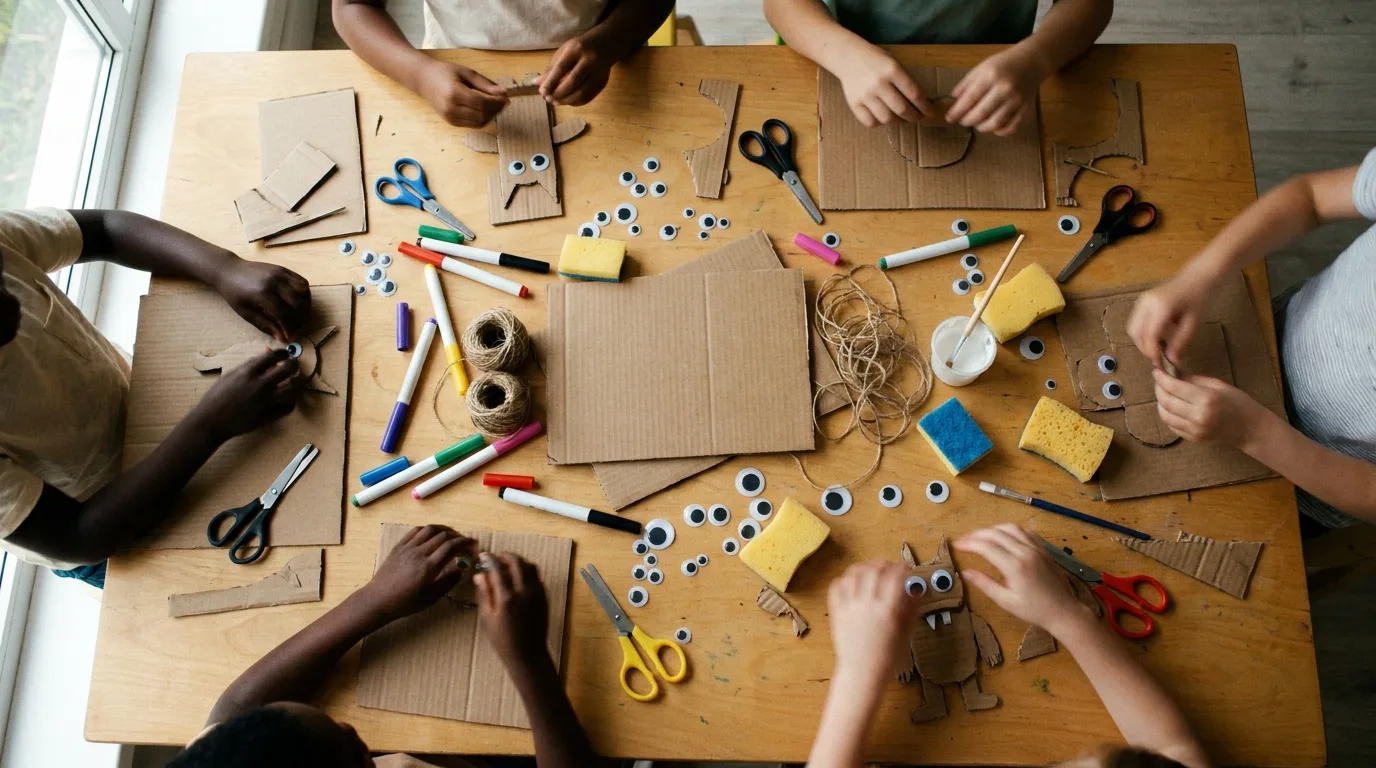
Look no further than your typical pre-school space. We need to redesign learning environments with materials, tools, layouts and spaces where learners individually and collectively explore, experiment and build. Where stuff, physical and conceptual, can be deconstructed and destroyed so that knowledge and skills can be built.
Every pre-school admin will tell you how they have to replenish their supplies every year because those little rascals break, abuse and viciously destroy the shiny tools they are given in their glorious individual and collective quest for discovery and learning, accompanied by the guidance of their in-person aunties.
Why stop at six? That’s how learning should be, not just for pre-schools, but also for elementary, middle school, high schools, even for college and post-graduate education.
And the concept is not even new. That is precisely what David Kelley did in 2005 when designing the d.school space at Stanford University.19 I remember walking into it the year it opened: a huge warehouse structure turned into a playground for learning, full of breakout rooms, rapid prototyping materials and even noise rooms where heated or animated discussions could take place among learners. Huge supplies of cardboard, scissors, cutters, rulers, markers, googly eyes, strings, sponges, you name it, if you could mold it, shape it, squeeze it, bend it, break it, make it shine or make it sound, if you could do something with it using your hands, the school had it.
Sure, interactive smart screens add value, and a good set of speakers adds value, for nothing ruins a sensory experience more than a visual experience accompanied by lousy sound. We must aim for full physical and mental engagement, bearing in mind that richness has to serve the learning rather than compete with it, since adding channels and interesting but extraneous material can reduce what is learned.20
Fear not AI in the classroom, for AI has no chance against a pair of googly eyes, or against the humor, wit and creativity of learners representing a moment in history, a physical reaction or a complex process openly using their bodies, their words and gestures.
Bring in tech, bring in AI, just make room for it next to our beautiful and unique sensory and human feelings and processes when learning is involved.
Every fact and statement in this article is carefully verified and checked against primary sources. All sources and references are listed below.
Four perspectives

The timing argument is the strongest thing here, and it is strong because it is narrow: the report dates the reading decline to around 2012 and the mathematics fall to after 2018, and ChatGPT shipped in November 2022. That rules out generative AI as the origin of the trend. It does not rule out AI as a factor in what happens next, and the report says so itself when it warns that the AI-use relationships may reflect who adopts AI and how, rather than an effect of AI. Keep both halves.
Read the Learning Compass line again, because it is the uncomfortable one: when fifteen-year-olds are left to decide their own procedures, the advantaged students pull further ahead. Handing learners autonomy without designing the guidance around it is not liberation — it is a transfer of risk onto the children with the least support at home. That is exactly why the guidance condition in this piece is not decoration. The schools that can least afford to get it wrong are the ones being told to figure AI out alone.

You cannot rebuild the room this term, but you can change what the room is for. Take one unit and rewrite the task so it produces something — a working model, an investigation, a school newspaper page — instead of an answer. Then decide out loud, with the learners, where AI helps and where it would skip the part that builds them, and give feedback on that choice, not just on the product. That is the self-regulation the meta-analysis actually supports: feedback on strategy, not a lecture about strategy.

The desks were made for listening in 1896 and most of them still are. That is the smoking gun, not the chatbot. Our job is not to regulate the instrument at the school gate, because the gate is where our authority ends and the instrument's does not. It is to design the interactions — with guidance, mentorship and supervision — so that the effort stays with the learner and the tools make room for it. Bring in AI. Just make room for it next to the googly eyes.
And the fifteen-year-olds?
PISA tests fifteen-year-olds. Three of our learner personAIs read the article.
Everyone spent a week arguing about whether my generation broke reading, and the dates were right there in the report the whole time — it started slipping when I was two. That is what it feels like from in here: a conversation about us that nobody thought to have with us. I am not asking you to hand me the chatbot and walk away. I am asking you to show me why the work matters and then stay in the room while I do it. Ban it at the gate and all you have told me is that you would rather not find out how I actually use it.
 Zainab HassanAdolescent Student (Teen)
The tray of sand on the desk in that old photograph is the part I keep looking at. Someone decided the desk was for making something. Most of my week is waiting — for the class to catch up, for the next instruction, for permission to go further than the worksheet goes. So yes, build the task around a whole project instead of a hundred small correct answers. That is the only version of school where I am not stalled. And keep the guidance: unsupervised is not the same as unlimited, and being left alone with a tool is not the same as being given depth.
 Sofia RossiGifted / Accelerated Learner
There is a line in here I would underline twice: teaching self-regulation as a topic fails, and designing the conditions in which it develops works. Nobody ever failed to explain planning to me. They explained it constantly. What was missing was anyone who stayed long enough to tell me whether what I tried had worked, without the face that says they already know the answer. That is why the tool matters to me differently than it does to the people arguing about it: it does not sigh. But a thing that does not sigh is not the same as a person who does not give up on you, and I need the second one more.
 Tyrone WilliamsPreviously Struggling Learner
References
Every quotation below was checked against its primary text, and the page is given wherever one exists. Quotations stay in the language they were verified in. Two entries are testimony rather than citation and say so: the description of the d.school is the author’s own first-hand account, and the hundred-times copying line is his illustration, not Freinet’s example.
- Dewey, J. (1899). The School and Society. Chicago: University of Chicago Press, first edition, pp. 47–48. Project Gutenberg eBook 53910. The 1915 Revised Edition carries the same passage at pp. 31–32 with slightly different wording (“a great deal of difficulty”); the wording quoted here is the first edition’s.
- University of Chicago Laboratory Schools, Our History: “In January, 1896, a new elementary school opened its doors in a small house on the South Side of Chicago.” ucls.uchicago.edu/about-lab/history
- “John Dewey (1858–1952): Philosophy and Education”, University of Chicago Library, The University of Chicago Faculty: A Centennial View. lib.uchicago.edu Source of the photograph of the geography lesson reproduced above.
- Francis W. Parker School, History: “Founded on October, 7 1901 by Colonel Francis Wayland Parker”. fwparker.org/about/history In Lincoln Park, on land donated by Anita McCormick Blaine.
- OECD press release, PISA 2025: Students’ reading and mathematics performance declined sharply across the OECD, 8 September 2026.
- OECD, Programme for International Student Assessment (PISA): “PISA measures 15-year-olds’ ability to use their reading, mathematics and science knowledge and skills to meet real-life challenges.” oecd.org/en/about/programmes/pisa.html
- OECD (2026), PISA 2025 Results (Volume I): “PISA 2025 recorded the lowest OECD-average performance observed so far in science, reading and mathematics.”
- OECD (2026), PISA 2025 Results (Volume I): “Reading has declined after peaking around 2012, while science has declined more gradually over the past decade, and mathematics has fallen especially sharply after 2018.”
- OECD (2026), PISA 2025 Results (Volume I), p. 239.
- Schleicher, A., Foreword to OECD (2026), PISA 2025 Results (Volume I), p. 7.
- Dewey, J. (1916). Democracy and Education. New York: Macmillan, ch. 5, “Preparation, Unfolding, and Formal Discipline”. Project Gutenberg eBook 852. Education is “a continuous process of growth”, which “contrasts sharply” with “the idea that education is a process of preparation or getting ready”, under which children “are looked upon as candidates; they are placed on the waiting list.”
- Dewey, J. (1897). “My Pedagogic Creed”, School Journal 54(3), Article II: “I believe that education, therefore, is a process of living and not a preparation for future living.” The widely circulated sentence “education is not preparation for life; education is life itself” does not appear in My Pedagogic Creed, The School and Society or Democracy and Education.
- Figlio, D. and Özek, U., Cellphone Bans in Schools, NBER Working Paper 34388: “we find significant improvements in student test scores in the second year of the ban”. Driven largely by reduced unexcused absences. The study also reports a short-term increase in suspensions, disproportionately among Black students, which dissipated after the first year.
- Dignath, C. and Büttner, G. (2008). “Components of fostering self-regulated learning among students. A meta-analysis on intervention studies at primary and secondary school level”, Metacognition and Learning 3(3), 231–264. Overall weighted effect 0.69 across 74 studies and 8,619 students (pp. 243–244); the sentence quoted in the text is at p. 255.
- OECD (2019), OECD Future of Education and Skills 2030: OECD Learning Compass 2030 — A Series of Concept Notes, OECD Publishing, Paris, p. 34. Citing the PISA 2012 database.
- Lim, K. Y. T., Hilmy, A. H. and Kuok, B. Z. W., in UNESCO (2026), The algorithm in the room: Seeing and confronting the implications of AI for the future of education, UNESCO, Paris, p. 28. The volume is a collection of signed contributions; its front matter states that the opinions expressed are those of the authors.
- Reuter, Y. (dir.) (2007), Une école Freinet : fonctionnements et effets d’une pédagogie alternative en milieu populaire, Paris: L’Harmattan. Freinet’s techniques — texte libre, calcul vivant, enquête du milieu and the journal scolaire — as described in the literature on Freinet pedagogy. The illustration of a child copying a line a hundred times is the author’s own, not Freinet’s example.
- Kirschner, P. A., Sweller, J. and Clark, R. E. (2006). “Why Minimal Guidance During Instruction Does Not Work: An Analysis of the Failure of Constructivist, Discovery, Problem-Based, Experiential, and Inquiry-Based Teaching”, Educational Psychologist 41(2), 75–86, p. 75.
- Hasso Plattner Institute of Design at Stanford (the d.school), founded in 2005 by David Kelley and Bernie Roth. The description of the space is the author’s own first-hand account of walking into it that year, as a Stanford Digital Vision Fellow and campus resident; it is testimony, not a citation.
- Mayer, R. E. (2002). “Multimedia Learning”, in B. H. Ross (ed.), The Psychology of Learning and Motivation, Vol. 41, pp. 85–139. San Diego: Academic Press. The coherence and redundancy principles.